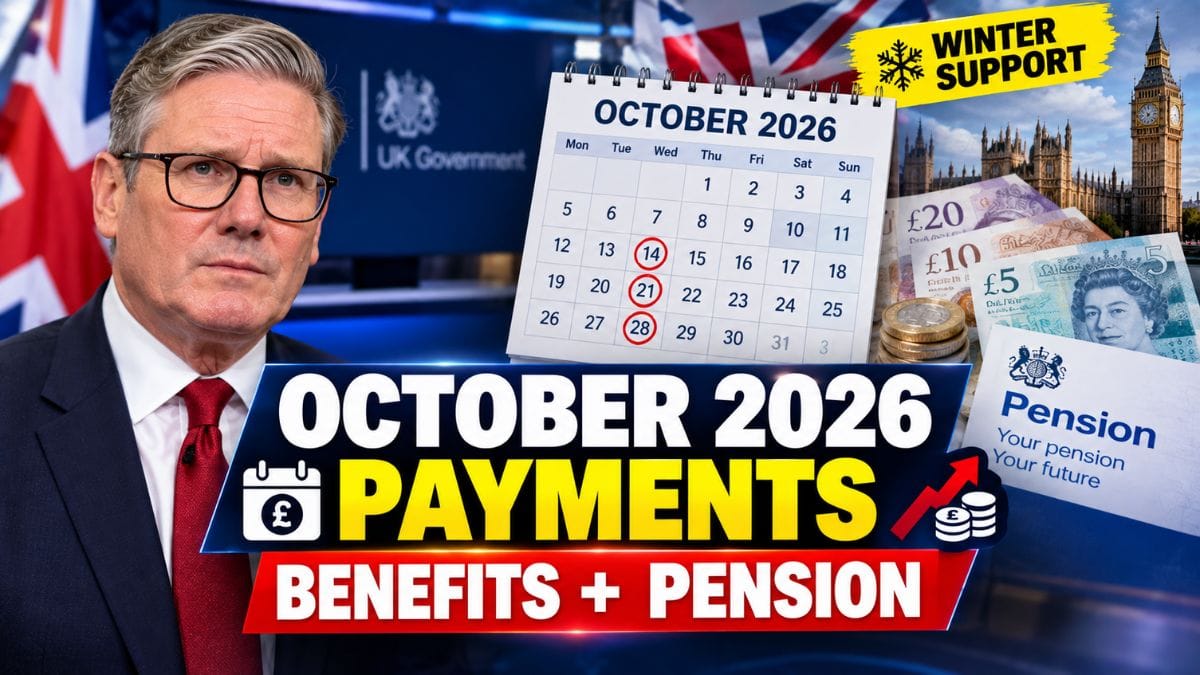
October brings a fresh set of payment dates and support measures for households across the UK, with benefit recipients and pensioners also facing continued pressure from household costs.
Inflation rose to 3.1% in August, according to the figures cited in the source material, while the Ofgem energy price cap increased to £1,723 for the October to December period. For households already managing tight budgets, knowing when payments are due and what additional help may be available can make a practical difference.
Around 24 million people receive some form of Department for Work and Pensions (DWP)-administered benefit, including people receiving the state pension. At the same time, research by Policy in Practice has estimated that billions of pounds in benefits go unclaimed each year.
Here is a guide to October 2026 payment dates, benefit increases, energy support and other help that may be available.
Payments
There are no bank holidays in England and Wales in October 2026 that would normally require the main DWP payment dates to be brought forward.
Benefits paid during the month include:
- Universal Credit
- State Pension
- Pension Credit
- Child Benefit
- Personal Independence Payment (PIP)
- Disability Living Allowance (DLA)
- Attendance Allowance
- Carer’s Allowance
Payment dates can depend on the particular benefit and the recipient’s circumstances. The government’s official benefits payment guidance provides information on how different benefits are paid.
People who have not received an expected payment should check their payment schedule and contact the relevant department if there is an issue.
Pension
The State Pension is normally paid every four weeks directly into a bank account.
For many recipients, the payment day is linked to the final two digits of their National Insurance number. The usual pattern is:
| National Insurance number | Usual payment day |
|---|---|
| 00 to 19 | Monday |
| 20 to 39 | Tuesday |
| 40 to 59 | Wednesday |
| 60 to 79 | Thursday |
| 80 to 99 | Friday |
The schedule can differ in some circumstances, including when payment dates coincide with public holidays.
People who are unsure about their payment date can check their bank statements or contact the relevant government service.
Rates
The State Pension increased by 4.8% in April 2026, according to the figures provided in the source material.
The full State Pension is currently stated as £12,547.60 a year. A further increase is expected in April 2027 under the State Pension triple lock, based on the relevant earnings measure.
The source material puts the expected 2027 increase at 3.9%, which would take the full annual State Pension to approximately £13,036.40.
Benefit rates are generally reviewed each year, with the exact increases depending on the rules applying to each benefit.
Universal Credit standard allowances also increased in April 2026. The amount a person receives depends on factors including age, relationship status, children and other circumstances.
Other benefits, including PIP, DLA, Attendance Allowance and Carer’s Allowance, are also subject to annual uprating.
Energy
The Ofgem energy price cap increased to £1,723 for October through December 2026, according to the figures supplied.
The price cap is not a maximum total bill for every household. Instead, it limits the unit rates and standing charges suppliers can apply to customers on standard variable tariffs. The quoted annual figure represents the cost for a typical household using a specified amount of energy.
That distinction matters because actual bills depend on how much electricity and gas a household uses.
The next price cap, covering January to March 2027, is expected to be announced by Ofgem in November.
Forecasts for the next cap can change considerably as wholesale energy prices and other market conditions move. Households should therefore treat early predictions as estimates rather than confirmed future bills.
Support
Households struggling with essential costs may have several sources of help available.
One option is the Crisis and Resilience Fund, which replaced the previous Household Support Fund and Discretionary Housing Payments arrangements.
The scheme includes crisis payments intended to help households experiencing a financial shock or facing difficulty paying for essentials. Local authorities have discretion over aspects of the scheme, including eligibility and how assistance is delivered.
There is also a housing payment element intended to help eligible households with certain housing costs. Eligibility rules differ from those for crisis payments.
Because local councils administer this support, the available help can vary between areas.
Loans
People receiving Universal Credit who face an unexpected need for money may be able to apply for a Budgeting Advance.
These loans are interest-free, with repayments normally taken directly from future benefit payments.
The maximum amount depends on a person’s circumstances. The figures supplied in the source material are:
- £348 for a single person
- £464 for a couple
- £812 for someone who meets the relevant child-related eligibility conditions
The amount available can also depend on savings, existing Budgeting Advances and other circumstances.
Since April 2025, deductions from Universal Credit for certain debts and loans have been subject to a lower maximum limit than previously, with deductions capped at 15% of the standard allowance in the circumstances covered by the rules.
Grants
Charitable grants can provide another source of assistance for people facing financial difficulty.
Eligibility varies considerably between organisations. Some grants are aimed at people who are disabled or seriously ill, while others support carers, bereaved people, unemployed workers, students or households facing particular financial circumstances.
Turn2us operates a grant search tool that allows people to search for potential sources of charitable support.
Grant payments are not guaranteed, and applicants normally need to meet the conditions set by the organisation providing the money.
Tariffs
Some energy, broadband and water providers offer reduced tariffs or other assistance to customers on low incomes or receiving qualifying benefits.
Broadband social tariffs can provide cheaper internet services for eligible households. Water companies also operate social tariffs, although the level and structure of assistance varies between providers.
Unlike energy suppliers, households generally cannot choose their water company. This means the support available can depend on where a person lives.
Anyone struggling with household bills can contact their supplier directly to ask what assistance is available.
Council
Council Tax Reduction may be available to people on low incomes or receiving certain benefits.
The amount of support varies between local authorities and depends on factors such as income, household circumstances and the council’s rules.
Some councils may also have discretionary arrangements for people experiencing severe financial hardship.
Applications are generally made through the local authority responsible for the household’s Council Tax.
Childcare
Eligible working parents can access government support towards childcare costs.
The childcare support available depends on the child’s age, the parents’ circumstances and the applicable scheme.
Eligible working parents can also use Tax-Free Childcare, through which the government adds 20p for every 80p paid into an account, subject to the applicable limits.
Eligibility should be checked before making childcare arrangements because the rules depend on household circumstances and employment.
Winter
Several schemes are particularly relevant as temperatures fall.
The Warm Home Discount provides eligible households with a £150 reduction on their electricity bill. Eligibility differs across the UK, and households in England and Wales generally need to meet specific benefit and income conditions.
The Winter Fuel Payment provides qualifying pensioners with help towards heating costs. Under the rules described in the source material, eligible pensioners with qualifying income can receive between £100 and £300.
There are also Cold Weather Payments for eligible low-income households in England and Wales when temperatures meet the qualifying conditions. A £25 payment is made for each qualifying seven-day period of very cold weather between November and March.
These schemes have different eligibility requirements, so receiving one form of support does not necessarily mean a household qualifies for another.
Payments
There is no general UK-wide Cost of Living Payment scheme currently continuing from the programme that operated between 2022 and 2024.
The final payment under that previous scheme was made to eligible households between 6 February and 22 February 2024.
People facing financial difficulty should therefore look at the support currently available through benefits, local councils, energy suppliers and other assistance programmes rather than expecting another automatic Cost of Living Payment.


Support
Financial pressure can also affect mental health, particularly when people are dealing with benefit applications, debt or uncertainty about paying household bills.
Samaritans can be contacted free on 116 123, 24 hours a day, seven days a week.
Mind also provides support and information for people experiencing mental health difficulties. Scope offers an online community for disabled people and their families, while the NHS provides mental health information and services.
The key point for October is that payment dates and support schemes are separate from one another. A household may qualify for several forms of help, but eligibility should be checked individually. With energy costs, benefit rates and winter support all changing at different times, checking official guidance and local authority information is the safest way to establish what assistance is available.