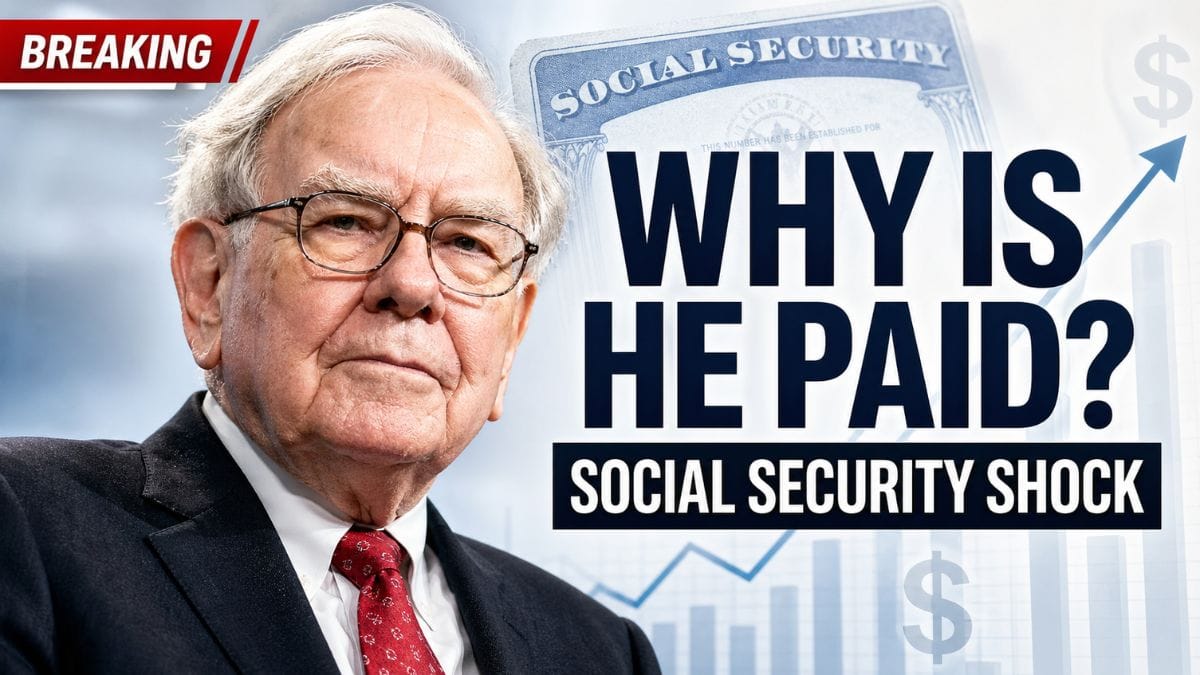
Warren Buffett, one of the world’s wealthiest individuals, continues to receive Social Security benefits despite having an estimated net worth of around $150 billion. At first glance, this may appear unusual. However, the explanation lies in how the U.S. Social Security system is structured. The program is designed to base benefits on an individual’s taxable earnings history rather than overall wealth.
Knowing why Buffett qualifies for these payments requires a closer look at the mechanics of Social Security, including how benefits are calculated and what factors influence the final payout.
System
Social Security in the United States operates as a contributory system. Workers pay payroll taxes during their employment years, and those contributions determine their eligibility and benefit levels in retirement.
The system does not evaluate an individual’s assets, investments, or net worth. Instead, it focuses strictly on earned income that was subject to Social Security taxation. As a result, individuals with vastly different financial positions today can receive similar benefits if their historical earnings records are comparable.
Calculation
The formula used to calculate Social Security benefits is standardized. It is based on an individual’s 35 highest-earning years, adjusted for inflation. If a person has fewer than 35 years of earnings, the remaining years are counted as zero, which reduces the average.
Several factors influence the final benefit amount:
| Factor | Description |
|---|---|
| 35-year record | Determines average indexed earnings |
| Earnings cap | Limits taxable income each year |
| Retirement age | Affects monthly payout |
| Delayed retirement | Increases benefits up to age 70 |
The earnings cap is a key component. In 2026, income above $184,500 is not subject to Social Security taxes. This means higher earnings beyond this threshold do not increase future benefits.
Income
Warren Buffett’s primary source of wealth is investment income, particularly from Berkshire Hathaway. However, Social Security does not consider investment gains. Only earned income, such as salary or wages, is included.
For several decades, Buffett has received an annual salary of approximately $100,000 from Berkshire Hathaway. This income has been consistently subject to Social Security taxes. As a result, his benefits are calculated based on this salary history rather than his investment portfolio.
This distinction explains why even individuals with substantial wealth can qualify for benefits if they have a consistent record of taxable earnings.
Limit
The Social Security system includes both contribution and benefit limits. Since only income up to the annual cap is taxed, there is also a maximum benefit that an individual can receive.
For those retiring at age 70 in 2026, the maximum monthly benefit is estimated at $5,181. Individuals who consistently earn at or near the taxable maximum over 35 years are most likely to qualify for this upper limit.
Below is a simplified estimate of Buffett’s situation:
| Category | Estimate |
|---|---|
| Annual salary | $100,000 |
| Years worked | 40+ years |
| Retirement age | Around 70 |
| Monthly benefit | Near maximum level |
Although this amount is modest relative to Buffett’s total wealth, it reflects the standard calculation applied to all eligible workers.
Structure
The inclusion of high-net-worth individuals in Social Security reflects the program’s universal design. It is not structured as a means-tested benefit. Instead, it operates as a system where eligibility is tied to contributions.
This approach simplifies administration and ensures consistency. Removing benefits based on wealth would require additional layers of verification, including asset assessments and ongoing financial reviews. Such changes could increase complexity and administrative costs.
By maintaining a contribution-based model, the system applies the same rules to all participants.
Perspective
Warren Buffett has publicly addressed Social Security policy on several occasions. He has expressed support for maintaining benefits while also suggesting reforms to improve long-term sustainability.
Some of the proposals associated with his views include:
- Adjusting benefits for higher-income retirees
- Gradually increasing the retirement age to reflect longer life expectancy
- Removing or raising the taxable income cap
The current cap means that individuals earning significantly above the threshold contribute the same amount as those earning at the limit. Adjusting this cap is often discussed as a way to strengthen the program’s financial position.
Debate
The question of whether wealthy individuals should receive Social Security benefits remains a topic of policy discussion. Some argue that excluding high-net-worth individuals could direct more resources toward those in greater need. Others emphasize that the system’s strength lies in its universality and predictability.
Maintaining a consistent framework helps preserve public trust and avoids creating distinctions based on wealth, which can be difficult to measure accurately.
Context
Buffett’s participation in Social Security illustrates a broader principle. The system is designed to provide retirement income based on work history, not financial status at retirement.
This structure means that individuals across the economic spectrum can receive benefits if they have contributed through payroll taxes. It also ensures that the calculation process remains transparent and uniform.
While Buffett’s personal financial situation makes his Social Security payments relatively insignificant, his case demonstrates how the system applies its rules consistently.
The example highlights the distinction between earned income and accumulated wealth, which is central to knowing how Social Security functions in practice.
FAQs
Why does Buffett get Social Security?
He paid payroll taxes on his salary.
Is wealth considered in benefits?
No, only taxable earnings are used.
What is the 2026 max benefit?
About $5,181 per month at age 70.
Do investments count for Social Security?
No, only earned income is counted.