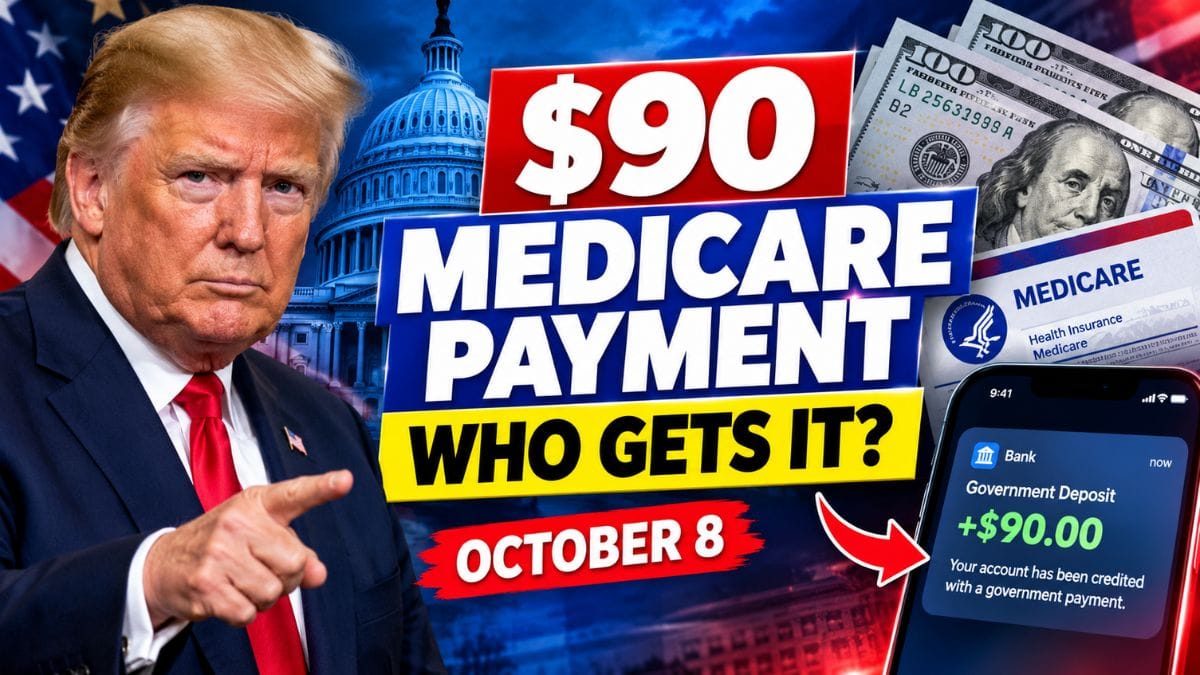
Some Medicare beneficiaries may notice a $90 payment appearing in their bank accounts or see a pending deposit linked to a government payment. The payment has attracted attention because many recipients normally associate deposits from the Social Security Administration with their monthly Social Security benefits.
However, the reported $90 payment is different. It is described as a one-time Medicare rebate intended to help eligible beneficiaries offset the cost of their October Medicare Part B premium. It is not a new monthly Social Security benefit and does not represent a permanent increase in Social Security payments.
The Centers for Medicare & Medicaid Services (CMS) says about 20.8 million people are eligible under the reported criteria. The payment is being distributed primarily through direct deposits, which is why it may appear similar to an ordinary Social Security payment.
Here is what beneficiaries need to know about the payment, eligibility rules, timing and exclusions.
Payment
The $90 payment is intended for a specific group of Medicare beneficiaries rather than everyone receiving Social Security or Medicare.
For most eligible people, the payment is expected to arrive through direct deposit. Because the Social Security Administration handles payments for many beneficiaries, the transaction may appear in a bank account in a way that resembles a regular Social Security deposit.
That distinction matters. A person receiving the $90 payment should not interpret it as an increase in their regular Social Security benefit. The payment is associated with Medicare and is designed to offset part of the October Part B premium.
CMS is the federal agency responsible for administering Medicare. Beneficiaries can review official Medicare information through the Medicare.gov website.
Some people may see a pending transaction before the payment is fully processed. Banking schedules can differ, so the appearance of a pending deposit does not necessarily mean that another payment is coming or that a recipient has received a permanent benefit increase.
Eligibility
The eligibility requirements are more limited than simply having Medicare.
According to the reported CMS criteria, a beneficiary may qualify if they are enrolled in Original Medicare Part B, live in the United States, do not receive Medicaid premium assistance and do not pay an income-related monthly adjustment amount, known as IRMAA.
Medicare Advantage enrollees are not included under the reported program.
That means two people of the same age could receive different results. One person with Original Medicare Part B could qualify, while another person enrolled in Medicare Advantage could be excluded.
The same applies to beneficiaries whose Medicare premiums are affected by Medicaid assistance or IRMAA.
The basic criteria can be summarized as follows:
| Medicare status or condition | Reported $90 rebate eligibility |
|---|---|
| Original Medicare Part B | May qualify |
| Medicare Advantage | Not included |
| Medicaid premium assistance | Not included |
| Pays IRMAA | Not included |
| Lives in the United States | Required |
| Lives outside the United States | Not included |
These conditions are important because Medicare covers a large population, but the reported rebate applies to a narrower group.
Timing
CMS says most eligible beneficiaries should receive the direct deposit on or around October 8.
Some beneficiaries may see the transaction earlier as a pending deposit, while others may see it after the expected date depending on how their financial institution processes government payments.
People who do not receive payments by direct deposit are expected to receive a paper check later in October. The check is expected to identify the payment as coming from the Medicare Improvement Fund and indicate that it is intended to offset the October Medicare premium.
Recipients should therefore allow additional time if they normally receive government payments by mail.
It is also important to distinguish between the payment date and the date a transaction becomes visible in a bank account. A pending transaction may not be immediately available for spending, and banks can use different processing schedules.
For the latest official Medicare information, beneficiaries can check the CMS website rather than relying on social media posts or third-party payment trackers.
Funding
The reported payment is connected to the Medicare Improvement Fund, a federal fund established by Congress to support improvements to the original fee-for-service Medicare program.
The White House has said the fund contains about $2 billion and that the administration is using it to provide money toward healthcare costs for eligible seniors.
The $90 rebate is relatively small compared with the overall cost of Medicare. It is also important to understand what the payment does not do.
It does not permanently reduce the Medicare Part B premium. It does not increase a person’s monthly Social Security retirement benefit. It is also not a new Medicare entitlement available to every beneficiary.
Instead, it is being presented as a one-time offset for an October Part B premium.
That distinction can be useful when checking a bank statement. A recipient should not expect another $90 payment every month unless the government separately announces a new program.
Premiums
Medicare Part B helps cover physician services, outpatient care and certain other medical services. Beneficiaries generally pay a monthly premium for Part B.
The reported $90 rebate comes at a time when Medicare costs have been an increasing concern for older Americans. Part B premiums increased in 2026, adding to the healthcare expenses faced by many beneficiaries.
A one-time $90 payment therefore provides some relief, but it does not eliminate the underlying premium obligation.
Beneficiaries should continue to follow their normal Medicare billing arrangements rather than assuming the rebate changes their regular premium schedule.
For example, if a beneficiary normally has the Part B premium deducted from their Social Security payment, the $90 rebate should not automatically be interpreted as a change to that deduction.
The rebate and the normal Medicare premium are separate matters.
Exclusions
A significant number of Medicare beneficiaries are not expected to receive the payment.
CMS says roughly 40 million Medicare Part B enrollees are excluded under the reported criteria. The exclusions include people enrolled in Medicare Advantage, beneficiaries who receive Medicaid premium assistance, people who pay IRMAA and individuals who live outside the United States.
The exclusions help explain why a Medicare beneficiary might hear about the $90 payment but see nothing in their own bank account.
Medicare enrollment by itself is not enough to establish eligibility.
IRMAA is particularly relevant for higher-income Medicare beneficiaries. It is an additional amount that some people pay for Medicare Part B and Part D based on their income. A beneficiary who pays IRMAA falls outside the reported eligibility rules for this rebate.
Similarly, people receiving certain forms of Medicaid assistance may not qualify.
This means beneficiaries should look at their specific Medicare status rather than assuming that age, Social Security enrollment or Medicare enrollment alone guarantees payment.
Deposits
For eligible recipients, the payment may look familiar because most payments are expected to be delivered electronically.
A bank statement could show a government-related deposit that a beneficiary initially assumes is Social Security. However, the $90 payment is associated with the Medicare rebate rather than a change in the recipient’s regular Social Security benefit.
If a payment is expected but has not appeared, beneficiaries should first review their Medicare eligibility and their usual bank deposit information.
It is also sensible to be cautious about unsolicited messages asking for personal information in connection with the payment. Government benefit programs can attract scams, particularly when a payment receives widespread public attention.
Beneficiaries should avoid providing Social Security numbers, Medicare numbers or bank details to people who contact them unexpectedly claiming they can release or accelerate the payment.
Official government websites and telephone numbers are the safer sources for payment information.
The Social Security Administration’s official website also provides information about Social Security programs and how to contact the agency.
Politics
The payment has received political attention because of its timing.
President Donald Trump announced the rebate weeks before the November 3 midterm elections, describing the measure as assistance for older Americans facing healthcare costs.
The timing has led to discussion about the political significance of the payment. However, the practical issue for beneficiaries is separate from that debate.
People who meet the eligibility requirements can focus on whether they should receive the payment and when it is expected to arrive.
It is also important not to confuse the political announcement with a permanent change to Medicare or Social Security. A one-time rebate is different from legislation that permanently changes benefit formulas, premium structures or Social Security payments.
Checking
Beneficiaries who are uncertain about their eligibility can contact Medicare directly.
CMS advises eligible Medicare beneficiaries to call 1-800-MEDICARE at 1-800-633-4227. The Social Security Administration is expected to begin handling payment-status enquiries from October 15 at 1-800-772-1213, according to the reported CMS information.
When contacting either agency, beneficiaries should have relevant information available so their account can be checked efficiently.
It can also help to review whether the person has Original Medicare or Medicare Advantage, whether Medicaid is paying or assisting with premiums and whether IRMAA applies.
Those details can determine whether the $90 payment is expected.
Beneficiaries who are waiting for a paper check should also remember that mailed payments can take longer than electronic deposits. A missing direct deposit does not necessarily mean that a person has been denied if they otherwise meet the eligibility criteria.
Difference
The easiest way to understand the payment is to separate three things: Social Security, Medicare and the rebate.
Social Security is a federal benefit program that provides monthly payments to eligible retirees, disabled workers and certain family members.
Medicare is a federal health insurance program, primarily serving people aged 65 and older and certain younger people with qualifying disabilities or medical conditions.
The $90 rebate is tied to Medicare costs. Although the Social Security Administration may be involved in distributing the payment, that does not turn it into a Social Security benefit.
This distinction is especially important because government payments can appear under familiar deposit arrangements.
A beneficiary who sees $90 in a bank account should therefore not assume that their Social Security benefit has been permanently changed.

Outlook
For eligible beneficiaries, the payment provides a limited amount of assistance with Medicare expenses. The broader issue is that healthcare costs can affect retirement budgets significantly, particularly for people relying on fixed monthly income.
The reported rebate addresses only one part of those costs and does not remove the need to budget for Medicare premiums, prescription medicines, supplemental coverage and other healthcare expenses.
Beneficiaries should also be cautious about claims that describe the $90 payment as a recurring monthly benefit. Based on the reported program, it is a one-time rebate connected with the October Part B premium.
Anyone who remains uncertain should use official Medicare or Social Security channels for confirmation rather than relying on unofficial posts or messages.
The $90 Medicare rebate is therefore best understood as a targeted, one-time payment rather than a new Social Security benefit. Most eligible recipients are expected to receive it by direct deposit around October 8, while people without direct deposit should receive paper checks later in October.
Eligibility depends on specific Medicare circumstances, including enrollment in Original Medicare Part B and the absence of certain forms of assistance or additional premium charges. For anyone who has not received the payment, checking eligibility and contacting Medicare or Social Security through official channels is the most reliable next step.