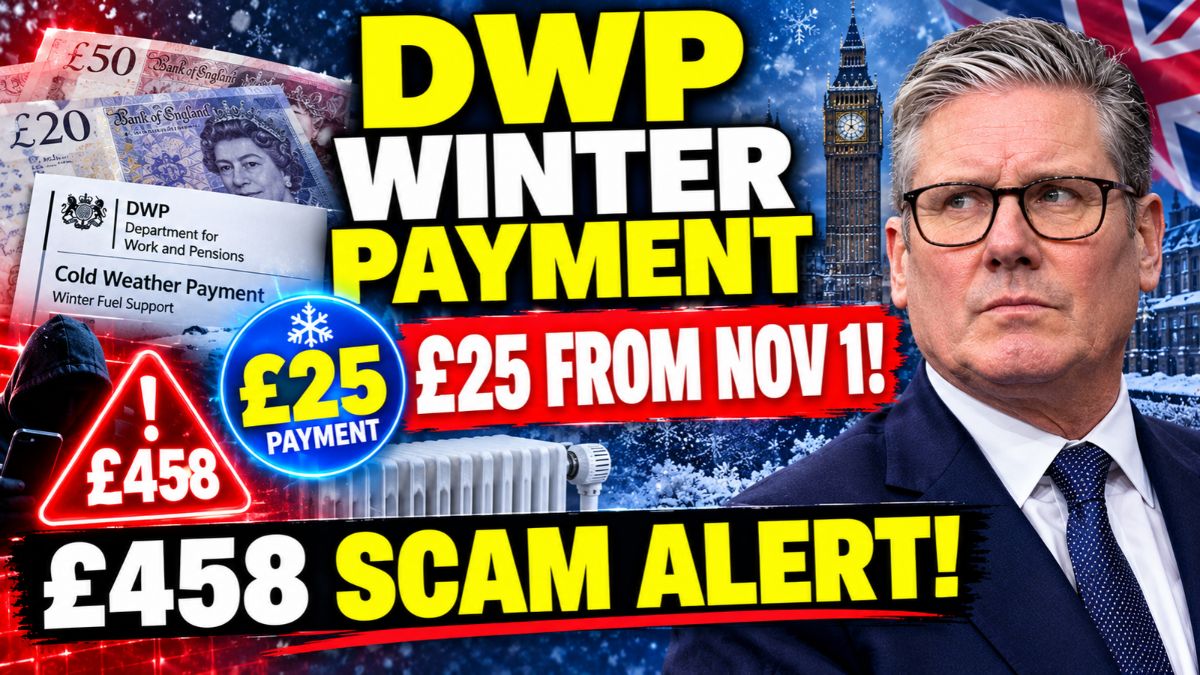
Millions of households across England and Wales are being urged to check their eligibility for winter financial support as the Department for Work and Pensions (DWP) prepares to restart the Cold Weather Payment scheme on November 1, 2026. Eligible households could receive £25 for each qualifying seven-day period when temperatures in their area are recorded or forecast to average 0°C or below.
The scheme is designed to help people on certain benefits manage additional heating expenses during periods of particularly cold weather. However, the announcement has also prompted warnings about fraudulent messages targeting pensioners and people receiving government assistance.
The security warning comes after research from cybersecurity company Kaspersky found that victims lose an average of £458.45 per message-related scam. Criminals are increasingly using convincing messages, fake government branding, and artificial intelligence to make fraudulent communications appear genuine.
For households already dealing with higher heating and living expenses, these scams can create additional financial pressure. The important point is that eligible Cold Weather Payments are normally issued automatically. Claimants do not need to pay a processing fee, activate a payment through a text message, or provide banking details through an unexpected link.
Here is what households need to know about the 2026-27 Cold Weather Payment scheme, eligibility requirements, payment dates, and how to protect themselves from winter benefit scams.
Scheme
The DWP Cold Weather Payment scheme is scheduled to operate from November 1, 2026, until March 31, 2027.
It provides financial assistance to eligible households when particularly cold weather affects their local area.
Under the scheme, qualifying recipients receive £25 for each seven-day period when the average temperature is recorded or forecast to be 0°C or below.
This means payments depend on local weather conditions rather than simply the arrival of winter.
For example, if an eligible household experiences two separate qualifying seven-day periods, it could receive £50. If four qualifying periods occur, the total could reach £100.
The payments are intended to help cover additional heating costs, particularly for older people, households with disabilities, and families facing financial difficulties.
During the previous winter, almost 1.5 million households across England and Wales had received Cold Weather Payments by mid-February, according to the Government figures cited in the supplied report.
Payments were triggered in several areas, including West Yorkshire, Greater Manchester, and Wales.
However, not every household receiving benefits automatically qualifies. Eligibility depends on the particular benefit received and additional circumstances.
The official Government information is available through the GOV.UK Cold Weather Payment service.
Eligibility
One of the most important things households should understand is that receiving a DWP benefit does not automatically guarantee eligibility for Cold Weather Payments.
The scheme covers people receiving certain qualifying benefits, subject to additional conditions.
People receiving Pension Credit generally qualify for the scheme.
Some recipients of Universal Credit may also qualify, depending on their circumstances.
Additional eligibility rules can apply to people receiving:
- Income-related Employment and Support Allowance.
- Income Support.
- Pension Credit.
- Universal Credit.
- Support for Mortgage Interest.
For Universal Credit recipients, the rules can depend on employment status, limited capability for work, and whether children are included in the household.
This means two people receiving Universal Credit may have different eligibility outcomes.
For example, a household with a qualifying health condition or responsibility for a child may meet additional conditions that another claimant does not.
Pensioners should also understand the difference between Cold Weather Payments and Winter Fuel Payments.
Although both schemes provide help with winter-related expenses, they operate under different eligibility rules.
Winter Fuel Payments provide annual winter assistance to eligible pensioners, while Cold Weather Payments are triggered by qualifying periods of very cold weather.
Households should check the relevant Government guidance rather than assuming that qualification for one scheme automatically means entitlement to the other.
Amount
The standard Cold Weather Payment is £25 for every qualifying seven-day period.
The amount received depends on how many qualifying periods occur in the recipient’s area during the scheme period.
The following examples show how payments could accumulate:
| Qualifying cold weather periods | Total payment |
|---|---|
| 1 period | £25 |
| 2 periods | £50 |
| 3 periods | £75 |
| 4 periods | £100 |
| 5 periods | £125 |
| 10 periods | £250 |
These figures are illustrations rather than predictions of how many payments individual households will receive.
Importantly, the £458.45 figure mentioned in the warning is not a Cold Weather Payment.
It refers to the reported average financial loss suffered by victims of message-related scams, according to Kaspersky research.
The distinction matters because misleading headlines and fraudulent messages can sometimes combine genuine government support announcements with unrelated financial figures.
Households should therefore check the actual payment amount and eligibility rules before responding to any communication claiming to offer additional winter assistance.
Automatic
Eligible households do not normally need to submit a separate application to receive Cold Weather Payments.
The DWP uses benefit records and local weather information to identify qualifying recipients.
When a qualifying cold weather period occurs, the payment is generally sent automatically into the same bank or building society account used for the relevant benefit.
According to the guidance provided, payments should normally arrive within 14 working days after a qualifying period.
This is an important protection against fraudulent messages.
A text claiming that someone must activate their Cold Weather Payment, submit an application through an unfamiliar website, or pay a release fee should be treated with caution.
Tom Rogers, a content specialist at Manage At Home, has highlighted the importance of checking unexpected communications before responding.
He explained that households looking for help with heating expenses may be more likely to trust a message promising financial assistance.
However, professional wording, familiar logos, and correct spelling do not establish that a message is genuine.
The safest approach is to visit GOV.UK independently and check the official information.
Scams
The return of the Cold Weather Payment scheme comes alongside warnings about fraudulent messages targeting people who receive winter support.
Scammers often use financial announcements to create a sense of urgency.
For example, a fraudulent message might claim that a household has been selected for a payment but must confirm personal details before a deadline.
Another message might suggest that a payment is waiting to be released and require the recipient to follow a link.
These communications can look convincing, particularly when they use government logos or language that resembles official announcements.
Artificial intelligence has also made it easier for criminals to produce professional-looking messages, websites, and other misleading material.
As a result, spelling mistakes are no longer a reliable way to identify every scam.
Instead, households should focus on what the sender is asking them to do.
Requests for banking passwords, PINs, one-time passcodes, or payments to release government benefits are major warning signs.
A genuine Cold Weather Payment does not require a processing fee or a payment to activate entitlement.
Warning
There are several practical steps households can take to protect themselves when receiving messages about DWP winter support.
1. Check eligibility independently
Do not rely on an unexpected text message claiming that you qualify for Cold Weather Payments.
Check your circumstances through GOV.UK or contact the relevant benefit office using established contact details.
Receiving Universal Credit or another qualifying benefit does not always mean automatic eligibility.
2. Ignore activation requests
Cold Weather Payments are normally issued automatically.
Messages asking you to apply, activate a payment, or pay a fee to release money should be treated as suspicious.
Do not follow unfamiliar links to provide personal or financial information.
3. Be cautious about urgent deadlines
Fraudulent messages frequently use phrases such as last chance, apply immediately, or confirm your details today.
These messages are designed to encourage people to act before checking whether the communication is genuine.
Take time to verify the information independently.
4. Do not trust familiar branding alone
Scammers can copy government logos, official-looking website designs, and professional communication styles.
Even a message with correct spelling and familiar branding could be fraudulent.
Pay particular attention to requests for sensitive information or unusual payments.
5. Contact your bank safely
If someone unexpectedly calls claiming to represent your bank, do not immediately follow their instructions.
End the call and contact your bank using the telephone number printed on your bank card.
You can also call 159 to reach participating banks.
However, remember that 159 is intended for contacting your bank, not checking DWP benefit eligibility.
6. Report missing payments through official channels
If you believe a qualifying Cold Weather Payment has not arrived, contact the Pension Service or Jobcentre Plus through your usual official channels.
Universal Credit recipients can also leave a message in their online journal.
Avoid third parties offering to recover or accelerate missing benefits in exchange for fees or banking information.
7. Report suspicious messages
Suspicious text messages can be forwarded to 7726 free of charge.
Suspicious emails can be forwarded to [email protected].
If you have already shared banking information or transferred money, contact your bank immediately using a trusted telephone number.
Payments
Another important question concerns what happens when a household qualifies for a Cold Weather Payment but does not receive the money.
The first step is to check whether the local area experienced a qualifying seven-day period.
A cold day alone does not automatically trigger a payment. The temperature must meet the scheme’s specific conditions over the qualifying period.
If the household appears eligible and the payment has not arrived within the expected period, recipients should contact the relevant benefit office.
For Pension Credit recipients, the Pension Service can provide assistance.
People receiving Universal Credit can use their online journal to report a missing payment or ask for clarification.
It is also important to check that the bank account details associated with the benefit are correct.
Households should never pay someone claiming to be a payment recovery agent or provide banking passwords to speed up a missing payment.

Outlook
The return of Cold Weather Payments on November 1, 2026, provides an important source of winter assistance for eligible households across England and Wales.
The £25 payment for each qualifying seven-day period can help recipients manage additional heating expenses when temperatures fall to 0°C or below.
However, eligibility depends on the benefit received and individual household circumstances. Payments are generally automatic, meaning claimants do not need to complete an online application or pay a fee to receive their entitlement.
The separate £458.45 scam warning highlights why households should remain careful when receiving unexpected messages about government financial support.
Fraudsters can use convincing branding, artificial intelligence, and urgent language to make fake payment offers appear genuine.
For pensioners and low-income families, checking eligibility through official Government channels and reporting suspicious communications can help prevent financial losses.
As the winter scheme begins, households should focus on understanding the payment rules, checking their benefit entitlement, and avoiding messages that request personal information or money in exchange for promised support.