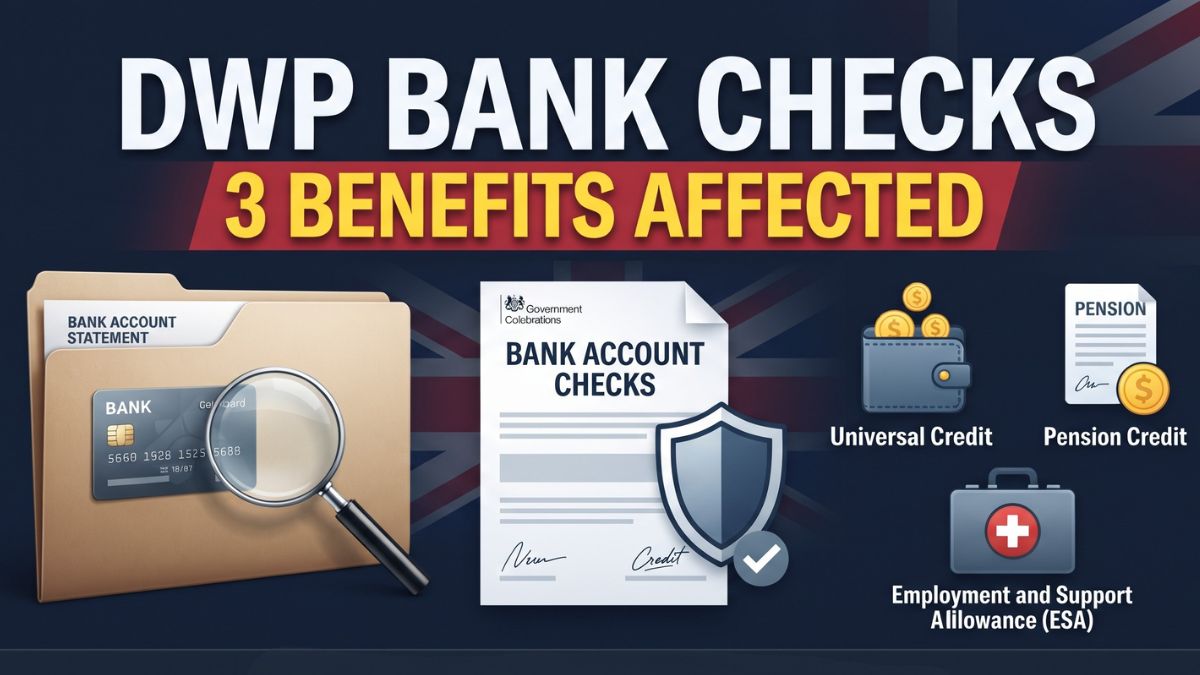
The Department for Work and Pensions (DWP) has begun using new bank account checks to help identify potential errors in benefit payments and determine whether claimants continue to meet eligibility requirements. The measures cover three benefits: Universal Credit, Pension Credit and New Style Employment and Support Allowance (ESA).
The new system allows the DWP to issue Eligibility Verification Notices to banks and other financial institutions, requesting limited information about accounts that may indicate a claimant no longer meets the rules for receiving benefits. The government says the measures are intended to tackle benefit fraud, reduce payment errors and ensure public funds reach people who qualify for support.
The announcement has raised questions about what information banks can share, who could be affected and whether claimants risk losing their payments. However, the DWP has clarified that the checks do not give officials unrestricted access to bank transactions or details of everyday spending. A flagged account also does not automatically mean that someone has committed fraud.
The measures are being introduced under the Public Authorities (Fraud, Error and Recovery) Act 2025, with an initial controlled testing phase before wider implementation. For people receiving benefits, knowing how the system works can help clarify what these changes mean for their financial security and responsibilities.
Checks
The DWP has confirmed that it has issued its first Eligibility Verification Notice under the new system. These notices allow financial institutions to check whether certain accounts meet specific indicators linked to benefit eligibility.
The purpose is to identify circumstances that may require further investigation. For example, some benefits have rules concerning savings, capital or the amount of time a claimant can spend outside the UK. If information held by a bank suggests that a claimant may no longer meet the relevant requirements, the account can be flagged for additional checks.
The system is designed to identify possible discrepancies rather than establish wrongdoing automatically. A bank’s information may indicate that a case needs reviewing, but the DWP must consider the circumstances before reaching a decision about entitlement.
The government estimates that the measures could save taxpayers £1.2 billion by the 2030/31 financial year. These projected savings form part of its broader efforts to reduce fraud and administrative errors in the benefits system.
The official GOV.UK guidance on Eligibility Verification Notices explains how the checks are intended to operate.
Benefits
The new bank account checks apply to three specific benefits. They do not automatically cover every benefit administered by the DWP.
| Benefit | What claimants should understand |
|---|---|
| Universal Credit | Eligibility may depend on income, savings, household circumstances and other rules. |
| Pension Credit | Claimants must meet the applicable age, income and capital requirements. |
| New Style ESA | Eligibility is based on qualifying National Insurance contributions and relevant employment and capability rules. |
Universal Credit provides financial support to eligible people on low incomes, those who are out of work and some people who cannot work because of health conditions or caring responsibilities. Capital rules can affect entitlement, making accurate information about savings important.
Pension Credit helps eligible pensioners with limited income. Depending on the type of Pension Credit and the claimant’s circumstances, capital and other financial resources can affect eligibility or the amount payable.
New Style Employment and Support Allowance is different because entitlement is generally based on National Insurance contribution requirements and a person’s limited capability for work due to illness or disability. Its eligibility rules are not identical to those governing Universal Credit or Pension Credit.
The fact that these three benefits are included does not mean that everyone receiving them will face an individual investigation. The system is intended to identify specific indicators that may justify further verification.
Information
One of the main questions surrounding the new measures is how much financial information banks can share with the DWP.
Under the published guidance, financial institutions may be required to provide limited account information when an account matches a relevant eligibility indicator. This can include the names of account holders, account numbers and information about linked or joint accounts.
The checks can also involve accounts connected to the account into which benefits are paid. This is relevant because some claimants may hold savings in more than one account or share financial accounts with another person.
However, the DWP has stated that the new powers do not provide access to full bank statements, individual transactions, spending habits or the specific locations where transactions took place through this verification process.
That distinction is important. The checks are intended to identify potential eligibility concerns, not monitor how people manage their daily finances.
For example, the purpose is not to establish whether a claimant regularly shops at a particular supermarket or spends money on clothing. Instead, the system is designed to identify information that could suggest a benefit’s eligibility requirements are no longer being met.
Claimants who want to know the safeguards can consult the official Code of Practice on Eligibility Verification Notices.
Savings
Savings are an important consideration for some people receiving means-tested benefits. Universal Credit and Pension Credit have rules governing capital, although the details differ between the two schemes.
For Universal Credit, capital of £6,000 or less generally does not affect the award. Capital above £6,000 and up to £16,000 can reduce entitlement, while people with capital above £16,000 will generally not qualify, subject to specific exceptions and disregarded capital rules.
Pension Credit has its own capital rules. Unlike Universal Credit, there is no general upper capital limit that automatically disqualifies every claimant. Instead, the calculation of Pension Credit can take account of assumed income from savings and investments.
These differences mean that a bank account indicator must be considered in the context of the benefit a person receives and the rules that apply to their circumstances.
A balance that requires attention under one benefit may be treated differently under another. Joint accounts can also raise questions about ownership and how much of the money belongs to an individual claimant.
The government has estimated that fraud and error involving undeclared savings and time spent abroad in Universal Credit and Pension Credit cost approximately £1.5 billion during 2025/26.
That figure relates to the government’s estimates of fraud and error in those benefits. It should not be interpreted as evidence that all claimants with savings or overseas connections have received payments incorrectly.
People receiving benefits should report changes when required and retain records that explain the source and ownership of their money.
Overseas
Time spent outside the UK is another area the DWP intends to address through its verification measures.
Different benefits have different rules concerning temporary absences and residence. Universal Credit claimants are generally subject to restrictions on how long they can be abroad, although exceptions may apply in certain circumstances.
Pension Credit and New Style ESA also have specific rules governing residence and temporary absences. Whether a person remains eligible depends on the relevant regulations and their individual circumstances.
The new system is intended to help identify possible cases where account information suggests that someone may have spent longer abroad than their benefit rules allow.
However, a potential indicator is not the same as proof of an eligibility breach. A claimant may have a legitimate reason for being abroad, or the information available to a financial institution may not establish the full circumstances.
The DWP would need to assess relevant details before deciding whether a person’s entitlement should change.
Claimants who are planning to travel or who have already spent time outside the country should check the rules for their specific benefit and report information when required. They should not assume that all three benefits have identical absence limits.
Investigations
A bank account being flagged does not automatically mean that a claimant has committed fraud or will lose their benefits.
The new measures provide information that may help the DWP decide whether additional checks are necessary. Officials must then assess the available evidence and the claimant’s circumstances before reaching a decision about entitlement.
If further information is required, the department may contact a claimant through their Universal Credit online journal, by telephone, letter or text message.
Recipients should read these communications carefully and respond within any stated deadline. Providing relevant documents or explanations promptly may help prevent unnecessary delays while the department reviews the case.
If the DWP subsequently decides that a claimant is no longer entitled to a benefit, the decision should be considered in light of the applicable rules and the evidence available. A claimant who disagrees with a decision can generally request a mandatory reconsideration before pursuing an appeal, where the relevant process applies.
People should also remain alert to scams. The introduction of new verification measures may create opportunities for fraudsters to impersonate government officials or claim that a payment will be stopped unless sensitive information is provided.
Anyone receiving an unexpected request should verify it through official DWP or GOV.UK channels before sharing personal or financial details.
Safeguards
The DWP says the new measures will be subject to independent oversight. The initial controlled testing phase is intended to help establish whether the checks work effectively and comply with the relevant safeguards before they are introduced more widely.
The legal basis for the measures is the Public Authorities (Fraud, Error and Recovery) Act 2025, which provides powers intended to help public authorities address fraud and error involving public funds.
The government’s stated objective is to improve the accuracy of benefit payments while protecting people who are legitimately entitled to support. The limits on the information banks can provide are a key part of the announced approach.
The effectiveness of the system will depend on how accurately potential indicators identify cases that genuinely require further investigation. It will also depend on whether claimants have a fair opportunity to explain their circumstances and provide relevant information.
For recipients, the practical steps remain straightforward: keep benefit records accurate, report changes when required, check official communications and seek advice if a decision appears incorrect.
Outlook
The DWP’s new bank account checks represent a change in how potential benefit eligibility issues can be identified. Initially covering Universal Credit, Pension Credit and New Style ESA, the measures are designed to flag circumstances that may require further review, particularly those involving undeclared savings or time spent abroad.
The government expects the system to help reduce fraud and error, but the checks do not automatically establish wrongdoing or give the DWP unrestricted access to personal spending information. Any decision affecting a claimant’s benefits must depend on the relevant eligibility rules and an assessment of their circumstances.
For people receiving these benefits, the most important step is to understand the rules that apply to their claim and respond promptly if the DWP requests additional information. Accurate records and clear communication can help ensure that legitimate claims are assessed fairly as the new system develops.
FAQs
Which benefits are covered by the new DWP checks?
Universal Credit, Pension Credit and New Style Employment and Support Allowance are covered.
Can the DWP see all bank transactions?
These checks do not provide full statements or individual transaction details.
Does a flagged account mean benefit fraud?
No. The DWP must investigate further before deciding whether eligibility has changed.
Why are banks checking benefit recipients’ accounts?
The checks aim to identify possible eligibility issues involving savings or overseas stays.