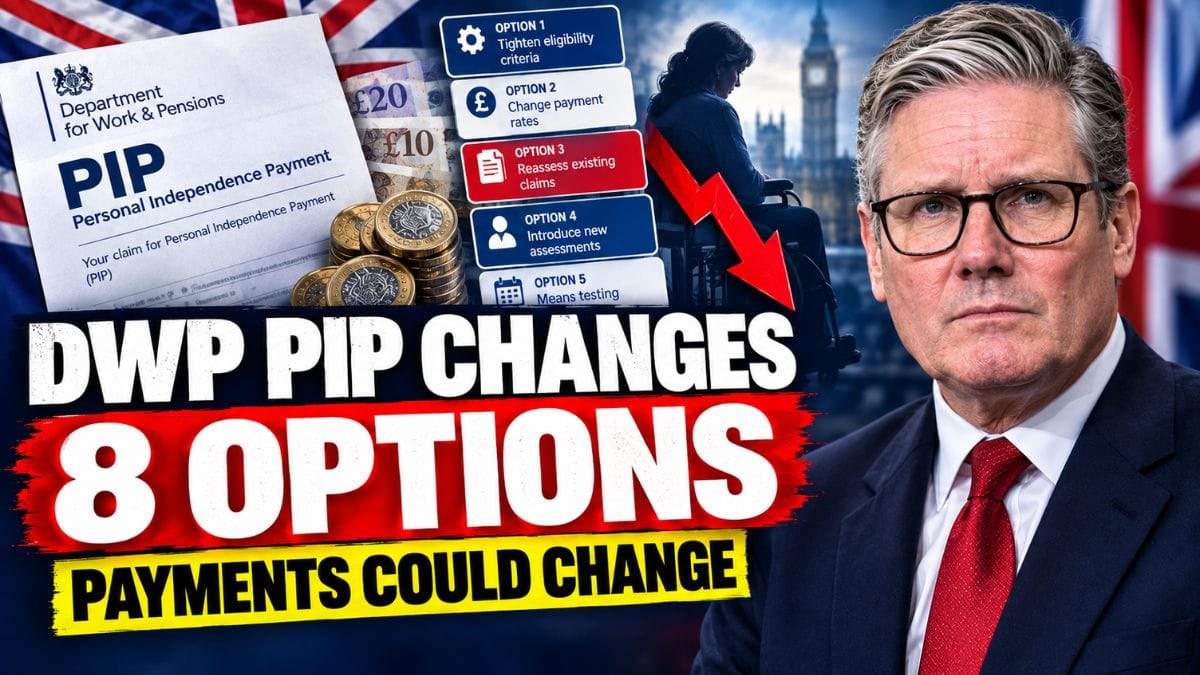
The government could potentially save billions of pounds by changing how Personal Independence Payment (PIP) is awarded, according to analysis from the Institute for Fiscal Studies (IFS).
One option examined by the think tank would make PIP available only to people who also receive Universal Credit. The IFS estimates that such a change could reduce spending by as much as £8.2 billion, equivalent to about 33% of current PIP spending.
Under current claimant numbers, around 1.32 million people could lose entitlement under the proposal. However, the IFS says changes in claimant behaviour could mean the actual number losing support would be lower.
The discussion comes as the government prepares for the final report of the Timms Review into PIP. The review is examining how the disability benefit works and what changes could make the system more sustainable.
Proposal
PIP was introduced in 2013 as a non-means-tested benefit. It is designed to help people with additional costs associated with a long-term health condition or disability.
Unlike means-tested benefits, eligibility for PIP is not normally based on household income or savings. That means someone can receive PIP even when they have earnings or other financial resources.
The IFS has now raised the possibility of changing that principle. It argues there is a case for targeting PIP more closely at people with lower living standards if the government’s objective is to concentrate financial support on those facing the greatest financial pressure.
Making PIP dependent on receipt of Universal Credit would represent a significant change to the way the benefit currently operates.
Spending
The debate comes as spending on PIP has increased substantially.
According to the figures cited in the supplied material, spending was £16.3 billion in 2019-2020. It rose to £27.3 billion in 2024-2025 and is forecast to reach £41.5 billion by 2030-2031.
The number of people receiving PIP has also reached a record level of about 4.1 million.
This growth has prompted questions about whether the current system can remain affordable over the longer term. The government has already been considering changes to welfare policy, while the Timms Review is examining PIP specifically.
The figures also explain why different approaches to eligibility and payment levels have become part of the policy discussion.
Payments
PIP is currently divided into two components: daily living and mobility. Each component has two possible rates, creating eight potential combinations of payments.
The amounts depend on the claimant’s circumstances and assessment outcome.
The IFS has argued that the current system does not always produce a payment that closely reflects the degree of need. Its analysis points out that people with different assessment scores can receive the same award.
Researchers have suggested a different approach based on a “pound-per-point” system. Under such a model, the amount paid would increase more directly with the number of points awarded during an assessment.
For example, the analysis cited in the supplied material says a claimant scoring 12 points in the daily living assessment could receive £4,240 annually, compared with the current amount cited as £5,960. Someone scoring 32 points could instead receive £11,310.
That would shift more financial support toward people recording higher levels of need.
Review
The IFS proposals come ahead of the final stage of the Timms Review.
The review was launched after controversy over earlier government plans to change PIP eligibility. Those plans faced opposition from some Labour MPs and disability campaigners.
An interim report from disability minister Sir Stephen Timms said PIP was “not fit for purpose”, according to the material supplied. Early recommendations included increasing face-to-face assessments and considering alternatives to cash payments for certain costs.
The final report is expected to provide further recommendations on how the benefit could be changed.
However, a review does not itself change benefit rules. Any major reform would require the government to set out its proposals and take the necessary parliamentary steps.
Concerns
Disability organisations have raised concerns about proposals that would make PIP more closely dependent on income or benefit receipt.
Ross Barrett, policy manager at the MS Society, criticised the IFS approach and argued that tighter restrictions could increase financial pressure on disabled people.
The broader concern is that PIP often covers additional disability-related costs that may not disappear simply because a claimant has an income above a particular threshold.
For example, someone in work can still face additional expenses related to mobility, personal care, specialist equipment or other needs. A means-tested approach would therefore change the relationship between disability-related costs and household income.
The effect would depend heavily on the precise rules eventually adopted.
Options
The IFS has outlined several possible ways to redesign PIP rather than focusing solely on means-testing.
One approach would target support toward people with the most severe disabilities. Another would direct more assistance toward people with the lowest incomes.
A pound-per-point structure could also make payment levels more closely connected to assessment scores.
These options could be combined or considered separately. Each would produce different effects for current and future claimants.
For policymakers, the central question is what PIP is intended to achieve. If its primary purpose is to compensate people for additional disability-related costs, income-based eligibility could produce different results from a system designed primarily to direct resources toward households with the lowest incomes.



Changes
The government has also said it is already making changes to the welfare system, including increasing face-to-face assessments and extending some award review periods.
According to the supplied material, ministers estimate these measures could generate savings of around £2 billion while reducing unnecessary pressure on disabled people.
The larger question is what happens after the Timms Review. A means-tested PIP system would be a major departure from the current structure, but it is only one option discussed in the wider debate.
No change to PIP entitlement should be assumed until the government announces a specific policy and Parliament considers any required legislation or regulations.
For millions of current claimants, the key issue will be whether future reforms change eligibility, payment rates, assessment rules or the way disability-related costs are recognised. The final government proposals will determine which of those changes, if any, move forward.