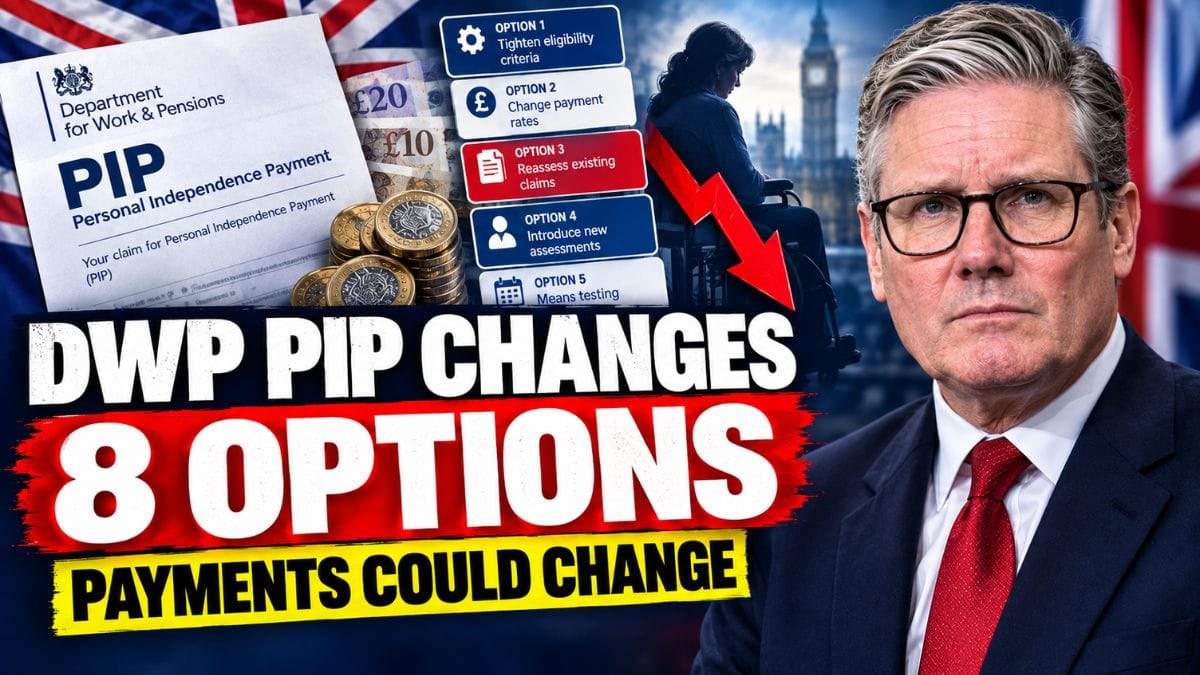
Millions of people receiving Personal Independence Payment (PIP) could be affected by potential changes as the government considers how to control rising welfare spending.
New analysis from the Institute for Fiscal Studies (IFS) has examined several ways PIP could be redesigned, including means-testing, changing how payments reflect assessed needs and altering eligibility for some groups.
The IFS has not recommended one specific policy. Instead, its analysis sets out possible options, their estimated financial effects and the groups that could potentially gain or lose from each approach.
The work comes ahead of the final Timms Review into the future of PIP and as ministers consider welfare policy ahead of the Budget.
Means-Test
One of the biggest options examined by the IFS would effectively make PIP means-tested by linking it to Universal Credit.
Under this scenario, PIP would be limited to people who also receive Universal Credit. The IFS estimates that the change could initially save as much as £8.2 billion a year, although the eventual saving could differ because people’s behaviour and benefit claims could change.
Means-testing would direct more support toward disabled people with lower incomes.
The IFS found that financial difficulties are already common among PIP recipients. According to its analysis, 62% of PIP recipients with below-average incomes said they could not afford essentials, compared with 34% of those with above-average incomes.
However, the researchers also point out that income does not tell the entire story. Disabled people with higher incomes can still have lower living standards than non-disabled people because of additional disability-related costs.
That creates a key policy question about what PIP should primarily achieve.
Payments
Another option would change the relationship between PIP payments and assessment scores.
PIP currently uses a points-based assessment. Claimants who reach the required threshold can receive the same enhanced rate even when their assessed level of need is considerably different.
The IFS illustrates the issue with examples of claimants who could currently receive the same annual daily living award despite having significantly different difficulties.
Researchers suggest a system that links payment amounts more closely to the number of points awarded.
Such a change would not necessarily reduce overall PIP spending. The payment structure could theoretically be redesigned so that the same overall budget is distributed differently.
People with higher assessed needs could receive more, while some claimants with lower scores could receive less.
Claimants
The effect of a points-based reform would vary between different groups.
The IFS says younger claimants and people with learning disabilities or cerebral palsy are more likely to have higher assessed levels and could potentially gain from a system that pays more according to severity.
Older claimants with conditions such as arthritis or back pain could be more likely to see their awards reduced under some versions of the proposal.
However, these outcomes would depend on the precise payment formula and the reliability of assessments.
The IFS has also stressed that a system based more heavily on assessment scores would work only if assessments accurately reflect the severity of people’s conditions and support needs.
Younger
The IFS has also examined an illustrative scenario involving younger adults.
There are around 689,000 PIP claimants under the age of 30, representing approximately one-fifth of the working-age caseload.
Ending PIP claims for everyone under 30 could theoretically save about £5.5 billion a year, according to the analysis. The IFS makes clear that this is a modelling scenario rather than a recommendation.
The potential saving would be smaller if people receiving the highest awards were protected. Under that approach, the maximum saving could fall to around £2.2 billion a year.
The figures also highlight why age-based restrictions would have different effects across the claimant population. Around half of PIP recipients under 30 receive the highest possible award, compared with about 34% of claimants aged over 30.
Conditions
Another option considered by the IFS involves changing eligibility for people whose main condition is a mental health, learning or neurodevelopmental condition.
These groups account for about 45% of PIP claimants, according to the analysis.
The IFS cautions that reducing eligibility for this group would not necessarily generate savings in line with the headline number of affected claimants. Some people have more than one health condition, including physical conditions, which could affect how any new eligibility rules operate.
The researchers also discuss arguments about whether some conditions are more difficult to verify. However, that issue does not apply equally to every claimant or diagnosis.
Any reform would therefore depend on the exact assessment and eligibility rules introduced by the government.
Growth
The pressure for reform has increased as PIP claimant numbers and spending have grown.
According to figures cited in the IFS analysis, the proportion of people aged 16 to 64 receiving PIP increased from 5.5% in 2019 to 8.2% in 2025.
Spending also increased from £14 billion in 2019-20 to £25 billion in 2025-26. Forecasts cited in the material suggest spending could reach £34 billion by 2030-31.
The increase has prompted wider questions about whether the current system is financially sustainable and whether support should be targeted differently.
However, higher spending alone does not determine which reform should be adopted. Changes to PIP could affect household finances, disability-related costs and incentives around work, making the policy choices more complicated than simply reducing expenditure.
Review
The Timms Review is examining the future of PIP against this background.
The review was commissioned following concerns about the rapid increase in claimant numbers and welfare spending. Its interim findings said PIP was no longer “fit for purpose”, according to the government.
The final recommendations are expected in the autumn.
The IFS says its analysis is intended to inform that debate rather than determine the outcome. Different options would involve different trade-offs, with some groups potentially receiving more support and others receiving less.
Mark Franks, director of welfare at the Nuffield Foundation, said the government faces significant choices in reforming PIP and that changes could have substantial effects on people currently receiving the benefit.
He also highlighted the importance of addressing barriers that disabled people can face when entering or remaining in work.



Government
The Department for Work and Pensions has said the Timms Review will provide the basis for sustainable reform.
The government has also pointed to measures already being introduced, including more face-to-face assessments and longer award review periods. According to the DWP, these measures are expected to deliver savings of around £2 billion while reducing unnecessary pressure on disabled people.
For PIP claimants, however, the most important details will be contained in the government’s eventual proposals. The IFS analysis describes possible routes, but it does not itself change eligibility or payment rules.
The debate now centres on what PIP should be designed to achieve, who should receive support and how payments should reflect individual needs. Until the government publishes its final plans and any required legislation or regulations are introduced, claimants should not assume that any of the options outlined by the IFS will become law.