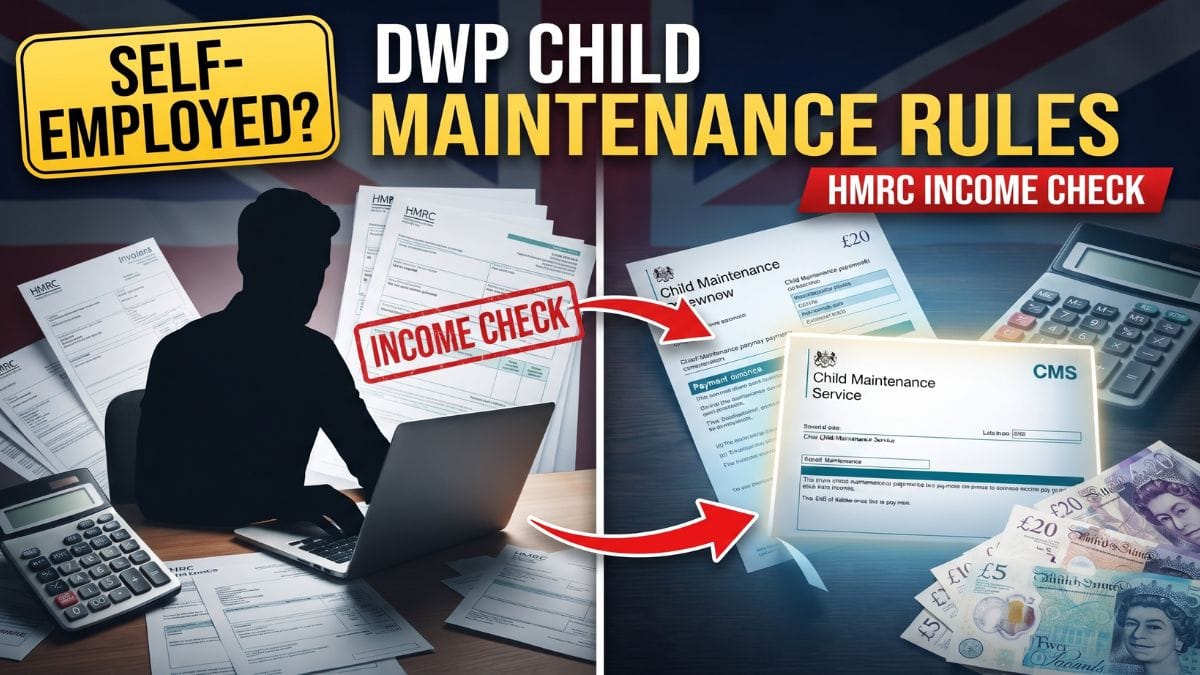
The Department for Work and Pensions (DWP) has outlined how the Child Maintenance Service (CMS) deals with income information when a paying parent is self-employed, including cases where there are concerns that earnings may have been under-reported.
The update comes as child maintenance continues to affect a large number of families across the UK. Recent government statistics show that around 1.1 million children were supported through CMS arrangements during one three-month period.
The issue of unpaid maintenance has also received wider attention after BBC Panorama featured parents who said they had experienced difficulties securing payments from former partners.
Rules
Self-employed parents have specific responsibilities when reporting their income for tax purposes. According to the DWP, they are required to keep accurate records of business income and expenses.
HM Revenue and Customs (HMRC) can impose penalties where inaccurate reporting results in tax being unpaid.
For child maintenance purposes, information about a self-employed paying parent’s income is normally obtained from HMRC. This provides the CMS with information that can be used when calculating the amount of maintenance due.
The system is designed to connect child maintenance calculations with verified income information rather than relying solely on figures supplied informally by a parent.
Reviews
The CMS reviews a paying parent’s income each year to determine the amount of child maintenance due for the forthcoming period.
As part of this process, the service obtains updated earnings information from HMRC.
This is particularly relevant for self-employed parents because their income can change from one tax year to another. A new tax return or updated HMRC information can therefore affect the maintenance calculation.
If a paying parent reports a change in earnings or disputes the income figure being used, the CMS requires a fully completed and verified Self-Assessment Tax Return from a more recent tax year than the information previously supplied by HMRC.
This gives the CMS a formal basis for considering whether the existing calculation should change.
Variations
Parents can apply for a variation when there is evidence that relevant income has not been fully reflected in a child maintenance calculation.
This can be important in cases involving more complicated financial circumstances. A variation provides a route for the CMS to consider information that may not have been captured by the standard calculation.
The DWP has also explained that cases involving suspected misrepresentation, complex income or potentially fraudulent behaviour can be referred to the CMS Financial Investigation Unit.
The unit has powers to obtain information from financial institutions when it needs to verify income and assets.
Investigations
Where an investigation identifies discrepancies between reported information and the financial information available, the CMS can reassess the calculation.
If the evidence supports a different figure, the service can recalculate the child maintenance liability in accordance with the relevant legislation.
This process is intended to ensure that maintenance calculations reflect a paying parent’s relevant financial circumstances.
It also provides a mechanism for addressing cases where concerns about reported income cannot be resolved through the normal annual review process.
Arrears
Unpaid child maintenance can create significant financial pressure for receiving parents and children.
Recent media coverage has highlighted cases in which parents say they struggled to collect money owed by former partners. One parent featured by BBC Panorama said she had been forced to use food banks and faced arrears of around £10,000.
Individual cases can involve different circumstances, however, and an unpaid maintenance balance does not necessarily mean that the CMS has determined that a paying parent deliberately avoided their obligations.
The DWP’s latest statement specifically addresses the process available when there is evidence that income may not have been fully reflected in a calculation.
Collection
Parents who use the CMS can receive help with collecting child maintenance where the other parent does not make the required payments.
The charity Gingerbread says parents with a private child maintenance arrangement may be able to ask the CMS to take over collection if that arrangement has broken down.
The CMS has several enforcement options for recovering unpaid maintenance. Depending on the circumstances, these can include deductions from earnings or certain benefits.
The collection process is separate from the calculation of how much maintenance should be paid. The amount due first needs to be established, while enforcement measures can then be used where payments are not made as required.



Guidance
For self-employed paying parents, keeping accurate financial records remains important because HMRC information is normally used by the CMS when assessing income.
For receiving parents who believe income has not been fully reflected in a calculation, the variation process can provide a way to raise the issue with the CMS.
The DWP says that where evidence identifies a discrepancy, the CMS can investigate, verify financial information and recalculate the liability where appropriate.
The latest update therefore clarifies how HMRC information, annual CMS reviews, variations and financial investigations can work together when self-employed income is disputed. For families relying on child maintenance, understanding which process applies can help them identify the appropriate route for addressing an income or payment issue.