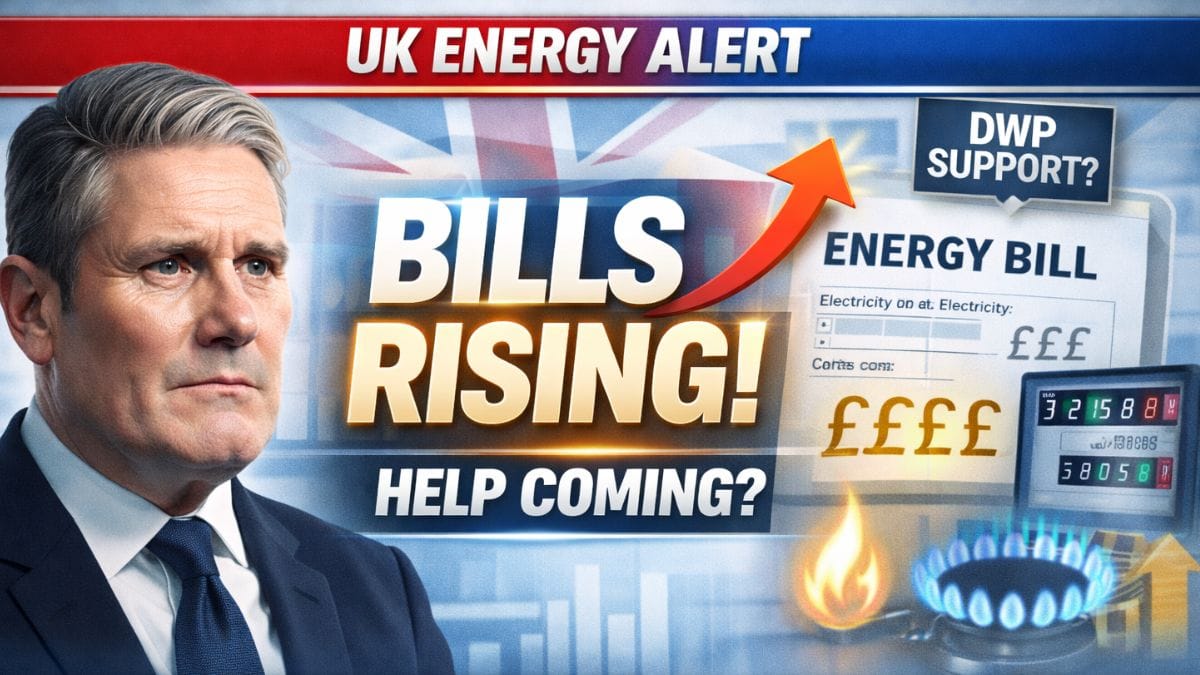
Rising global tensions and increasing fuel costs are beginning to affect household energy bills across the UK. As oil and gas prices climb בעקבות the ongoing conflict in the Middle East, the Government is facing growing pressure to provide additional support, particularly for vulnerable households and those receiving benefits.
Recent statements from ministers suggest that more targeted assistance for Department for Work and Pensions (DWP) claimants may be under consideration, although no final policy has yet been confirmed.
Energy prices have risen sharply in recent weeks, driven largely by higher global oil costs. Brent crude has increased from around $72.48 per barrel before the conflict to approximately $95.
This rise has contributed to broader increases in household expenses, as energy costs influence everything from heating bills to transportation and production. For many households, especially those on fixed or low incomes, these changes are becoming increasingly difficult to manage.
The situation has prompted political attention, with MPs raising concerns about how best to support those most affected.
Pressure
The UK is not alone in facing these challenges. Several countries, including Germany, France, Italy, Japan and South Korea, have already introduced measures to reduce the burden of rising energy costs on households.
In the UK, pressure is mounting on the Government to take similar action. Questions have also been raised within Parliament about whether existing benefits could be used more effectively to target support.
Labour MP Ruth Jones recently asked whether benefits such as Personal Independence Payment (PIP), Disability Living Allowance (DLA) and Attendance Allowance (AA) could be included in eligibility criteria for energy support schemes.
Response
In response, the Government has indicated that it is actively reviewing options to provide more focused assistance. Officials emphasised that contingency planning is underway to address different possible scenarios.
Martin McCluskey, Parliamentary Under Secretary of State at the Department for Energy Security and Net Zero, stated that the Government is closely monitoring the situation and preparing measures to support households facing rising costs.
A key part of this effort is the National Data Library energy support “Kickstarter” project. This initiative aims to improve how public sector data is used to identify and assist households in need.
By linking data across departments, the Government hopes to ensure that support reaches those who are most affected, rather than applying broad, untargeted measures.
Measures
Some steps have already been announced in response to rising costs. In March, Chancellor Rachel Reeves outlined plans to strengthen the powers of the Competition and Markets Authority (CMA).
These measures are intended to address potential price increases and prevent unfair practices such as price gouging. The Government is also considering temporary, targeted regulatory powers to respond more quickly to market disruptions.
In addition, the CMA is working with the Government to monitor the cost of essential goods and services, including energy.
Support
Existing support mechanisms continue to play a role in limiting household costs. Ofgem’s energy price cap has contributed to a reduction in average annual bills, with a typical decrease of £117 recorded in April.
However, this cap is subject to periodic review and may change depending on market conditions. The next reassessment is expected in July.
The Government has also introduced a £53 million support package aimed at low-income households in rural areas, particularly those affected by higher heating oil costs.
This targeted approach reflects a broader shift towards directing assistance to specific groups rather than applying universal subsidies.
Outlook
While no new nationwide support scheme has been confirmed, current signals suggest that future measures may focus on better targeting of aid. This could include linking eligibility to existing benefit systems, such as those administered by the DWP.
The effectiveness of such an approach will depend on how accurately households in need can be identified and how quickly support can be delivered.
At the same time, the broader economic impact of rising energy prices remains uncertain. Continued volatility in global markets could lead to further increases in household costs in the coming months.
The Government has indicated that it will continue to monitor developments and adjust its response as needed, within existing fiscal constraints.
For households, particularly those receiving benefits, the coming months may bring changes in how support is structured and delivered. Staying informed about eligibility criteria and available assistance will be important as policies evolve.
FAQs
Why are UK energy bills rising?
Due to higher global oil and gas prices.
Who may get extra support?
DWP claimants and vulnerable households.
What is the price cap change?
Bills dropped by about £117 in April.
What is the Kickstarter project?
A plan to target support using data.