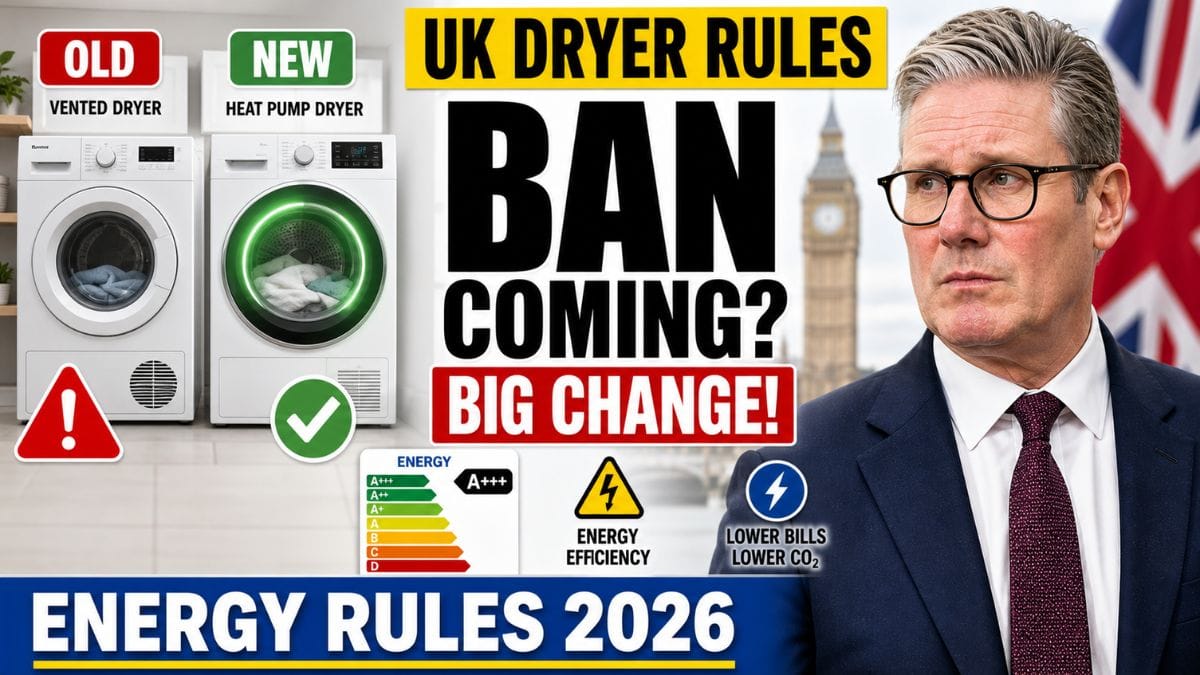
Changes to UK energy efficiency rules for household appliances are beginning to influence consumer behaviour, particularly in the tumble dryer market. Ahead of proposed regulations, retailers report increased demand for traditional models, as households respond to plans that would limit the sale of less efficient machines.
The policy is part of a broader government effort to reduce energy consumption and support net zero targets. While existing appliances will not be banned from use, the sale of certain types is expected to be phased out.
Policy
The government has outlined proposals to introduce stricter minimum energy performance standards for tumble dryers. Under the new framework, only machines with an Energy Efficiency Index (EEI) below 85 would remain available for sale.
This threshold effectively excludes many conventional vented and condenser dryers, which typically exceed that level. The intention is to encourage a transition toward more efficient heat pump dryers.
Models
Traditional tumble dryers generally fall into three categories:
| Type | Key Feature | Efficiency Level |
|---|---|---|
| Vented | Expels hot air through a hose | Low |
| Condenser | Collects moisture in a tank | Average |
| Heat Pump | Recycles warm air | High |
Heat pump dryers operate at lower temperatures, usually around 50C, compared to 70 to 75C in conventional models. This makes them more energy efficient, though drying cycles may take longer.
Market
Retailers have reported a noticeable increase in sales of traditional dryers. Some businesses describe a surge in demand as customers look to purchase familiar models before the proposed changes take effect.
This pattern has also been observed in regions already subject to similar regulations. In Northern Ireland, where EU-aligned standards apply, retailers have seen comparable shifts in buying behaviour.
The increase in sales appears to reflect both practical concerns and uncertainty about future availability.
Cost
Government estimates suggest that switching to heat pump dryers could lead to long-term savings. According to official data, an average household may save around £250 over a 12-year period compared to using a condenser dryer.
Over a longer 20-year lifespan, the total benefit could reach approximately £900, due to both lower energy consumption and longer appliance durability.
These projections form part of the policy rationale for encouraging adoption of higher-efficiency models.
Concerns
Despite potential savings, some consumers and retailers have raised practical concerns. Heat pump dryers tend to have longer drying times, which may not suit all households.
Performance in colder environments is another issue. Many UK households place tumble dryers in garages, sheds, or outbuildings. In temperatures below 10C, heat pump dryers may operate less efficiently and take longer to dry clothes.
This has led some consumers to question whether the newer models will meet their specific needs.
Space
Installation requirements also play a role in purchasing decisions. Traditional vented dryers often require external ventilation, while condenser and heat pump models offer more flexibility in placement.
However, space constraints inside homes can limit options. Households that rely on outdoor or unheated spaces may find it more difficult to transition to heat pump systems without adjustments.
Transition
Officials have clarified that the proposed rules do not prevent households from continuing to use their existing appliances. The focus is on restricting the sale of new, less efficient models rather than mandating immediate replacement.
This approach allows for a gradual transition, giving consumers time to adapt as older machines reach the end of their lifespan.
Outlook
The shift toward stricter energy standards reflects a broader policy direction aimed at reducing household energy consumption. While the long-term goal is improved efficiency and lower emissions, the short-term impact includes changes in consumer behaviour and retail demand.
As the regulations move closer to implementation, further clarity on timelines and enforcement may influence how quickly households adopt newer technologies.
FAQs
Will old tumble dryers be banned?
No, existing dryers can still be used.
What dryers are affected by new rules?
Vented and some condenser models may be restricted.
What is EEI in tumble dryers?
It measures energy efficiency performance.
Are heat pump dryers cheaper to run?
Yes, they use less energy over time.