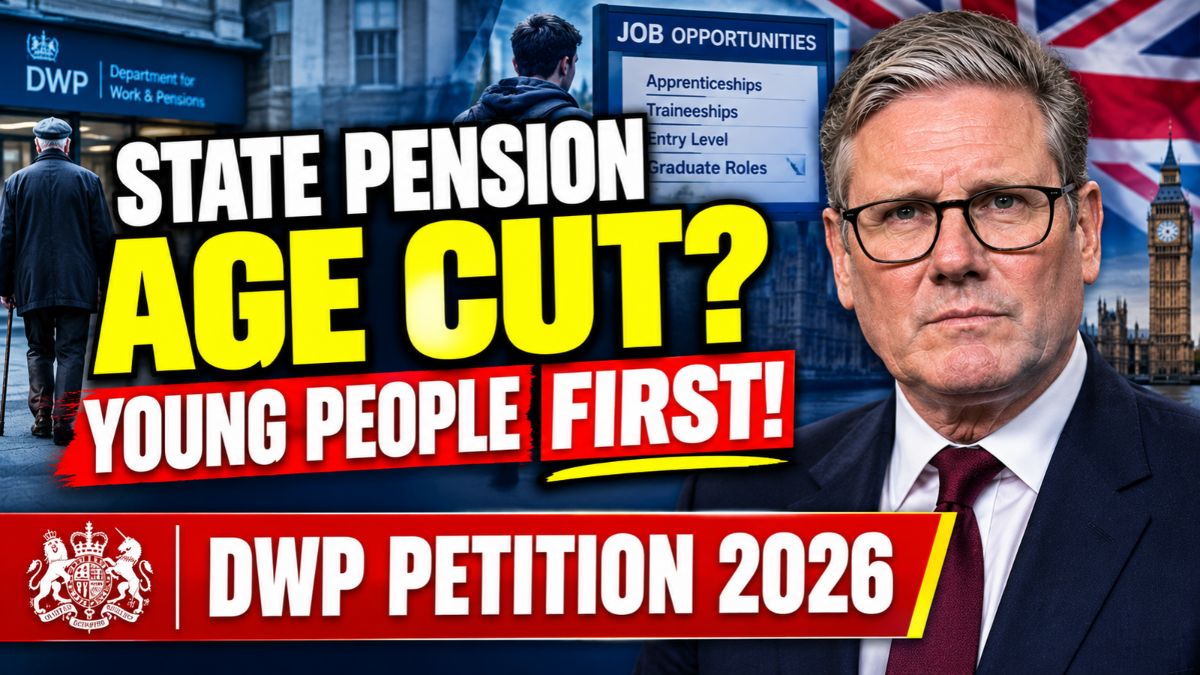
A petition calling for the UK Government to lower the State Pension age to help young adults find work has attracted thousands of signatures. The campaign argues that encouraging older workers to retire earlier could create more employment opportunities for younger people who are struggling to enter the workforce.
Created by Helen Grice on June 25, 2026, the petition asks the Government to consider reducing the age at which people can claim their State Pension. It suggests that employers could recruit younger workers to fill positions vacated by people choosing to retire.
The petition remains open until December 25, 2026. It needs at least 10,000 signatures to receive a Government response. If it reaches 100,000 signatures, it will be considered for a parliamentary debate, although this does not guarantee that a debate will take place.
For now, the proposal is a campaign request rather than an announced Government policy. It does not specify a replacement State Pension age or outline how such a change would be funded.
Petition
The campaign centres on the argument that older employees remaining in work for longer may make it harder for young adults to find employment.
The petition states: “The longer people are having to work the fewer jobs there are out there for young adults.”
It argues that lowering the State Pension age could encourage some older workers to retire, potentially allowing employers to recruit younger people. The campaign also says earlier retirement could give older people more time to enjoy life after years in employment.
However, the petition does not provide a detailed policy proposal or specify which age groups would be affected. It primarily calls for the Government to consider whether reducing the State Pension age could improve employment prospects for young adults.
Pension
The State Pension provides regular income to eligible people who have reached the qualifying age and meet the relevant National Insurance requirements.
The State Pension age is determined by legislation and is subject to scheduled changes. Lowering it would be a significant policy decision because it could allow people to claim payments earlier and increase the number of years during which the Government pays the benefit.
The petition does not propose a specific new qualifying age. It also does not explain whether a reduction would apply to everyone or only to particular groups of workers.
Any change would therefore require further consideration of eligibility rules, public spending and the potential effect on retirement decisions.
Employment
The petition’s central assumption is that earlier retirement could free up jobs for younger workers. However, the relationship between retirement and youth employment is not straightforward.
When an older worker retires, an employer may recruit a younger employee, but that outcome is not guaranteed. Businesses may instead redistribute responsibilities, reduce staffing, automate tasks or leave a vacancy unfilled.
Employment opportunities also depend on economic growth, employer demand, workers’ skills and the availability of suitable training. Even if more vacancies became available, young adults might need additional support to secure those roles.
The petition highlights concerns about young people’s access to employment, but it does not provide evidence showing how many jobs might become available if the State Pension age were reduced.
Costs
Reducing the State Pension age could have substantial financial implications. People who qualified earlier would potentially receive their pension for a longer period, increasing Government expenditure unless the policy were accompanied by other changes.
The financial impact would depend on the new qualifying age, how quickly the change was introduced and how many people became eligible sooner.
There could also be consequences for the labour market. Some older people might choose to retire earlier, while others could continue working because they wanted or needed additional income.
A detailed assessment would therefore be needed to determine whether the proposal could deliver meaningful employment benefits for younger people and how those benefits would compare with the additional cost of pension payments.
Response
Under the UK Parliament’s e-petition process, a petition that receives 10,000 signatures normally receives a Government response. Reaching 100,000 signatures means it will be considered for debate in Parliament, but a debate is not automatic.
The petition’s closing date is December 25, 2026. Until the Government announces a policy change, the existing State Pension age arrangements remain in place.
People interested in the campaign can read the petition and follow its signature total on the official UK Parliament petitions website.
The proposal raises a broader question about how the UK can improve employment prospects for younger people while supporting older workers approaching retirement. Lowering the State Pension age is one suggestion, but its effectiveness would depend on whether earlier retirement actually led to additional recruitment. Any Government decision would need to consider employment evidence, pension affordability and the different financial circumstances of younger and older people.
FAQs
What is the State Pension age cut petition about?
It calls for a lower State Pension age to help create jobs for young adults.
Who created the petition?
Helen Grice created the petition on June 25, 2026.
When does the petition close?
The petition closes on December 25, 2026.
How many signatures are needed for a Government response?
The petition needs 10,000 signatures for a Government response.