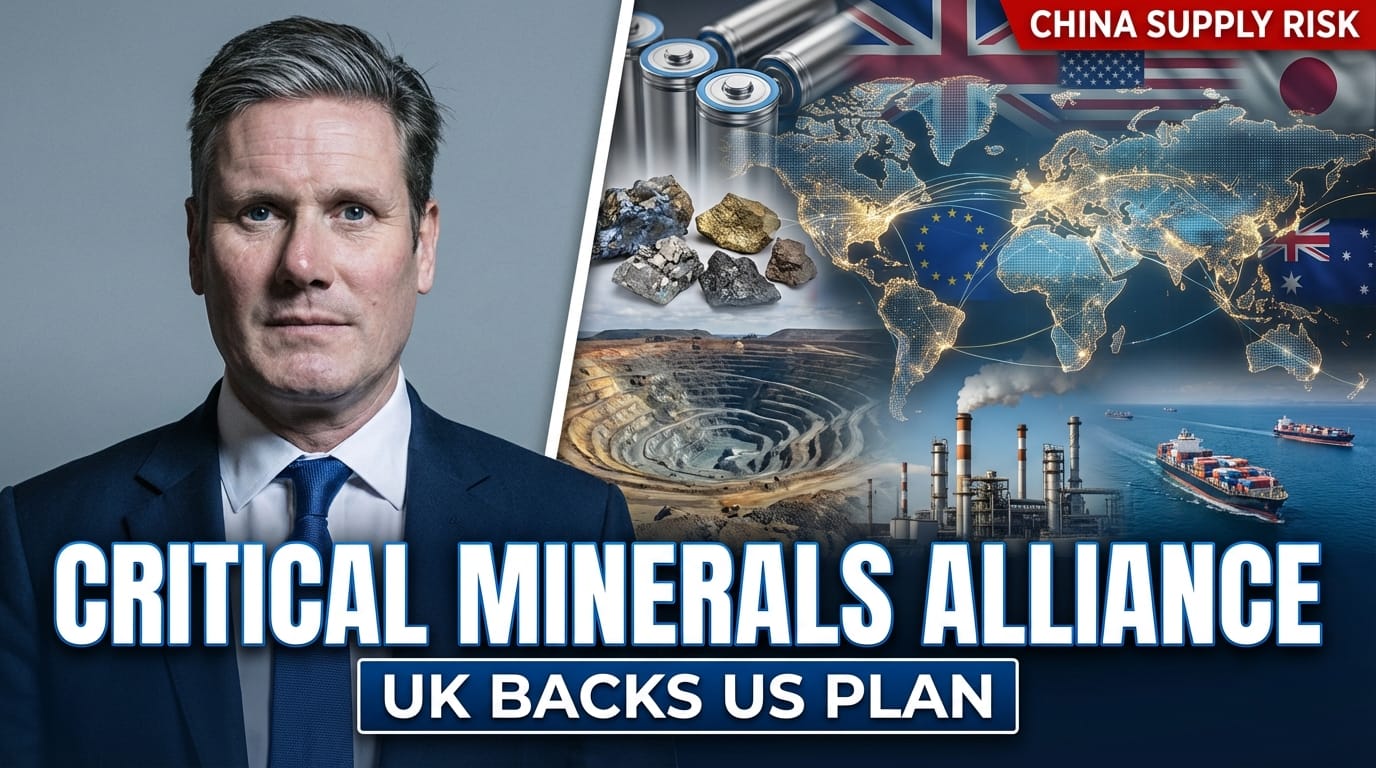
The UK has signalled support for the creation of a multinational critical minerals alliance, as the United States steps up efforts to build a coordinated response to China’s dominance in the sector. The move reflects growing concern among Western governments about long-term supply risks for materials vital to industry, defence, and the energy transition.
Speaking at a UK Export Finance event on Thursday, February 5, UK business and trade secretary Peter Kyle said such an alliance “makes sense,” provided it reflects the differing needs and capabilities of participating countries.
Talks
Kyle’s comments come amid US-led discussions to establish a new critical minerals trading bloc aimed at reducing reliance on China, the world’s leading producer and processor of many strategic minerals.
“Alliances make perfect sense, as long as they take into account the specific peculiarities of domestic markets,” Kyle told reporters. He added that countries involved produce different minerals and face different industrial requirements, meaning any arrangement would need to be fully cooperative rather than uniform.
Kyle said he was approaching strategic partnership talks “with a can-do spirit.”
Partnership
The remarks followed the signing of a new UK-US partnership agreement after a summit in Washington DC on Wednesday. According to both governments, the deal is intended to accelerate efforts to secure supplies of critical minerals needed to support domestic manufacturing and future-facing industries.
The Washington talks brought together ministers from dozens of countries, including several EU member states, South Korea, India, Japan, and Australia. The discussions focused on improving cooperation on supply chains, financing, and investment to counter China’s dominant position.
Context
Western governments agreed in 2024 to increase coordination between export credit agencies and development finance institutions to support critical minerals projects. The move followed concerns that investment in mining, processing, and refining had lagged behind demand growth.
Critical minerals are essential inputs for sectors such as clean energy, electronics, and defence. However, EU auditors warned this week that financing for extraction and processing projects remains at an early stage. A McKinsey report published last October estimated that close to US$5tn in capital expenditure could be required to prevent future shortages of metals.
UK Strategy
The UK government published its Critical Minerals Strategy last November, committing up to £50mn in new funding to support domestic production and processing.
Kyle said action could not wait for the outcome of international alliance talks alone. “It might well be that these things will take time to deliver, and we can’t wait for the alliances before we start acting,” he said, pointing to the role of UK Export Finance in supporting projects in the meantime.
UKEF
UKEF chief executive Tim Reid said the export credit agency is placing increased emphasis on the sector. He said UKEF is expanding its product offering to better support critical minerals projects, describing the sector as both a challenge and an opportunity.
Reid noted that UKEF has already launched new financial tools that allow support based on offtake agreements, including imports of critical minerals, rather than being limited to traditional export financing. This approach is being delivered through the recently introduced Critical Goods Export Development Guarantee.
The UK government has also introduced legislation to double UKEF’s overall capacity from £80bn to £160bn. Reid said part of this expanded headroom would be directed toward supporting critical minerals projects in the coming months and years.
Outlook
The UK’s stance suggests it is open to deeper cooperation with allies as competition over critical minerals intensifies. While the shape of any formal alliance remains under discussion, policymakers are increasingly aligned on the need to diversify supply chains, mobilise long-term financing, and reduce strategic dependence on a small number of producers.
FAQs
What did the UK say about a critical minerals alliance?
It said such an alliance makes sense.
Who is leading the talks on critical minerals?
The United States is leading discussions.
Why are critical minerals important?
They are vital for energy, tech, and defence.
What is UKEF’s role in critical minerals?
It provides finance and guarantees for projects.