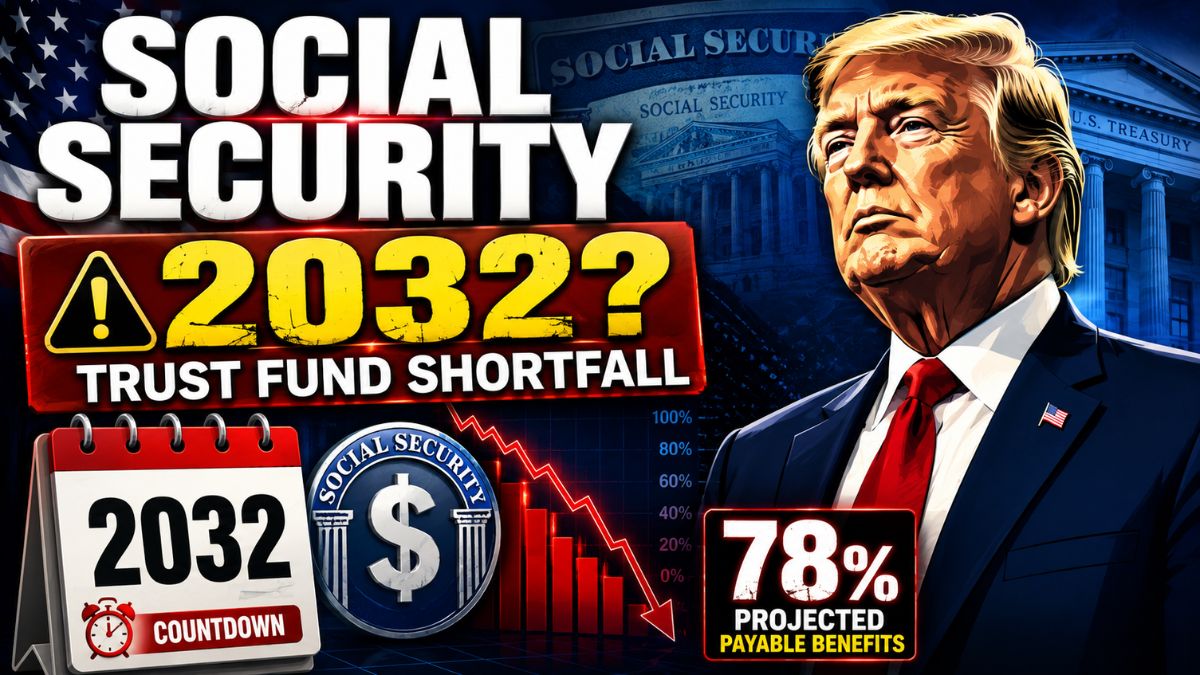
Social Security’s retirement trust fund is projected to reach depletion in late 2032, according to the Social Security Administration’s 2026 trustees report released in June. The estimate is three months earlier than the previous projection. If Congress does not make changes before then, incoming payroll tax revenue would be enough to cover only about 78% of scheduled retirement benefits.
That does not mean Social Security would stop paying benefits in 2032. Instead, the program would face a gap between the benefits promised under current law and the revenue coming in through payroll taxes. How that gap is addressed will depend on decisions made by Congress.
Depletion
The trust fund’s projected depletion date has moved forward largely because of changes to federal tax policy. According to the trustees’ analysis, the One Big Beautiful Bill Act, signed into law in 2025, reduced tax liability for some Social Security beneficiaries.
Because federal income taxes collected on Social Security benefits contribute to trust fund revenue, the reduction in taxable benefits is expected to lower the amount flowing into the program.
The Social Security chief actuary said the law would have material effects on the financial condition of the trust funds. The change illustrates how decisions outside the Social Security payroll tax system can also affect the program’s finances.
Still, the depletion date is a projection rather than a fixed deadline. Future economic conditions, wage growth, employment, immigration, fertility, legislation and other factors can change the outlook.
Demographics
Social Security’s financial challenges are also closely tied to demographic trends.
In 1960, there were more than five workers paying into Social Security for every retiree. Today, that ratio is about 2.9 workers per retiree, according to the Bipartisan Policy Center. It is projected to decline to roughly 2.2 workers per beneficiary by the 2070s.
That shift matters because Social Security operates largely on a pay-as-you-go basis. Today’s workers and employers pay payroll taxes that help finance benefits for current recipients.
As the number of workers supporting each retiree declines, maintaining the same level of benefits requires more revenue per worker, lower benefits, or changes elsewhere in the system.
Longevity
Americans are also spending more years in retirement than previous generations.
Life expectancy at age 65 has increased by more than 50% since 1940. Longer lives are an important achievement, but they also mean Social Security may need to provide benefits for more years.
At the same time, the trustees lowered their assumptions for fertility and immigration. Lower population growth can mean fewer workers entering the labor force in future decades.
Together, these trends put additional pressure on the program’s long-term finances.
Shortfall
The trustees estimate that Social Security’s 75-year financial shortfall has grown to approximately $30.3 trillion, compared with about $26 trillion in the previous year’s report.
The program has also been paying more in scheduled benefits than it collects in payroll tax revenue for many years. Payroll tax revenue has not covered annual benefit costs since 2009, requiring Social Security to use its accumulated trust fund reserves to cover the difference.
As reserves decline, the program becomes increasingly dependent on current revenue.
That is why the depletion date receives so much attention. Once reserves are exhausted, Social Security would not have access to those accumulated assets to cover the difference between scheduled benefits and incoming revenue.
Benefits
A trust fund depletion does not mean benefits would automatically fall to zero. The projected 78% figure is important because it represents the share of scheduled benefits that could be paid from incoming revenue under current projections.
In practical terms, that could mean a significant reduction if Congress does not act.
For example, a beneficiary receiving $2,000 per month could face a reduction of approximately $440 per month under a 22% cut scenario. That would equal about $5,280 less per year.
The impact would vary depending on the size of the person’s benefit. A lower-income beneficiary could lose around $275 per month, while a higher-income retiree could face a reduction of roughly $594 per month.
These figures illustrate why the issue matters for households at different income levels. Even a relatively modest percentage reduction can translate into a substantial change in annual retirement income.
History
Congress has faced a similar Social Security financing problem before.
In 1983, lawmakers acted when the program was approaching a funding crisis. The legislation included several measures designed to improve the system’s finances, including taxation of a portion of Social Security benefits and a gradual increase in the retirement age.
The earlier experience demonstrates that changes do not necessarily have to come from a single policy. Lawmakers can combine revenue increases, benefit changes and eligibility adjustments to address a funding gap.
However, the timing of reforms can affect how much adjustment is required. Waiting until reserves are close to depletion can leave policymakers with fewer years to phase in changes.
Planning
For people approaching retirement, the trust fund outlook does not mean Social Security should be removed from financial plans. It does mean that relying on today’s scheduled benefit estimate without considering potential changes could introduce additional risk.
Retirees and workers can review their Social Security statements and consider how different benefit scenarios would affect their retirement income. It may also be useful to examine how much income would come from savings, pensions, employment or other sources.
The decision about when to claim Social Security remains separate from the trust fund’s projected depletion date. Claiming earlier or later can affect an individual’s monthly benefit, while potential legislative changes could affect future benefits more broadly.
Social Security remains a major source of income for millions of Americans. The program currently provides monthly benefits to roughly 71 million people, and AARP estimates that it supplies the majority of income for 43% of seniors.
The central issue is therefore not whether Social Security will suddenly disappear, but how policymakers will address the gap between scheduled benefits and available revenue. Combining the retirement and disability trust funds could extend the projected depletion date to 2034, according to the Bipartisan Policy Center, but that would not eliminate the underlying financial imbalance.
With the retirement trust fund now projected to be depleted in late 2032, the timeline gives Congress several years to consider changes. The eventual solution could involve adjustments to taxes, benefits, eligibility rules or a combination of policies. Until lawmakers act, the most practical approach for households is to understand the current projections, avoid assuming one outcome is certain and build retirement plans that can accommodate different Social Security scenarios.
FAQs
When could Social Security’s trust fund be depleted?
The retirement trust fund is projected to be depleted in late 2032.
Will Social Security stop paying benefits in 2032?
No. Incoming payroll taxes could still cover about 78% of scheduled benefits.
Why is Social Security facing a shortfall?
Demographic changes and insufficient payroll revenue are major factors.
Could Congress prevent benefit reductions?
Yes. Congress could change taxes, benefits, eligibility rules or other policies.



How many people receive Social Security?
Social Security currently provides monthly benefits to about 71 million people.