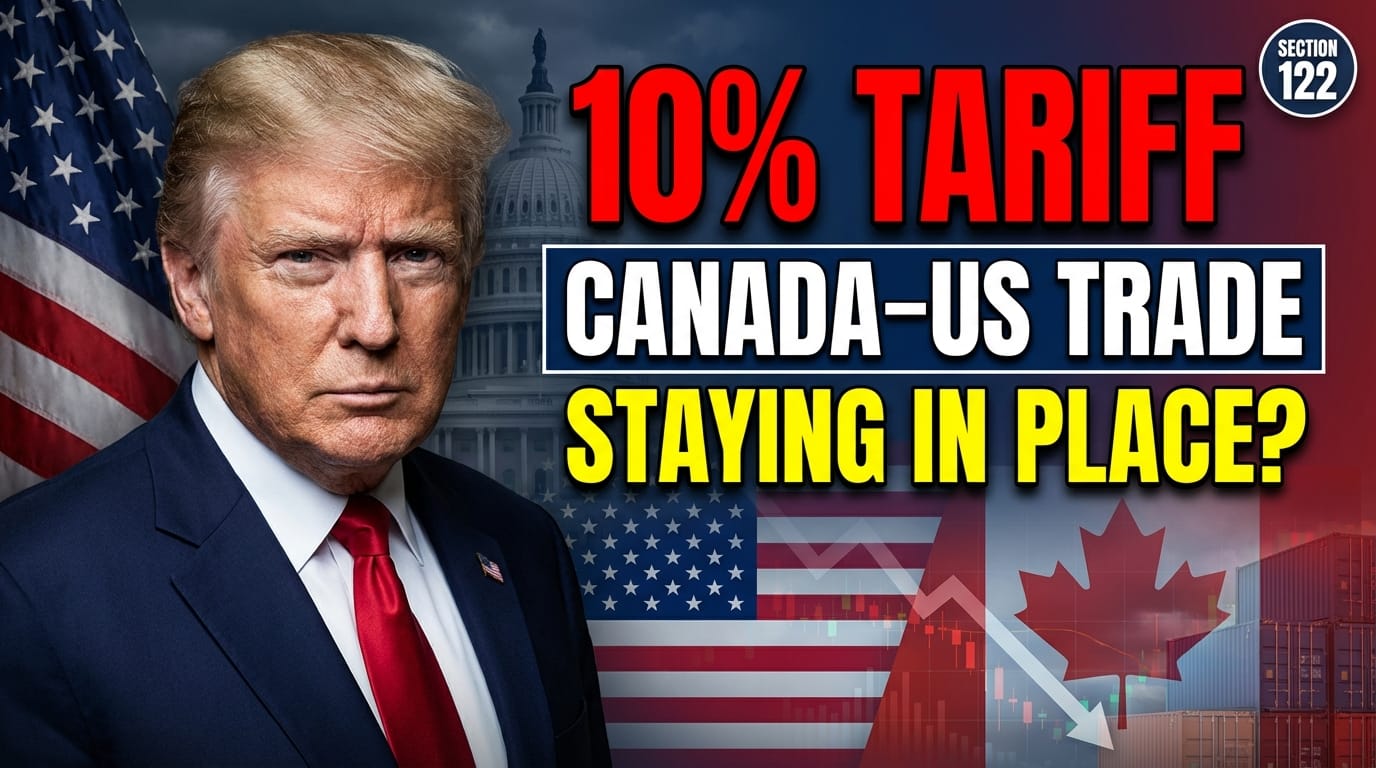
Canada’s finance minister has indicated that US tariffs are unlikely to be lifted in the near term, suggesting that a baseline tariff may become a standing condition for access to the American market. The comments reflect a broader shift in US trade policy and signal that Ottawa is preparing for a prolonged period of structured trade costs rather than temporary restrictions.
The remarks followed President Donald Trump’s State of the Union address, in which he reiterated his support for tariffs as a long-term revenue mechanism. The president stated that tariffs could eventually play a larger role in federal funding, potentially reducing reliance on income taxes. While such a structural change would require congressional action, the administration’s policy direction appears consistent.
Policy
The most recent development came after the US Supreme Court ruled 6-3 that a previous sweeping tariff policy exceeded presidential authority. In response, President Trump invoked Section 122 of the Trade Act of 1974, a rarely used provision that allows the president to impose tariffs of up to 15% for 150 days without prior congressional approval.
Under this authority, a 10% global tariff was introduced and took effect earlier this week. Congress must determine within 150 days whether to extend, revise, or terminate the measure.
A summary of the current tariff framework is outlined below:
| Tariff Category | Rate | Status |
|---|---|---|
| Global baseline tariff | 10% | Active under Section 122 |
| Maximum under Section 122 | 15% | Limited to 150 days |
| Steel and aluminium | Higher | Sector-specific measures |
| Softwood lumber | Elevated | Ongoing trade dispute |
While the new global tariff applies broadly, certain sector-specific tariffs remain in place, particularly affecting steel, aluminium, and softwood lumber exports.
Exposure
Canada remains highly dependent on the United States as an export market. Approximately 75% of Canadian exports are destined for the US, making trade policy shifts in Washington particularly significant for Canadian industries.
| Export Destination | Share of Canadian Exports |
|---|---|
| United States | 75% |
| Other Countries | 25% |
Although the United States-Mexico-Canada Agreement provides exemptions for goods that comply with its terms, not all products qualify. As a result, some Canadian industries continue to face elevated tariffs.
Finance Minister François-Philippe Champagne stated that the US administration views market access as carrying a cost. He noted that while multiple countries are subject to tariffs, Canada is currently facing comparatively lower rates than others.
Negotiations
US Trade Representative Jamieson Greer has stated that some level of higher tariff may need to be accepted as part of broader trade negotiations. He indicated that discussions could include increased US access to Canadian markets in sectors such as dairy and agriculture.
This suggests that tariffs are being used not only as a revenue instrument but also as leverage in trade discussions. Both governments appear to be positioning their policies within a framework of reciprocal concessions.
For Canada, the objective is to maintain competitiveness in key export sectors while managing additional costs. For the United States, the administration has emphasized domestic economic priorities and market access concerns.
Diversification
In response to ongoing trade uncertainty, Prime Minister Mark Carney has announced a long-term goal of doubling Canada’s non-US exports within the next decade. The strategy focuses on expanding trade relationships in industries such as metals and automotive manufacturing.
Diversification is viewed as a risk management approach. Reducing reliance on a single export market could help mitigate future policy shifts or trade disputes. However, expanding into new markets requires infrastructure development, regulatory coordination, and sustained diplomatic engagement.
While progress may take time, policymakers have indicated that broadening Canada’s export base is a strategic priority.
Outlook
Based on recent statements from both Washington and Ottawa, there is limited expectation that tariffs will be fully removed in the short term. Instead, policymakers appear to be adjusting to a framework in which certain baseline tariffs may remain part of the trading environment.
The temporary nature of Section 122 authority means that congressional action will be required in the coming months. This could introduce additional debate regarding the long-term direction of US trade policy.
For Canadian exporters, the current environment underscores the importance of cost management and market diversification. For US policymakers, the discussion centers on balancing revenue objectives with trade relationships and domestic economic considerations.
As both countries continue discussions, the trajectory of North American trade will likely depend on legislative decisions in the United States and Canada’s ability to expand trade partnerships beyond its largest customer.
FAQs
Why did the US impose a 10% tariff?
To adjust trade policy and raise revenue.
What is Section 122?
A law allowing temporary tariffs up to 15%.
How much does Canada export to the US?
Around 75% of its total exports.
Are all Canadian goods affected?
No, USMCA-compliant goods may be exempt.