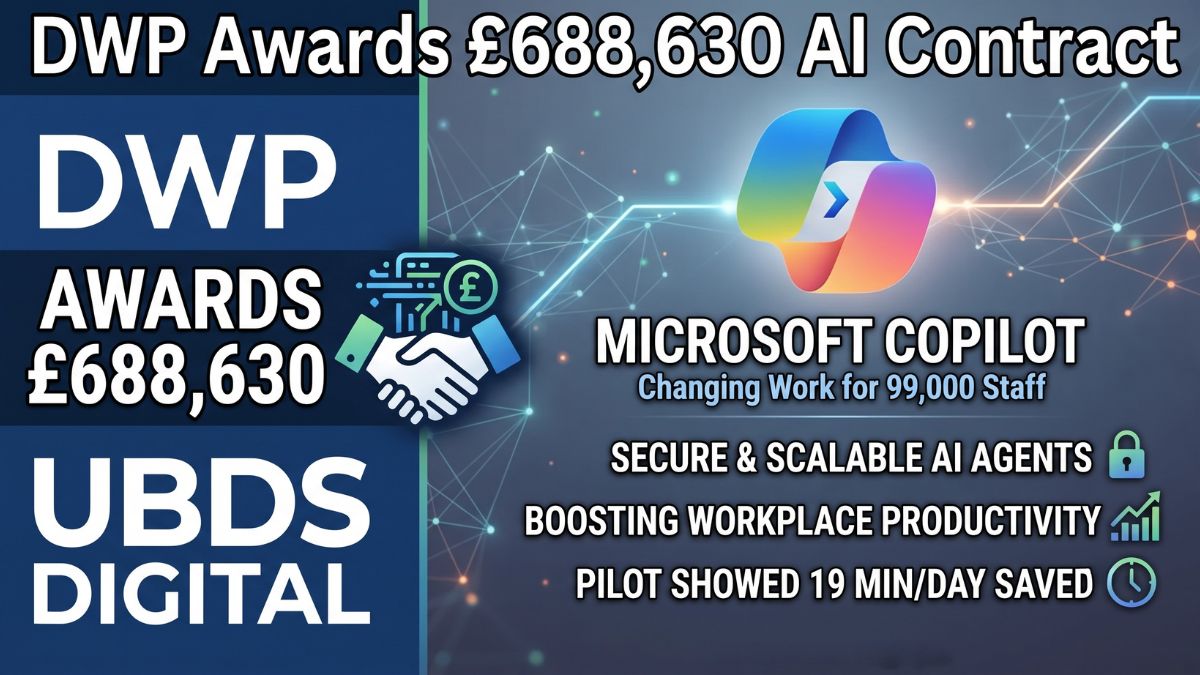
The UK Department for Work and Pensions (DWP) has awarded a £688,630 contract to technology consultancy UBDS Digital to support the department’s expanding use of artificial intelligence. The one-year agreement is intended to help establish a secure, consistent, and scalable approach to AI agents and other digital workplace tools, including Microsoft’s Copilot technology.
The contract reflects the government’s continued interest in using AI to improve workplace productivity while maintaining appropriate security standards. With approximately 99,000 staff relying on the DWP’s digital workplace services, the department faces the challenge of introducing new technology in a way that supports employees without compromising sensitive information or established processes.
The agreement also marks another stage in the department’s changing approach to generative AI. After initially restricting access to public AI chatbots on government-issued devices, the DWP has since explored Microsoft-based tools and revised its rules for using several large language models.
Contract
The DWP’s Digital Workplace team entered into a one-year agreement with London-based technology consultancy UBDS Digital on August 31, according to the commercial notice described in the announcement.
The contract is valued at £688,630 and covers specialist support for Copilot agents and other digital workplace AI solutions. Its stated purpose is to help the department develop its AI capabilities and establish a consistent framework for delivering AI agents across the organisation.
Rather than representing a straightforward purchase of an individual software product, the agreement focuses on specialist services to support implementation and development. This may include helping the department determine how AI tools should be introduced, managed, and supported within its existing technology environment.
The published contract description does not, by itself, establish that every DWP employee will receive access to AI agents or that the department will deploy a particular system across all its services. The specific scope and results will depend on the work delivered under the agreement.
Objectives
The central objective is to create a scalable, secure, and consistent approach to AI agents. These systems can perform defined tasks, retrieve information, and assist users with workflows, depending on their configuration and the permissions they receive.
For a large government department, introducing AI across different teams can create operational challenges. Employees may use different applications, handle different types of information, and follow separate procedures. Without common standards, the department could face inconsistent practices, duplicated effort, and difficulties maintaining oversight.
A coordinated approach can help establish common rules for access, deployment, monitoring, and support. It can also make it easier to assess whether individual AI applications are useful and appropriate for official work.
Security is particularly important because the DWP manages information relating to benefits, employment support, pensions, and other public services. AI tools used in this environment must be introduced with appropriate controls over data access, information handling, and employee permissions.
The contract’s stated aims provide a framework for this work, although they do not independently confirm which technical safeguards will be implemented or what measurable outcomes the department expects to achieve.
Copilot
Microsoft Copilot is an important part of the DWP’s broader digital workplace plans. The technology can assist with tasks such as summarising documents, drafting communications, organising information, and supporting work within compatible Microsoft applications.
The department previously conducted an initial six-month Copilot pilot. In February 2026, the DWP reported that participating staff saved an average of 19 minutes per day during the trial. The department also reported that 73% of workers experienced improvements in the quality of their outputs, while 65% said they felt more fulfilled at work.
These results suggest that employees perceived benefits from using the technology during the pilot. However, the figures should be understood in the context of the trial and the department’s own reporting. They do not establish that every employee will achieve the same time savings or that the same results will continue after wider implementation.
The potential productivity benefits depend on the task being performed, the quality of the information supplied to the system, and how employees review its output. Copilot may reduce the time needed to prepare a first draft or locate information, but staff may still need to verify accuracy, correct mistakes, and ensure that the final work meets departmental requirements.
The new contract could help the DWP build on its experience with these tools, although the commercial notice alone does not specify how much additional time the department expects to save.
Background
The DWP’s current approach follows a period of tighter restrictions on public generative AI tools.
In February 2024, PublicTechnology reported that the department had prohibited officials from using services such as ChatGPT on their work devices. At the time, the department indicated that it was exploring potential internal AI applications, including tools based on Microsoft Copilot.
This approach reflected concerns common to public-sector organisations adopting generative AI. Public chatbots can introduce questions about confidential information, data protection, accuracy, and the appropriate use of government resources.
An internally managed or enterprise-configured environment may offer different administrative controls, but it does not eliminate every risk. Departments still need clear policies covering sensitive information, access permissions, human oversight, and the reliability of AI-generated content.
The DWP’s subsequent Copilot pilot provided an opportunity to assess how workplace AI could be used in a more controlled setting. The reported productivity findings helped establish the department’s case for further exploration, while the later policy changes indicated a more differentiated approach to AI access.
Policy
The department subsequently reversed its broader prohibition on civil servants using several widely available large language models, including ChatGPT, according to reporting by PublicTechnology in May 2025.
DeepSeek, a China-based AI service, remained excluded from official use under the policy described in that report. The restrictions covered use for official business and access through government-issued machines.
This distinction illustrates how AI policies can evolve beyond a simple decision to allow or prohibit all public tools. Different systems can raise different questions about data handling, organisational security, and the terms under which they are accessed.
However, permission to use a particular chatbot does not necessarily mean employees can enter any type of government information into it. Staff must follow applicable departmental policies and security requirements, regardless of whether a tool is approved for some official uses.
The new UBDS Digital contract is consistent with the department’s broader effort to establish a structured approach to workplace AI. It does not, on its own, indicate that existing restrictions have been removed or that every AI product will be approved for government work.
Governance
AI agents can offer more than conventional chatbots because they may be configured to perform sequences of actions within defined workflows. Depending on the system, an agent might help locate documents, prepare a summary, organise information, or assist with routine administrative tasks.
These capabilities can also introduce additional risks. A system with access to internal applications may expose information to users who should not receive it if permissions are configured incorrectly. An agent that takes actions rather than simply generating text may also require more careful testing and monitoring.
For a department of the DWP’s size, consistent governance can help clarify which tools employees may use, what information they can access, and when human approval is required.
A well-managed deployment would normally consider access controls, audit records, testing, staff training, and procedures for handling errors. It would also distinguish between tasks suitable for automation and decisions that require professional judgement or formal administrative review.
The commercial notice identifies security and consistency as objectives, but further information would be needed to assess the detailed governance arrangements or determine how individual AI agents will be authorised.



Outlook
The £688,630 agreement with UBDS Digital represents a further investment in the DWP’s digital workplace capabilities. Its focus is on specialist support for Copilot agents and other AI solutions, with the stated goal of developing a secure and consistent approach that can expand across the organisation.
The department’s previous pilot suggests that employees may benefit from AI assistance with routine workplace tasks. However, the long-term value of these systems will depend on their implementation, the reliability of their outputs, the quality of staff training, and the safeguards used to protect government information.
The contract should therefore be viewed as part of an ongoing process rather than evidence that AI has already been deployed uniformly across the department. As the work progresses, the key questions will be how the technology is used, what measurable improvements it delivers, and how effectively the DWP maintains oversight of its expanding AI capabilities.