Millions of older Americans rely on Social Security as an important source of retirement income. For some households, those monthly payments cover most of the cost of housing, food, health care and other necessities.
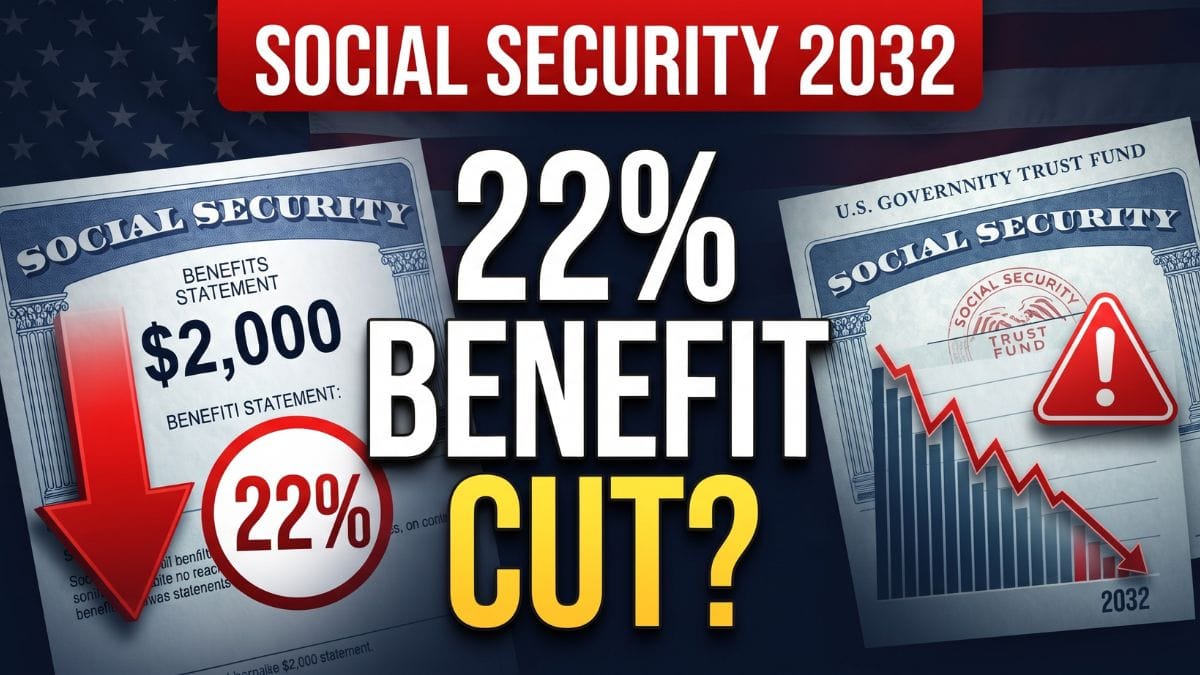
That makes the program’s long-term finances an important issue for current and future beneficiaries. According to the latest Social Security Trustees projections, the retirement trust fund faces depletion in 2032 if no legislative changes are made. At that point, incoming revenue would still support a substantial share of scheduled benefits, but the program would not have enough money to pay the full amounts currently promised under law.
The often-cited figure is a benefit reduction of roughly 22% if the trust fund is depleted and Congress does not change the law. However, that figure is a projection, not a scheduled cut that has already been approved.
Shortfall
Social Security is primarily financed through payroll taxes paid by workers and employers. Employees generally contribute 6.2% of covered wages, with employers paying another 6.2%.
The system also uses trust fund reserves to help cover benefits when payroll tax revenue is not enough to meet scheduled payments.
The underlying challenge is demographic. Americans are living longer, while birth rates have declined. That changes the relationship between the number of workers paying Social Security taxes and the number of people receiving benefits.
As the population ages, fewer workers are supporting a larger beneficiary population. This does not mean Social Security suddenly runs out of all revenue when the trust fund is depleted. Payroll taxes would continue to flow into the program.
The concern is that those taxes would not be enough to cover the full scheduled benefit amounts.
The Social Security Administration provides detailed information about the program’s financing and long-term solvency.
22% Cut
The projected reduction is often described as a 22% Social Security benefit cut. That wording can be misleading if it suggests Congress has already approved a 22% reduction.
The projected reduction would result from the difference between scheduled benefits and the amount that could be paid using continuing program income after trust fund reserves are exhausted.
In other words, if the law remains unchanged and the trust fund reaches depletion as projected, Social Security would face a financing gap.
For a retiree receiving $2,000 per month, a hypothetical 22% reduction would equal $440, leaving $1,560 per month. For someone receiving $2,500, the same reduction would equal $550, leaving $1,950.
| Current monthly benefit | 22% reduction | Hypothetical remaining benefit |
|---|---|---|
| $1,500 | $330 | $1,170 |
| $2,000 | $440 | $1,560 |
| $2,500 | $550 | $1,950 |
| $3,000 | $660 | $2,340 |
These figures are illustrations rather than forecasts of what any particular retiree will receive.
The actual outcome would depend on future legislation, economic conditions, payroll tax revenue and the financial condition of the trust funds at the time.
Demographics
The financial pressure on Social Security is closely connected to demographic changes.
When the program was created, there were substantially more workers relative to beneficiaries. Over time, lower birth rates and longer life expectancy have changed that balance.
A worker paying payroll taxes today is not generally putting that money into a personal account reserved for their own retirement. Instead, current payroll tax revenue helps finance benefits for current beneficiaries, while trust fund reserves provide additional financing.
This structure makes the worker-to-beneficiary ratio important.
If the number of workers grows more slowly than the number of beneficiaries, the system faces greater pressure unless tax revenue, benefit formulas or other aspects of the program change.
The Social Security Trustees’ latest report provides the government’s projections for the program’s finances, including trust fund depletion estimates and projected income and expenditures.
Payroll Tax
One potential solution would involve increasing revenue.
The combined Social Security payroll tax rate for employees and employers is currently 12.4%, with each side generally paying 6.2% on covered wages up to the annual taxable maximum.
Increasing the tax rate would provide additional revenue, although it would also increase payroll costs for workers and employers.
Another approach would be to change the amount of earnings subject to Social Security taxation.
For 2026, the Social Security taxable maximum is $184,500. Earnings above that amount are generally not subject to the 6.2% Social Security payroll tax.
Congress could change the taxable maximum, potentially subjecting more high-income earnings to Social Security taxes. Policymakers have also discussed proposals that would modify or eliminate the wage cap, although different approaches would have different effects on program finances and future benefits.
The Social Security Administration’s contribution and benefit base information tracks the taxable maximum and related figures.
Retirement Age
Another possible policy change would involve Social Security’s full retirement age, or FRA.
For people born in 1960 or later, the full retirement age is currently 67. Claiming benefits before FRA generally results in a permanent reduction in the monthly benefit, while delaying benefits beyond FRA can increase monthly payments up to age 70.
Raising the full retirement age could reduce long-term program costs because beneficiaries would need to wait longer to receive their full scheduled benefit. It could also encourage some people to remain in the workforce longer, potentially generating additional payroll tax revenue.
However, such a change would affect workers differently depending on their health, occupation, income and ability to continue working.
That is why changes to the retirement age can have significant consequences for people approaching retirement, particularly those in physically demanding jobs.
Congress
The projected trust fund depletion date does not mean beneficiaries should expect their Social Security checks to stop in 2032.
Even after trust fund reserves are exhausted, workers and employers would continue paying Social Security payroll taxes. Those incoming taxes could be used to pay benefits, but under current projections they would not be sufficient to cover all scheduled benefits.
Congress therefore has several potential policy options. These could include increasing payroll taxes, raising the taxable maximum, changing benefit formulas, adjusting the retirement age, modifying benefits for certain groups or combining several measures.
The earlier lawmakers act, the more options they generally have to spread changes over time. Waiting can reduce the time available to phase in tax increases or benefit changes.



Planning
For households that rely heavily on Social Security, the projected funding gap is a reason to review retirement plans rather than assume a specific benefit cut will occur.
Workers can consider building additional savings, reducing high-interest debt and reviewing expected retirement expenses. Those still working may also have an opportunity to increase retirement contributions or develop another source of income.
People approaching retirement should be cautious about making decisions based solely on a projected 22% reduction. The figure represents a potential shortfall under current law and current projections, not a guaranteed reduction in every beneficiary’s check.
Social Security remains an important source of income for millions of Americans, and its long-term financing will ultimately depend on decisions made by Congress. Until those decisions are made, the most practical approach for households is to understand the projections, monitor legislative changes and build as much financial flexibility as possible.