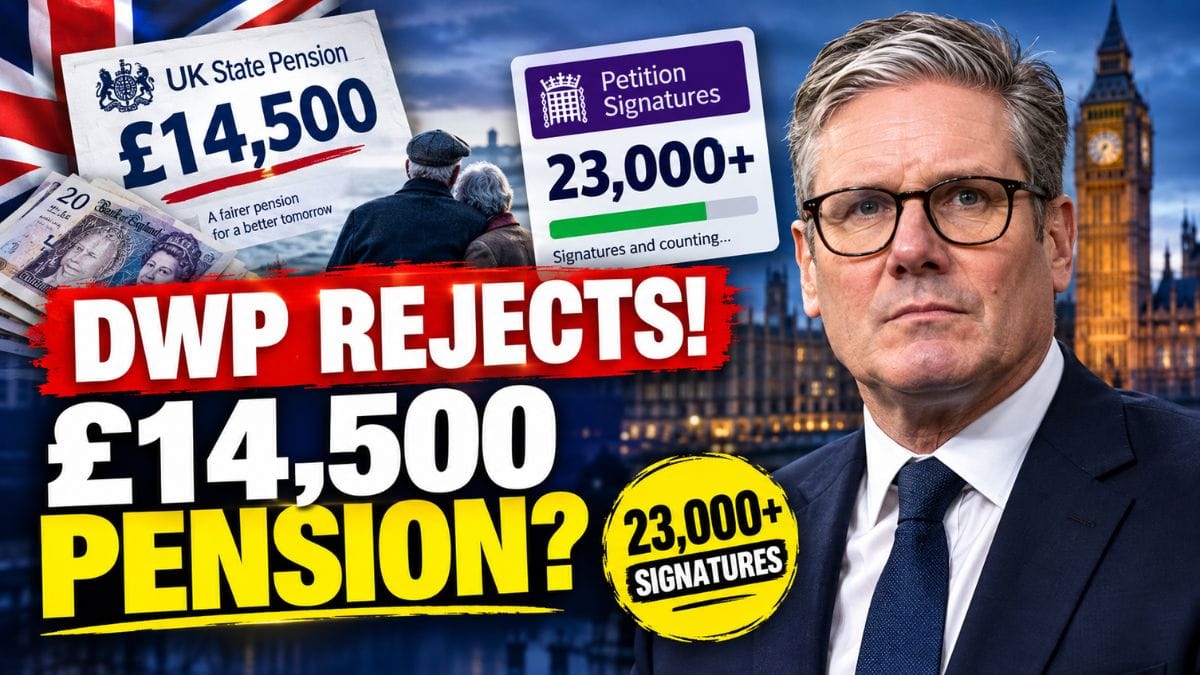
A campaign calling for the UK State Pension to be increased to at least £14,500 a year has passed 23,000 signatures, but the Department for Work and Pensions (DWP) has rejected the proposal to link the State Pension directly to the National Minimum Wage.
The petition, created by Richard Sobey MBE, had attracted 23,355 signatures and remains open until January 28, 2027. If it reaches 100,000 signatures, it will be considered for debate in Parliament.
The campaign argues that people who have spent decades paying National Insurance should receive at least an income comparable with the minimum wage available to younger workers.
The Government, however, says the State Pension and National Minimum Wage serve different purposes and should not be directly compared.
Petition
The petition calls for the minimum State Pension to be increased to £14,500 a year.
Its creator argues that the current full new State Pension does not provide the same level of annual income as some statutory minimum wage rates.
The petition states that the full new State Pension is around £12,564 a year, although the official 2026/27 weekly rate is £241.30. At 52 weekly payments, that amounts to £12,547.60.
The campaign says the difference is significant for pensioners who rely heavily on their State Pension as their main source of income.
Sobey has argued that a minimum retirement income of £14,500 would provide what he considers a more appropriate standard of living for people aged 65 and over.
However, the petition’s comparison with wages does not represent the Government’s method for determining State Pension rates.
Rates
The full new State Pension for 2026/27 is £241.30 a week.
That is an increase from £230.25 a week in 2025/26. The increase was made under the State Pension triple lock.
The triple lock means the basic State Pension and new State Pension are increased each year by whichever is highest of:
- Average earnings growth
- Consumer price inflation
- 2.5%
The policy is intended to provide an annual increase in State Pension payments while maintaining the link with earnings and inflation.
The actual amount an individual receives can be lower than the full new State Pension. Payments depend on a person’s National Insurance record and other eligibility factors.
The Government’s official State Pension guidance provides information about eligibility, payments and qualifying years.
Minimum
The petition also compares the State Pension with statutory minimum wage rates.
From April 2026, the National Minimum Wage rates cited in the campaign are:
| Age group | Hourly rate | Annual amount at 35 hours |
|---|---|---|
| 16 to 17 | £8.00 | £14,560 |
| 18 to 20 | £10.85 | £19,747 |
| 21 and over | £12.71 | £23,132 |
The annual figures assume 35 hours of work each week for 52 weeks.
These figures illustrate the basis of the campaign’s argument, but the Government does not use minimum wage rates to calculate the State Pension.
The National Minimum Wage is a statutory wage floor for employees. The State Pension is a contributory social security benefit intended to provide a foundation for retirement income.
That distinction is central to the Government’s response.
Response
The Government has rejected the proposal to make the full State Pension equal to the minimum wage for workers under 18.
In its response to the petition, the Government said the State Pension and National Minimum Wage have different purposes and that a direct comparison cannot be drawn.
It also highlighted the increase in the full new State Pension to £241.30 a week and reaffirmed its commitment to the triple lock.
Under the Government’s approach, the State Pension is intended to provide a foundation for retirement income, alongside workplace pensions, private pensions and other sources of income.
The Government has also pointed to additional support that may be available to pensioners depending on their circumstances.
Support
Pension Credit is one of the main forms of additional financial support available to pensioners on lower incomes.
For 2026/27, the standard minimum guarantee is £227.10 a week for a single person and £346.60 a week for a couple, before additional amounts that may apply.
Pension Credit is separate from the State Pension. A person can receive the State Pension and still qualify for Pension Credit if their circumstances and income meet the relevant conditions.
Other support mentioned by the Government includes Winter Fuel Payments, the Warm Home Discount and Housing Benefit, although eligibility varies between schemes.
People who think they may qualify for Pension Credit can check the official GOV.UK Pension Credit service.



Petition
The petition remains open until January 28, 2027.
With 23,355 signatures reported, it would need almost 77,000 additional signatures to reach the 100,000-signature threshold for consideration for debate in Parliament.
Reaching 100,000 signatures does not automatically mean a debate will take place. Petitions that reach the threshold are considered for debate by the Petitions Committee, which decides whether a debate should be scheduled.
The petition can be viewed and signed through the official UK Parliament petitions website.
The Government has also referred to the Pensions Commission, which is considering longer-term questions about how the UK’s pensions system should operate in the future.
For now, the Government’s position remains that the State Pension should not be directly linked to the National Minimum Wage. The petition campaign continues to argue for a £14,500 minimum annual State Pension, while the existing system continues to use the triple lock to determine annual increases.
The difference between the two positions largely comes down to how retirement income and minimum employment income are defined. The State Pension is part of the wider social security and retirement system, while the National Minimum Wage is a legal minimum for employees. That distinction is the basis for the Government’s rejection of the proposed £14,500 link.