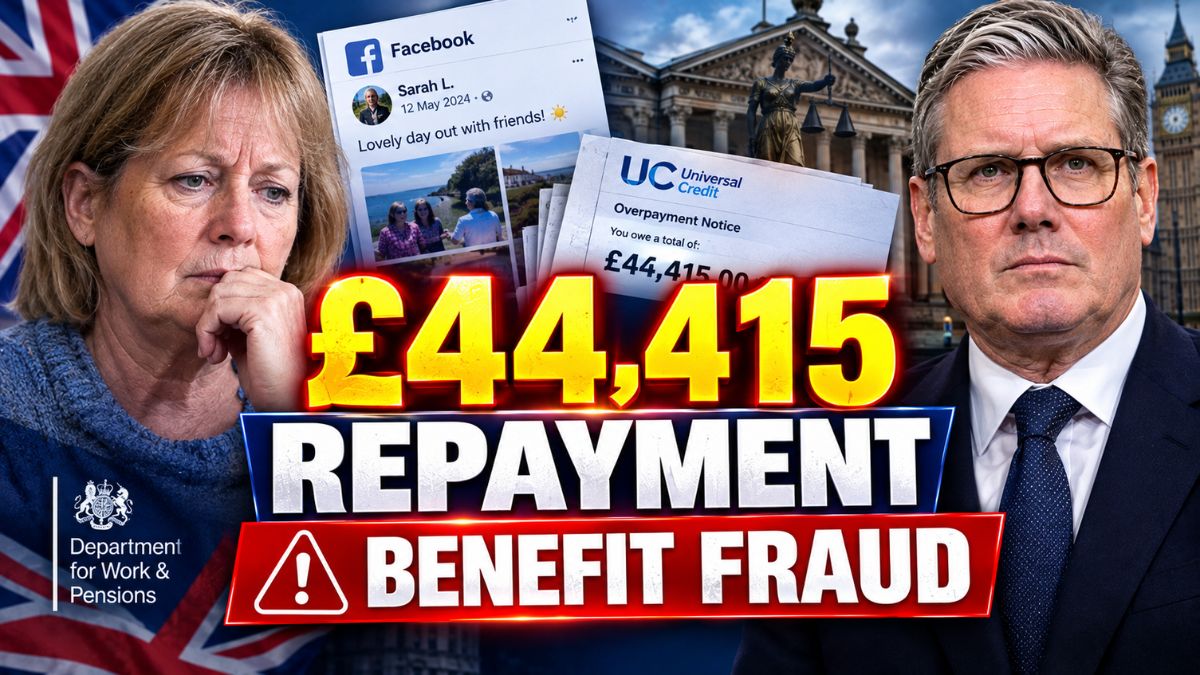
A woman who received more than £44,000 in benefits after claiming Universal Credit as a single person has been given a suspended prison sentence after investigators found evidence that she had been living with a partner.
Judith Blackmore, 64, of Main Street, Etton, near Beverley, admitted two fraud offences involving the failure to disclose information to the authorities. The case was heard at Hull Crown Court.
Court proceedings heard that Blackmore received £40,023 in Universal Credit and a further £4,392 through a council tax reduction, resulting in a total overpayment of £44,415.
The case centred on information she provided about her relationship and household circumstances while receiving support.
Claim
Blackmore made an online Universal Credit claim in October 2018.
According to the prosecution, she declared that she was single, lived with another tenant and had no money or savings. She also said she was caring for a relative.
People receiving Universal Credit are required to report relevant changes in their circumstances, including changes concerning a partner or household arrangements.
The prosecution said Blackmore had signed a declaration confirming that the information supplied was complete and correct and that changes would be reported promptly.
She subsequently reported a change of address and housing costs in July 2019. She continued to describe the man she lived with as another tenant.
The authorities later investigated the circumstances surrounding the claim.
Payments
An examination of bank statements belonging to Blackmore and the man she described as a co-tenant found evidence of substantial financial transfers between their accounts.
The court heard that approximately £96,000 was transferred from the man’s accounts to Blackmore’s accounts, while around £73,000 moved in the other direction.
The prosecution described the financial activity as evidence of financial interdependency rather than a straightforward arrangement between unrelated joint tenants.
The investigation also extended to publicly available social media information.
Facebook posts became an important part of the evidence presented to the court.
Investigators found that Blackmore’s Facebook profile showed her as having been in a relationship with the man since 2013.
The court heard that photographs on the profile included images from a wedding reception and honeymoon.
A marriage certificate was subsequently obtained. It showed that Blackmore and the man had married on May 3, 2024.
The prosecution said Blackmore had not informed the DWP that she was living with a partner while claiming Universal Credit.
The social media evidence was considered alongside the financial records and other information gathered during the investigation.
Council
The case also involved a council tax reduction.
Blackmore received a reduction on the basis that she was a single occupant and had no other income or capital.
The court heard that when Blackmore and the man took on their tenancy, they presented themselves to the landlord as a couple rather than as separate individuals.
Companies House records also showed that the man was a director of a horsebox-related company owned by Blackmore.
Following a reassessment of her council tax entitlement, the council calculated that £4,392 had been underpaid.
The council tax element was therefore separate from the Universal Credit overpayment.
Interview
During an interview with investigators, Blackmore accepted that the information she had not disclosed would have affected her benefit entitlement.
The prosecution said she eventually accepted that she should have declared having a partner when she made her Universal Credit claim in 2018.
However, she disputed the nature and continuity of the relationship during parts of the period in question.
She said that although the pair had lived together since 2011, they were not always a couple and described the relationship as not being a “proper” relationship.
The prosecution also told the court that Blackmore said she had not mentioned her marriage earlier because she had not been asked about it.
She had no previous convictions.
Business
The defence provided the court with information about Blackmore’s personal and financial circumstances.
Her barrister, Julia Baggs, said Blackmore had pleaded guilty at the first available opportunity and was very sorry for what she had done.
The court heard that Blackmore had been caring for her mother and had also been attempting to establish a business refurbishing horseboxes.
That business had left her with significant debts, the defence said.
Baggs told the court that Blackmore had allowed the situation to escalate and now felt a deep sense of shame about her actions.
She was described as someone who had generally worked with animals, including horses and dogs.
Blackmore was already repaying the money she had obtained through the fraud at a rate of £300 a month. Her barrister said she intended to increase the payments when she was able to do so.
Sentence
Recorder Richard Wright KC described the conduct as persistent dishonesty over a considerable period.
He said there had been multiple opportunities for Blackmore to stop the conduct and that she had continued to obtain money to which she was not entitled.
The judge also acknowledged that Blackmore was ashamed and remorseful.
Blackmore was sentenced to a 16-month prison sentence, suspended, and ordered to complete 120 hours of unpaid work.
Because the sentence was suspended, she was not immediately sent to prison. However, the court warned her that committing another offence could result in the prison sentence being activated.
Recorder Wright told her that if she committed further offences, she could face serving the 16-month sentence.



Lessons
The case highlights why people receiving means-tested benefits must provide accurate information about changes in their circumstances.
Universal Credit entitlement can depend on household circumstances, income, savings and whether someone is considered to be living with a partner. Council tax reductions can also depend on household circumstances and other factors.
The precise rules vary according to the benefit and individual circumstances. A person should therefore report relevant changes rather than assume that a particular living arrangement will have no effect on entitlement.
In Blackmore’s case, the court considered evidence from bank accounts, social media, tenancy arrangements, company records and the marriage certificate. Together, that evidence formed part of the prosecution case concerning the information that had not been disclosed.
The case ended with a suspended prison sentence, unpaid work and continued repayment of the money involved. It also demonstrates that benefit investigations can examine information from several sources when authorities assess whether a claimant’s reported circumstances accurately reflect their situation.