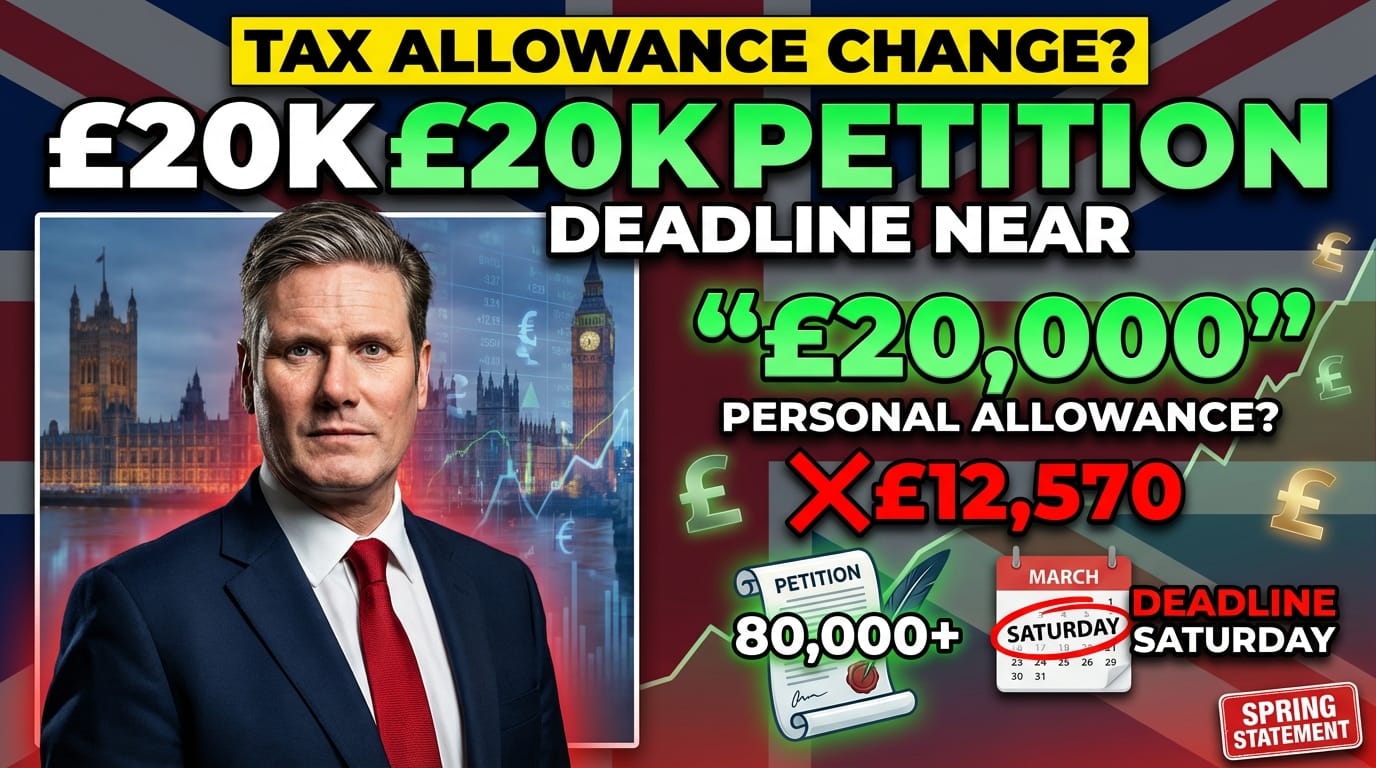
A petition calling for the UK income tax personal allowance to be raised from £12,570 to £20,000 is approaching its closing date, with campaigners urging supporters to act before Saturday’s deadline. The campaign has gathered more than 80,000 signatures, triggering a requirement for a formal Treasury response. If it reaches 100,000 signatures, it could be considered for parliamentary debate.
The issue has resurfaced ahead of the Spring Statement on March 3, placing renewed attention on Chancellor Rachel Reeves and the government’s fiscal strategy.
Background
The personal allowance, the amount individuals can earn before paying income tax, has been frozen at £12,570 since April 2021. During that time, inflation has increased and wages have risen in response. As a result, more workers have been drawn into the tax system, a process often described as fiscal drag.
Under fiscal drag, taxpayers move into higher tax brackets or become liable for tax because thresholds remain fixed while earnings rise. Although nominal wages increase, the tax-free threshold does not adjust, leading to higher effective tax burdens.
At present:
| Tax Band | Threshold | Rate |
|---|---|---|
| Personal allowance | Up to £12,570 | 0% |
| Basic rate | £12,571 to £50,270 | 20% |
| Higher rate | Over £50,270 | 40% |
Both the personal allowance and the higher rate threshold have remained unchanged since 2021.
Petition
The latest petition, launched by Shannon Keene, calls for the allowance to be increased to £20,000. Supporters argue that the change would help households cope with rising housing costs, council tax, and energy bills. Some campaigners also suggest it could improve work incentives, particularly for lower-income families facing high childcare expenses.
The petition has passed 80,000 signatures. If it reaches 100,000 before closing on February 28, it may be considered for debate in Parliament. Earlier this year, a similar petition attracted more than 281,000 signatures and led to a Westminster Hall debate.
Campaigners view the strong public response as evidence of widespread concern over living costs and tax pressures.
Fiscal Impact
The Treasury has estimated that raising the personal allowance to £20,000 would cost more than £50 billion annually. That figure has been cited as a significant constraint on policy options.
James Murray, Exchequer Secretary to the Treasury, acknowledged public concern but emphasized fiscal responsibility. He noted that while the government aims to keep taxes as low as possible for working people and pensioners, large unfunded tax reductions could destabilize public finances.
For context, the estimated £50 billion annual cost exceeds the £45 billion in unfunded tax cuts announced in the 2022 mini-Budget, which contributed to market instability at the time.
| Proposal | Estimated Annual Cost |
|---|---|
| Raise allowance to £20,000 | Over £50 billion |
The scale of the potential revenue loss explains the government’s caution.
Economic Context
The debate occurs against a backdrop of continued cost-of-living pressures. Although inflation has eased from its peak, many households continue to face elevated food, housing, and utility costs.
Freezing tax thresholds during periods of inflation increases government revenue without raising headline tax rates. According to independent fiscal analysts, fiscal drag has significantly boosted tax receipts in recent years.
However, critics argue that the burden falls disproportionately on lower and middle-income earners, particularly those who previously earned below the personal allowance but are now drawn into taxation due to wage adjustments.
Political Debate
During a recent Westminster Hall debate, Liberal Democrat MP Daisy Cooper described the petition as reflecting widespread public concern. She characterized the level of support as indicative of the pressures facing households nationwide.
The government, meanwhile, maintains that fiscal discipline remains a priority. Officials argue that reducing revenue on the scale proposed would require either spending cuts, borrowing increases, or alternative tax rises.
The Spring Statement on March 3 may provide further clarity on the government’s approach to income tax thresholds and broader fiscal policy.
Outlook
Whether the petition reaches 100,000 signatures before Saturday will determine if the issue returns to parliamentary debate. However, even if debated, the substantial estimated cost presents a significant policy hurdle.
The discussion highlights a broader challenge for policymakers: balancing household cost pressures with the need to maintain sustainable public finances. As fiscal drag continues to affect more taxpayers, the personal allowance debate is likely to remain part of the wider conversation on tax reform.