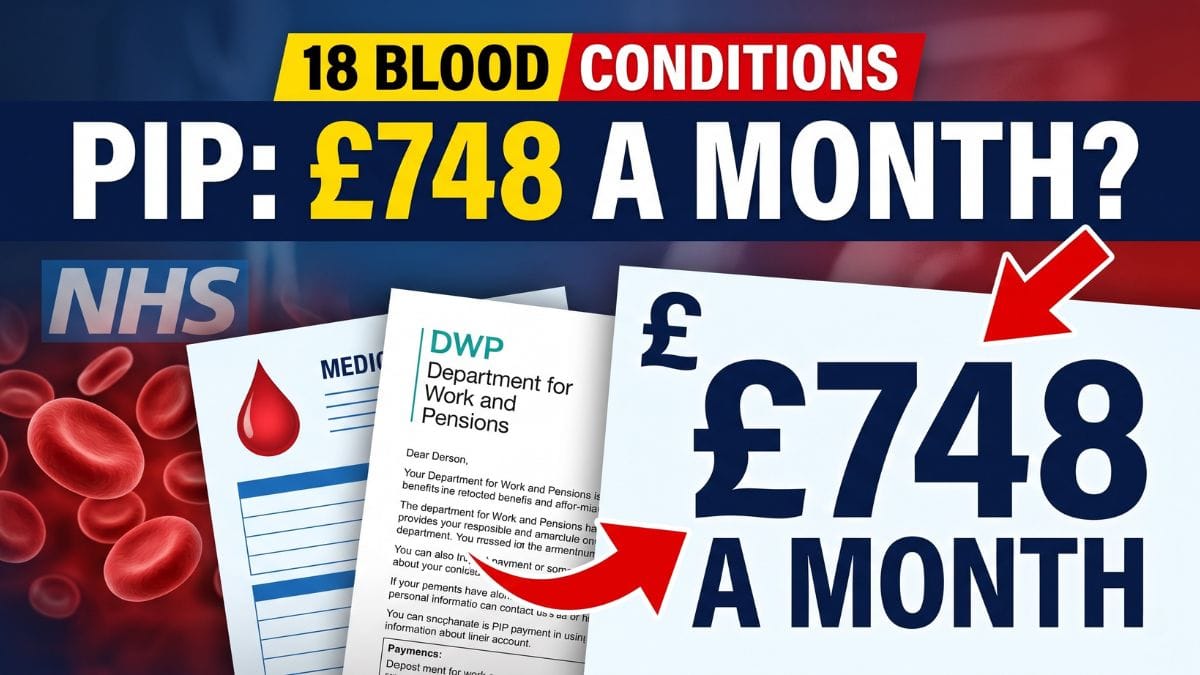
People living with certain blood conditions may be able to claim Personal Independence Payment (PIP) if their condition causes significant difficulties with everyday activities or mobility.
The Department for Work and Pensions (DWP) records thousands of successful PIP claims associated with blood disorders. However, having a particular diagnosis does not automatically qualify someone for PIP. The assessment focuses on how a health condition affects a person’s ability to carry out specific daily tasks and move around.
PIP rates increased by 3.8% in April 2026. At the current rates, a person who qualifies for both the enhanced daily living and enhanced mobility components can receive up to £187 a week. That works out to about £748 over a four-week period.
Conditions
The DWP recognises a range of blood conditions in its statistics on PIP claims. The available figures show 18 blood-condition categories associated with successful claims.
| Blood condition | Successful PIP claims |
|---|---|
| Anaemia – iron deficiency | 300 |
| Anaemias – other / type not known | 831 |
| Anaemia – sickle cell | 2,618 |
| Haemolytic disorders – other / type not known | 314 |
| Hereditary spherocytosis | 39 |
| Thalassaemia | 366 |
| Glucose 6 phosphate dehydrogenase (G6PD) deficiency | 18 |
| Metabolic red cell disorders – other / type not known | 85 |
| Polycythaemia | 397 |
| Clotting disorders – other / type not known | 766 |
| Haemophilia A | 787 |
| Haemophilia B (Christmas disease) | 107 |
| Von Willebrand’s disease | 134 |
| Autoimmune (idiopathic) thrombocytopaenic purpura (ITP) | 480 |
| Platelet disorders – other / type not known | 161 |
| Blood disorders – type not known | 1,763 |
The figures supplied for these categories total 9,166 claims. This is lower than the reported figure of 9,729, which indicates that the broader DWP dataset may contain additional categories or classifications not included in the list above.
Eligibility
PIP is not awarded simply because someone has a condition appearing in DWP statistics.
Instead, the assessment considers how the person’s physical or mental health condition affects their ability to perform daily living activities and mobility tasks. The difficulties generally need to have lasted, or be expected to last, for at least 12 months.
This distinction is important. Two people with the same blood disorder could receive different outcomes if their symptoms affect their daily lives in different ways.
For example, a blood condition may cause fatigue, pain, weakness or other limitations that make preparing food, washing, dressing, communicating or managing medication more difficult. In other cases, complications could affect a person’s ability to plan or follow journeys or move around.
The focus is therefore on functional impact rather than the diagnosis alone.
Rates
PIP has two separate components: daily living and mobility. Each component has a standard and enhanced rate.
The 2026 weekly rates provided are:
| PIP component | Standard rate | Enhanced rate |
|---|---|---|
| Daily living | £76.55 | £114.80 |
| Mobility | £30.20 | £80.10 |
A claimant who qualifies for both enhanced components can receive £194.90 based on these listed rates. Therefore, the stated £187 weekly figure does not match the individual 2026 rates provided in the source material.
This also means the maximum monthly amount should not be described as a fixed £748 figure without clarifying the payment period and applicable rates. PIP is normally paid every four weeks rather than monthly, so four weekly payments at £194.90 would total £779.60.
The exact amount a claimant receives depends on which components and rates they qualify for.
Assessment
The PIP assessment considers whether a claimant can complete relevant activities safely, repeatedly, to an acceptable standard and within a reasonable time.
For someone with a blood disorder, symptoms and complications can be particularly important when explaining the practical impact of the condition.
Medical evidence can help support a claim. This might include information from a GP, consultant, specialist nurse or other healthcare professional. Claimants should explain not only the diagnosis but also what happens when they attempt everyday activities and how frequently difficulties occur.
A diagnosis on its own does not establish entitlement. Equally, a condition does not need to appear on a named list for a person to potentially qualify if it causes qualifying difficulties.
Claims
People who believe they may qualify can begin a PIP claim through the relevant government process. The assessment then looks at how their condition affects daily living and mobility.
It can be useful to keep records of symptoms and practical difficulties before an assessment. Details such as fatigue, pain, treatment side effects, hospital appointments, assistance from another person and difficulties with specific activities can help explain the day-to-day impact.
Claimants should provide accurate information based on their typical experiences rather than focusing only on their best or worst days.
PIP is also separate from other benefits. Receiving another benefit does not automatically mean someone qualifies for PIP, and eligibility for PIP does not depend simply on household income or savings.
Support
The list of blood conditions can help show the range of diagnoses associated with PIP claims, but it should not be treated as an automatic eligibility list.
The central question is how a person’s condition affects their independence. Someone with anaemia, sickle cell disease, haemophilia, thalassaemia or another blood disorder may qualify if they meet the relevant PIP criteria, while another person with the same diagnosis may not.
The current PIP rates also depend on the components awarded. Claimants should check the latest official DWP guidance for the applicable rates and assessment rules rather than relying on a single headline figure.
For people living with blood disorders, understanding the assessment criteria and documenting the practical effects of their condition can be more important than the name of the diagnosis itself.
FAQs
Do blood conditions qualify for PIP?
They can qualify if they cause qualifying daily living or mobility difficulties.
Is a diagnosis enough for PIP?
No. PIP focuses on how the condition affects daily life and mobility.
What is the enhanced daily rate?
The enhanced daily living rate is £114.80 per week in the figures provided.
What is the enhanced mobility rate?
The enhanced mobility rate is £80.10 per week in the figures provided.