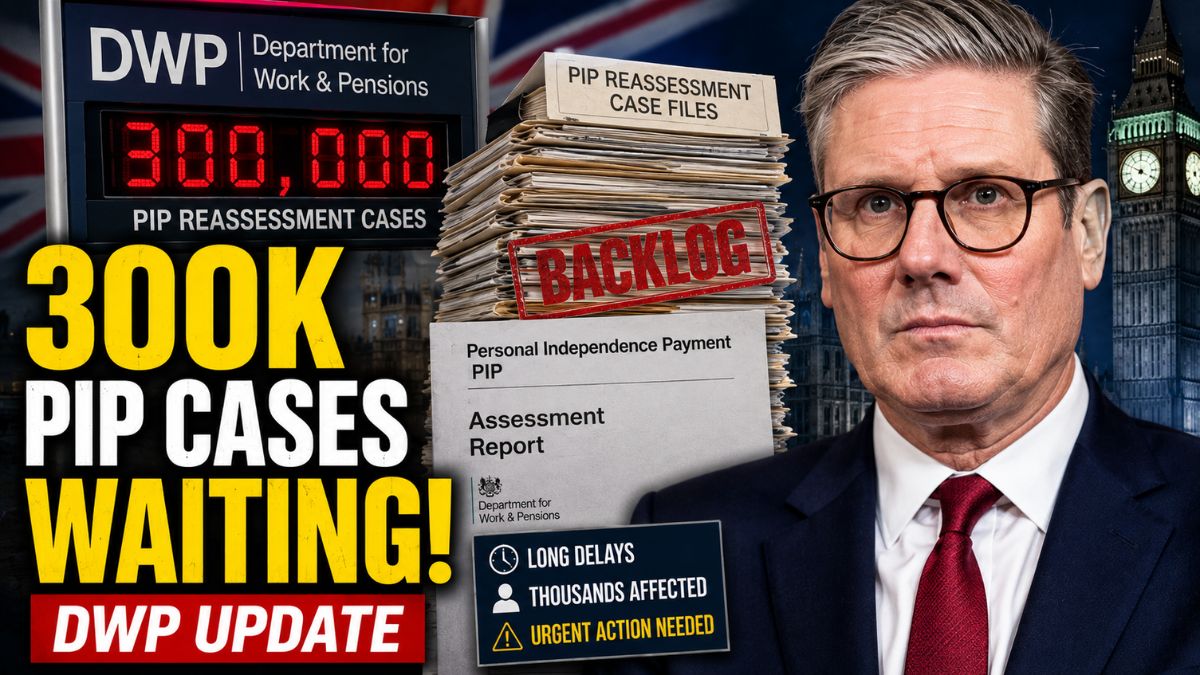
The Department for Work and Pensions (DWP) has provided a new update on Personal Independence Payment (PIP) reassessments, with figures showing around 300,000 cases were outstanding at the end of May 2026.
The update comes as the government prepares to expand testing of a new approach to PIP decision-making. The Transformed Decision Making process is intended to change how evidence is assessed, with greater responsibility placed on DWP case managers when making final decisions.
The developments are also taking place alongside the Timms Review of PIP, which is examining how the benefit could be improved and is expected to report in autumn 2026.
Backlog
The latest DWP figures show the scale of the outstanding PIP award review caseload.
In response to a parliamentary question from DUP MP Jim Shannon, Sir Stephen Timms, Minister of State for Social Security and Disability, said there were 300,000 cases outstanding at all stages of the PIP Award Review process at the end of May 2026.
The figure applies to England and Wales and covers cases at different stages of the reassessment process.
The DWP noted that the number comes from unpublished management information collected for internal use. It has not been quality assured to the standards used for National Statistics or Official Statistics.
The figure has also been rounded to the nearest 10,000 cases.
Payments
Importantly, the DWP said people remain in payment while their award reviews are being completed.
This means the 300,000 figure does not represent 300,000 people whose PIP payments have automatically stopped while waiting for reassessment.
The department also said that where a planned review results in an increase to an award, the increase will be backdated where appropriate.
A change in circumstances reported by a claimant can trigger an unplanned review. According to the DWP, such cases are prioritised alongside new claims.
The department said reducing the time claimants spend going through the process remains a priority.
Review
The reassessment figures come as the government continues its broader review of PIP.
The Timms Review was launched to examine how the benefit can be made fair and suitable for the future. The review is being carried out with disabled people and their organisations.
The government has said it expects the review to report to the Work and Pensions Secretary in autumn 2026 and has committed to reporting its outcomes to Parliament.
The review could therefore provide further information about the future direction of PIP, including how assessments and decision-making may operate.
Decisions
Alongside the review, the DWP is testing a different approach to making PIP decisions.
The Transformed Decision Making pilot is part of the Health Transformation Programme and is designed to change the respective roles of Healthcare Professionals and DWP case managers.
Under the approach being tested, Healthcare Professionals would focus on collecting and recording clear, factual information about how a person’s health condition or disability affects their daily activities.
They would no longer provide views on which PIP descriptors should apply or how long an award should last.
Instead, DWP case managers would have a stronger role in reviewing all available evidence and making the final decision.
Testing
The first phase of the Transformed Decision Making trial began on 16 March 2026 and covered areas accounting for around 1% of national PIP assessment volume.
The DWP expanded the test on 1 June 2026 to around 4% of PIP assessment volume nationally.
According to Sir Stephen Timms, the second phase is expected to involve approximately 2,800 to 3,300 PIP customers each month.
The department says the trial will be evaluated to assess its impact before decisions are made about the wider approach.
| Testing stage | Start date | PIP assessment coverage |
|---|---|---|
| Initial phase | March 16, 2026 | Around 1% |
| Second phase | June 1, 2026 | Around 4% |
| Expected monthly customers in phase two | June 2026 onward | 2,800-3,300 |
Purpose
The DWP says the transformed approach is intended to rebalance the decision-making process.
One stated aim is to allow Healthcare Professionals to concentrate on providing factual evidence while giving case managers greater responsibility for considering the complete evidence before reaching a decision.
The department has also said the operational change is intended to free up capacity among assessment providers and improve decision quality.
However, the process remains a test rather than a confirmed permanent change to the PIP system.
The pilot is being conducted under the governance arrangements of the wider Health Transformation Programme, which is responsible for modernising the PIP service.
Impact
For people receiving PIP, the most immediate issue remains the length of time involved in award reviews.
The DWP’s statement confirms that claims remain in payment while planned reviews are ongoing, which provides an important distinction between waiting for a reassessment and losing entitlement.
At the same time, the 300,000 outstanding cases show the size of the workload facing the department.
The new decision-making pilot could eventually change how PIP assessments are handled, but the government will need to evaluate the results before determining whether the approach should be expanded further.
The combination of the large reassessment caseload, the new decision-making trial and the Timms Review means several aspects of the PIP system could change over the coming months. For now, the DWP says existing claims remain in payment while award reviews are in progress, while the transformed decision-making system continues to be tested. The findings from the trial and the Timms Review are likely to provide further detail on the future of PIP later in 2026.
FAQs
How many PIP reviews are outstanding?
Around 300,000 cases were outstanding at the end of May 2026.
Are PIP payments stopped during reviews?
The DWP says claims remain in payment during planned reviews.
What is Transformed Decision Making?
It gives DWP case managers a stronger role in final decisions.
When did the PIP pilot expand?
The second testing phase began on June 1, 2026.



When will the Timms Review report?
The review is expected to report in autumn 2026.