For about an hour, markets were jolted.
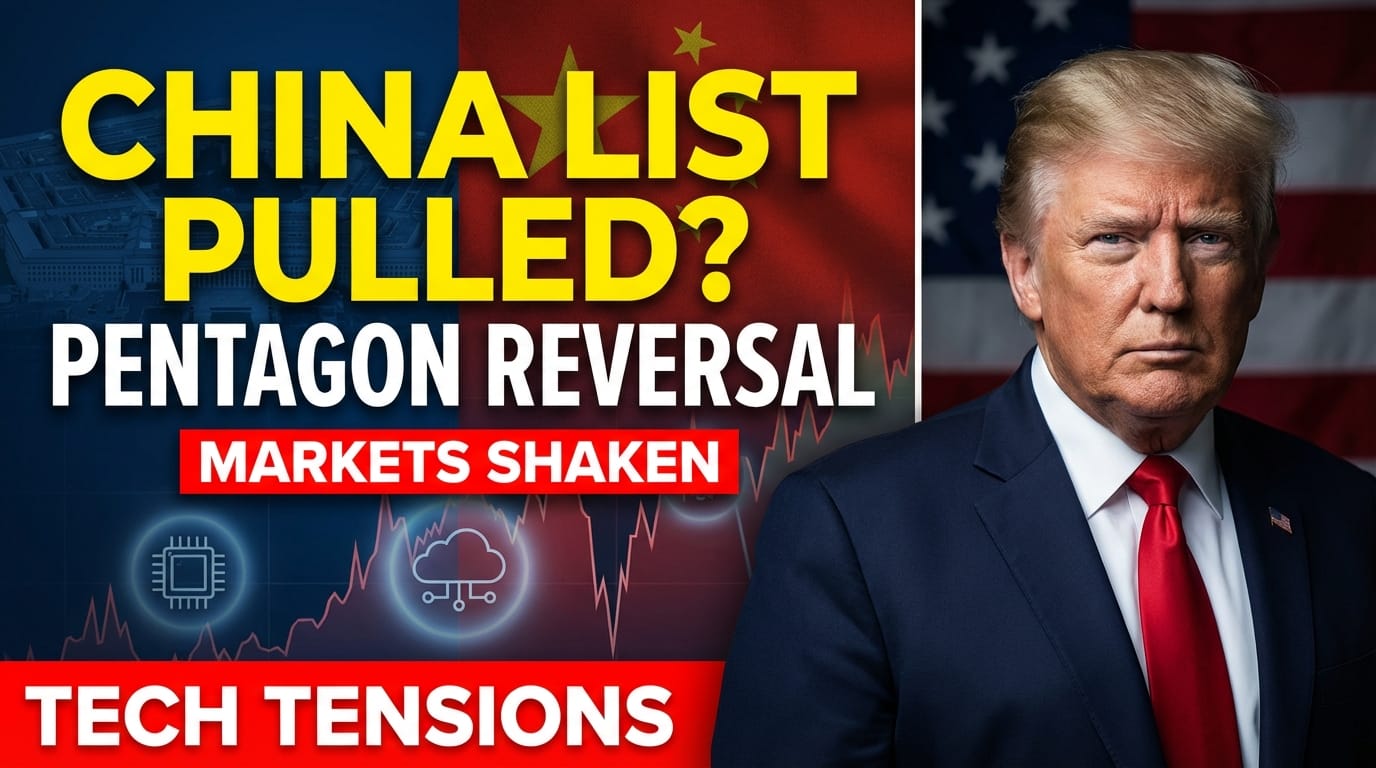
The United States briefly posted an updated list of Chinese companies allegedly aiding Beijing’s military – only to withdraw it shortly afterward. The temporary document included major tech names like Alibaba and Baidu, while reportedly removing top memory chipmakers CXMT and YMTC.
That sudden reversal has raised questions about policy direction, geopolitical strategy, and what it means for investors watching U.S.-China tensions.
Let’s unpack what happened and why it matters.
Update
The Pentagon posted an updated list of Chinese firms it believes are linked to China’s military. Such lists do not automatically impose sanctions, but they carry weight. Under U.S. law, the Department of Defense will eventually be barred from contracting with listed companies.
The updated version reportedly added:
- Alibaba
- Baidu
- BYD
- WuXi AppTec
- RoboSense Technology
At the same time, it removed major memory chipmakers CXMT and YMTC — a move that immediately drew criticism from China hawks in Washington.
Then, just as quickly as it appeared, the notice was withdrawn.
A Pentagon letter requested removal of the document from public inspection and withdrawal from publication in the Federal Register. No reason was provided.
Context
Timing matters.
The withdrawal comes amid a softer U.S. stance toward China following a trade truce between President Donald Trump and Chinese President Xi Jinping in October. Since then, several national security measures have reportedly been delayed or shelved.
Recent developments include:
| Policy Move | Status |
|---|---|
| Nvidia AI chip exports to China | Approved |
| Tech purchase restrictions | Postponed |
| China Telecom U.S. ban | Shelved |
| Data center equipment limits | Delayed |
President Trump is expected to travel to China in April, though exact dates remain unconfirmed.
Against that backdrop, the posting and rapid removal of the Pentagon list appears politically sensitive.
Impact
Although inclusion on the Pentagon list does not immediately trigger sanctions, it has serious consequences.
Being listed:
- Restricts future Pentagon contracting
- Sends warning signals to suppliers
- Influences U.S. government procurement decisions
- Raises reputational risks
Companies previously added to the list, including Tencent and CATL, have faced scrutiny and in some cases legal challenges.
Alibaba responded swiftly, stating there was no basis for inclusion and signaling possible legal action. The company emphasized it is not part of any military-civil fusion strategy.
For investors, even temporary inclusion can affect stock sentiment. Regulatory headlines often move markets faster than earnings reports.
Chips
The removal of CXMT and YMTC sparked particular controversy.
These companies are key players in China’s memory chip industry. Some U.S. policymakers worry that advances in Chinese semiconductor production could strengthen military capabilities.
One former White House National Security Council official suggested that if the document was pulled because of the chipmaker removals, correcting that would make sense. From that perspective, removing them while adding firms like Alibaba and Baidu seemed inconsistent.
Semiconductors remain the central battleground in U.S.-China technology competition. Any policy shift in this space tends to draw immediate scrutiny.
Signals
So what does this episode signal?
One possibility is procedural. An Asia-Pacific defense policy expert described the withdrawal as potentially tied to interagency sign-off issues. In other words, the list may not have been fully finalized internally.
Another possibility is strategic calibration. The administration may be attempting to avoid escalating tensions ahead of diplomatic engagements.
Think of it like a thermostat. Policymakers are adjusting pressure carefully – trying to maintain leverage without overheating relations.
Markets
For investors, these events reinforce a key theme: geopolitical risk is now embedded in major Chinese stocks.
Companies like Alibaba and Baidu are not just tech platforms. They are increasingly viewed through a national security lens.
That creates several layers of uncertainty:
- Policy unpredictability
- Regulatory overhang
- Potential legal battles
- Diplomatic volatility
Markets dislike ambiguity. Even a one-hour listing can ripple through global portfolios.
At the same time, the withdrawal could be interpreted as a sign that escalation is not inevitable. If additions remain and removals are reviewed, as some analysts suggest, the final list may look different from the brief posting.
Outlook
This episode highlights how fluid U.S.-China technology policy has become.
On one side, Washington seeks to limit China’s access to advanced technologies with military applications. On the other, economic and diplomatic considerations push toward moderation.
For companies caught in the middle, headlines can change risk perception overnight.
Is this a simple bureaucratic misstep? Or evidence of deeper policy recalibration?
Investors will be watching closely for the next official update. In today’s environment, geopolitical developments can matter just as much as earnings growth or revenue forecasts.
The bigger picture is clear: U.S.-China tensions remain a defining force in global markets. Lists may come and go, but the strategic competition shaping them is far from over.
FAQs
Why was the list withdrawn?
The Pentagon gave no official reason.
Were sanctions imposed?
No, the list does not trigger sanctions.
Which firms were added?
Alibaba, Baidu, BYD and others.
Why are chipmakers controversial?
Due to military technology concerns.