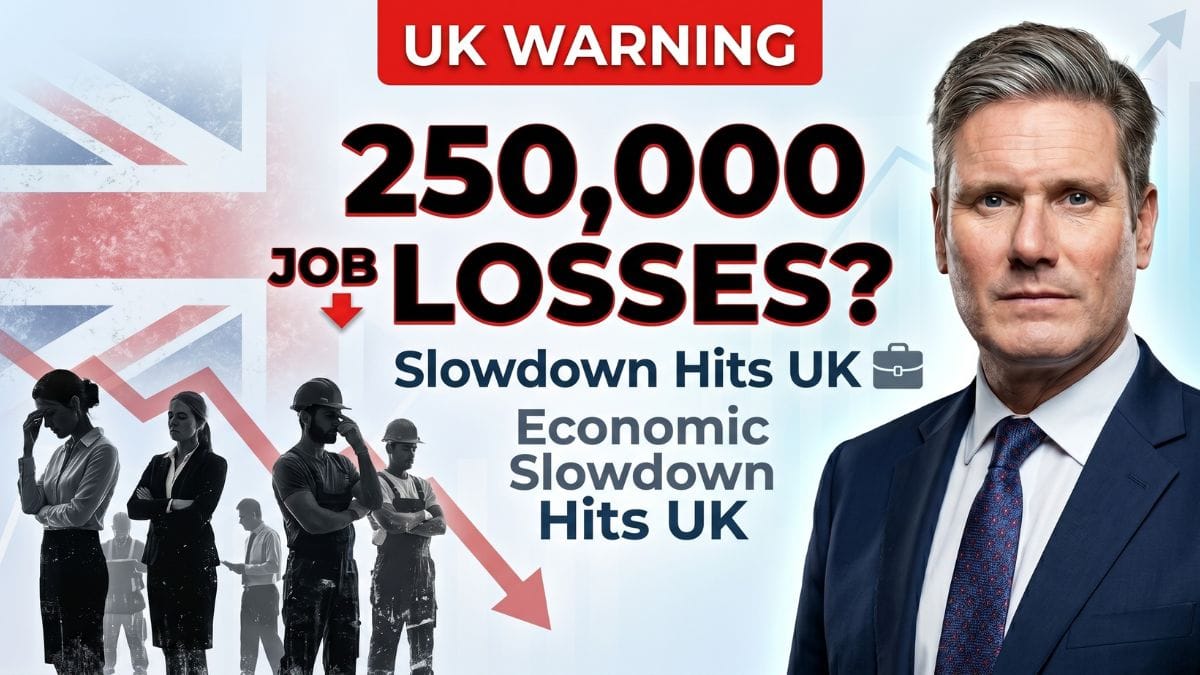
The UK economy is entering a period of slower growth, with forecasts indicating a potential rise in unemployment over the next two years. Analysts suggest that up to 250,000 jobs could be lost as economic pressures build, marking the most significant labor market impact since the Covid-19 pandemic. While the outlook does not confirm a recession, it highlights increasing risks linked to global developments, rising costs, and subdued investment.
Outlook
Economic projections suggest that the UK’s growth will slow notably in 2026. Gross domestic product is expected to increase by around 0.7%, compared with 1.4% growth recorded in 2025. This deceleration reflects weaker domestic demand and external pressures affecting trade and investment.
There is also a possibility that the economy may enter a technical recession, defined as two consecutive quarters of declining output. Current forecasts indicate stagnation during the second and third quarters, though the overall annual figure remains positive.
Drivers
Several interconnected factors are contributing to this outlook. A key driver is the increase in global energy prices, partly linked to geopolitical tensions involving Iran. Higher oil and gas costs raise operating expenses for businesses and reduce disposable income for households.
Supply chain disruptions are also affecting production and distribution. Delays and increased logistics costs can reduce efficiency and profitability, particularly in manufacturing and retail sectors.
In addition, global uncertainty is weighing on business confidence. Companies may delay investment decisions due to unclear economic conditions, which in turn affects hiring and expansion plans.
| Factor | Economic Effect |
|---|---|
| Energy prices | Higher business and household costs |
| Supply chains | Delays and rising input expenses |
| Global uncertainty | Reduced investment activity |
| Consumer spending | Lower demand due to cost pressures |
Jobs
The labor market is expected to weaken gradually. Forecasts suggest the unemployment rate could rise to 5.8% by mid-2027. This increase would correspond to approximately 250,000 additional people out of work.
While this level remains below historical peaks, the projected rise represents a notable shift from recent stability. Sectors that are sensitive to energy costs, trade fluctuations, and consumer demand may be more exposed to job reductions.
Employers facing higher costs and uncertain demand may adjust staffing levels or pause recruitment. This trend can develop gradually rather than through sudden large-scale layoffs.
Inflation
Inflation is projected to increase again, reaching close to 4% in the latter part of 2026. This would place it above the Bank of England’s 2% target and reflect ongoing cost pressures from energy and supply chains.
Higher inflation reduces purchasing power, as households spend more on essentials such as energy, food, and transportation. This can limit discretionary spending, which is an important driver of economic activity.
At the same time, businesses may find it more difficult to pass on higher costs to consumers, particularly if demand weakens. This can place additional pressure on margins and profitability.
Rates
Despite the expected rise in inflation, interest rates are likely to remain unchanged through much of 2026. The Bank of England is expected to maintain a cautious approach, balancing inflation control with the need to support economic stability.
Raising interest rates further could increase borrowing costs for households and businesses, potentially slowing the economy more sharply. Given current conditions, policymakers may prefer to wait for clearer signs that inflation is easing before making adjustments.
There is also an expectation that interest rates could be reduced later, possibly in 2027, if inflation trends downward and growth remains subdued.
Spending
Consumer spending is likely to remain under pressure. Higher living costs, particularly energy bills, reduce the amount households can allocate to non-essential purchases. This can affect sectors such as retail, hospitality, and leisure.
Business investment may also slow. Companies facing higher financing costs and uncertain demand conditions may delay capital expenditure or expansion plans. This combination of weaker consumption and investment contributes to slower overall economic growth.
Resilience
Recent economic data suggests that the UK economy retains some underlying resilience. For example, GDP growth of 0.5% was recorded in February, marking the strongest monthly performance since early 2024.
This indicates that while challenges are present, economic activity has not declined uniformly. Certain sectors may continue to perform relatively well, and short-term fluctuations can still produce positive results.
Forecast
The following table summarizes key projections for the UK economy:
| Indicator | Forecast Value |
|---|---|
| GDP growth (2026) | 0.7% |
| Inflation peak | Around 4% |
| Unemployment rate | 5.8% by 2027 |
| Job losses | About 250,000 |
| Interest rates | Stable in 2026 |
These figures point to a period of modest growth combined with rising economic pressures. The outlook does not indicate a severe downturn, but it does suggest a more constrained environment for both households and businesses.
Overall, the UK economy appears to be entering a phase of adjustment rather than abrupt decline. Slower growth, higher costs, and cautious investment are likely to define the near-term outlook. While risks remain, particularly from global developments and energy markets, policy responses and underlying economic stability may help limit the scale of disruption over time.
FAQs
How many jobs could be lost in the UK?
Around 250,000 jobs may be lost by 2027.
Why is UK growth slowing?
Energy costs and global uncertainty are key factors.
Will the UK face a recession?
There is a risk but it is not certain.
What is the inflation outlook?
Inflation may rise to about 4% in 2026.