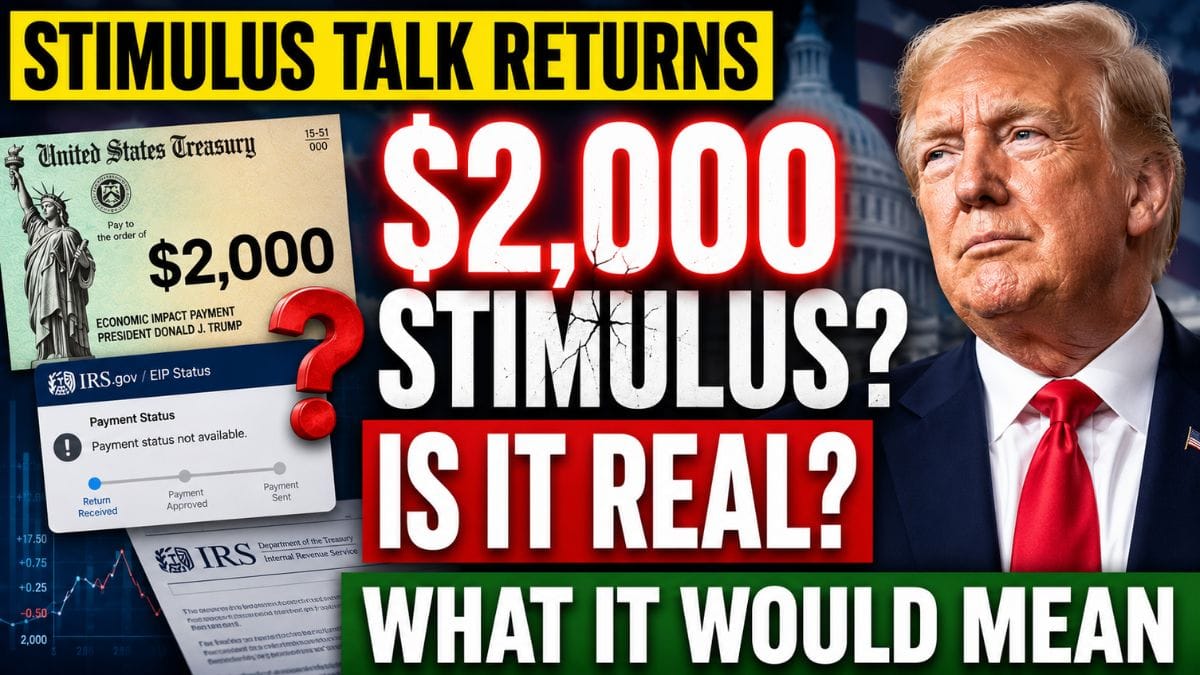
Discussion of another stimulus check has resurfaced online and in some news coverage, with claims suggesting Americans could receive payments of $2,000 or more in 2026. While the idea has gained attention, the facts behind it are more limited. Several proposals have been mentioned by lawmakers, but none have passed Congress or been signed into law. At this point, there is no approved federal stimulus program, and any new direct payments would face significant legal and political hurdles.
Knowing where these claims come from helps explain why they continue to circulate and why expectations should remain cautious.
Origins
One source of renewed interest is the concept of so-called tariff dividends. Former President Donald Trump previously suggested that money collected from tariffs could be returned directly to American households. Early estimates tied to that idea mentioned payments of roughly $2,000 for middle- and lower-income families.
However, the proposal encountered a major setback. In February 2026, a federal court ruled that the broad tariffs underpinning the plan were illegal. As a result, an estimated $166 billion in tariff revenue is now being refunded to importers that originally paid the charges, not to consumers. Without that revenue stream, the foundation for any large-scale household payment tied to tariffs effectively disappeared.
States
After the tariff-dividend idea stalled, attention shifted to state-level discussions. Some governors, including Gavin Newsom of California and Maura Healey of Massachusetts, have argued that consumers ultimately absorb the cost of tariffs through higher prices. They have raised the possibility of state rebates or relief programs to offset those costs.
These discussions echo pandemic-era stimulus efforts, but they remain proposals only. No state has enacted a tariff-related direct payment program. Even if states move forward independently, any relief would vary widely by location, with different eligibility rules, payment amounts, and timelines.
IRS
Confusion has also been fueled by misunderstandings about tax refunds and stimulus payments. The Internal Revenue Service has emphasized that the two are not the same.
Tax refunds occur when taxpayers have overpaid their federal income taxes during the year. These refunds are processed as part of the normal tax filing system and are based on individual circumstances such as withholding, credits, and deductions.
Stimulus payments, by contrast, require explicit authorization from Congress and approval by the President. They are separate from the tax system and are distributed under specific legislation.
The IRS is currently processing 2025 tax returns and issuing refunds. Some households may receive larger refunds than in previous years, but those payments are not stimulus checks. The agency has also stated that any new federal payment program would be announced through official IRS notices and government statements, not social media posts.
Proposal
Another proposal contributing to the conversation is legislation introduced by Senator Bernie Sanders and Representative Ro Khanna. Known as the Make Billionaires Pay Their Fair Share Act, the bill would provide annual payments of $3,000 to many Americans.
Under the proposal, households earning up to $150,000 per year would qualify. The payments would be funded through a 5 percent annual tax on wealth above the billionaire threshold. While the idea has drawn attention, it remains in the early stages of the legislative process. It has been introduced in Congress but has not advanced to a vote, and there is no indication that passage is imminent.
Even if the bill were to move forward, implementation would likely take considerable time.
Rumors
Stimulus rumors tend to spread quickly for several reasons. The memory of three rounds of direct payments during the COVID-19 pandemic created an expectation that similar relief could return during periods of economic strain.
Rising costs for housing, food, and energy have also increased interest in any form of financial relief, making unapproved proposals feel more plausible. In addition, policy ideas such as tax rebates or tariff refunds are sometimes described in ways that sound like guaranteed payments, even when no program has been authorized.
Outlook
At present, no new federal stimulus program is active or scheduled. For most Americans, the only guaranteed federal payments in 2026 are standard tax refunds tied to their 2025 tax returns.
Any new direct payment program would require legislation, approval by both chambers of Congress, a presidential signature, and administrative rollout by federal agencies. That process typically takes months or longer.
The deadline to claim the final round of pandemic-era stimulus payments passed on April 15, 2025. Those funds are no longer available.
Headlines referencing $2,000 or $3,000 stimulus checks reflect ongoing policy discussions rather than enacted law. Until Congress acts and a bill is signed, no new direct payments are guaranteed. Any legitimate program will be communicated through official government channels, not viral posts or unverified claims.
FAQs
Is a $2,000 stimulus check approved for 2026?
No, no federal stimulus payment has been approved.
What happened to the tariff dividend idea?
A court ruling ended the funding source for it.
Are states sending stimulus payments?
No state has approved a tariff-related payment.
Is the $3,000 annual payment law?
No, it is only a proposed bill.