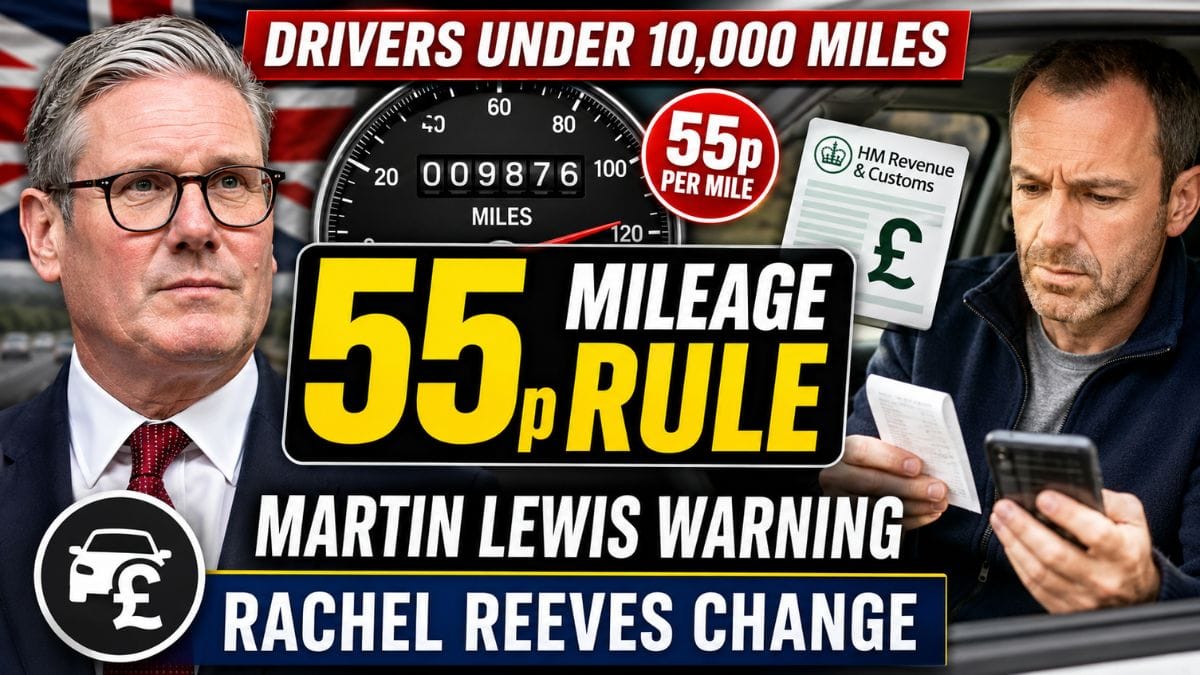
A change to work mileage rates announced by Chancellor Rachel Reeves could bring meaningful financial relief to thousands of UK motorists who use their own vehicles for work. Consumer finance expert Martin Lewis has described the update as one of the most important, yet potentially overlooked, measures in the recent announcement.
The change raises the approved mileage allowance for cars and vans to 55p per mile for the first 10,000 work-related miles each tax year. That is an increase of 10p per mile from the long-standing 45p rate, which had remained unchanged since 2011.
Speaking on the BBC, Martin Lewis said the mileage allowance increase deserves more attention than it has received so far. He noted that many workers have absorbed rising fuel, insurance and maintenance costs for years while the tax-free mileage rate stayed frozen.
Under the new rule, employees who drive for work can now claim tax relief at 55p per mile for up to 10,000 miles annually. Beyond that threshold, the rate remains lower, in line with existing HMRC rules.
The updated allowance applies to cars and vans and is backdated to April 2026.
What changed
The approved mileage allowance payment, often referred to as AMAP, is the rate employers can pay workers for business travel without triggering tax or National Insurance.
For more than a decade, this rate stood at 45p per mile for the first 10,000 miles. Rachel Reeves’ decision to raise it to 55p represents the first increase since 2011.
Martin Lewis described the change as particularly significant for workers who rely heavily on their vehicles, such as care workers, community health staff and others who travel between multiple locations during the working day.
He said many of these workers had effectively been subsidising their employers due to rising motoring costs and an outdated allowance.
Who Benefits
The rule applies to employees who use their own car or van for work purposes. This includes workers whose job requires regular travel, even if driving is not their main role.
The key point highlighted by Martin Lewis is that the allowance applies whether or not an employer pays the full rate. If an employer pays less than 55p per mile, the worker can claim tax relief on the difference through HMRC.
For example, if an employer pays 40p per mile, the employee can claim tax relief on the remaining 15p per mile, reducing their overall tax bill.
The allowance covers fuel, servicing, insurance, road tax and general wear and tear, all bundled into a single tax-free rate.
Why it matters
One reason the change has attracted attention is how long the previous rate had been frozen. Since 2011, fuel prices, vehicle purchase costs and insurance premiums have all risen sharply.
Union leaders argue that the outdated rate placed a disproportionate burden on lower-paid workers who depend on their cars to do their jobs. Unison general secretary Andrea Egan welcomed the move, calling it a simple measure that offers immediate help to frontline public service staff.
Because the allowance is tax-free, workers receive the full benefit without paying income tax or National Insurance on the amount claimed.
How to claim
How workers claim the mileage allowance depends on how their employer handles expenses.
If an employer pays mileage expenses at the full approved rate, no further action is needed. The payment is not taxed and does not need to be declared.
If the employer pays less than the approved rate or nothing at all, the employee can claim tax relief on the unpaid portion. This is done through HMRC, either via a Self Assessment tax return or by submitting a mileage expense claim online.
Claims can typically be backdated for up to four tax years, which may allow some workers to recover money they missed out on in previous periods.
Key details at a glance
| Item | Details |
|---|---|
| New mileage rate | 55p per mile |
| Previous rate | 45p per mile |
| Mileage limit | First 10,000 miles per tax year |
| Applies to | Cars and vans |
| Effective date | Backdated to April 2026 |
| Claim method | Employer expenses or HMRC tax relief |
Wider Context
Mileage allowances are just one part of how the tax system supports working motorists. While the increase does not affect company car drivers who use fuel benefit rules, it has a direct impact on employees using their own vehicles.
Martin Lewis has urged workers to check their payslips and expense policies to ensure they are not missing out, especially if their employer has not yet updated mileage rates.
As motoring costs remain a significant household expense, the higher allowance may help offset some of the financial pressure faced by workers who depend on their cars to earn a living.
FAQs
What is the new mileage allowance rate?
55p per mile for the first 10,000 miles.
When does the new rate apply from?
It is backdated to April 2026.
Who can claim the mileage allowance?
Employees using their own car or van for work.
What if my employer pays less than 55p?
You can claim tax relief on the difference.