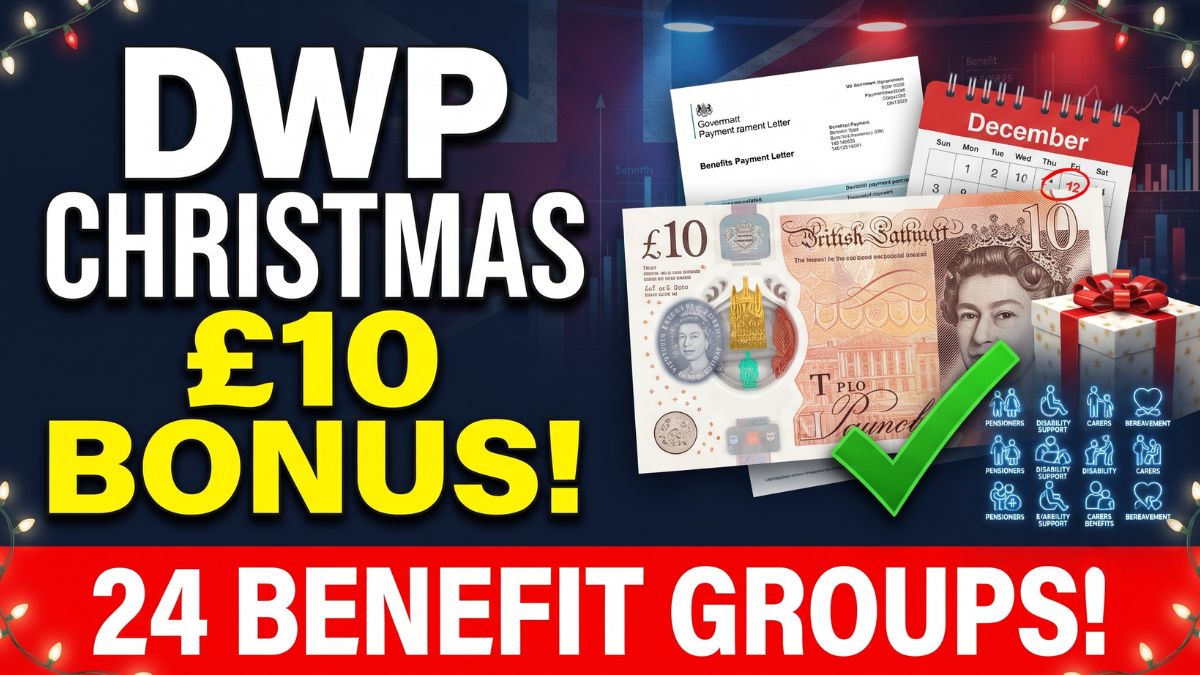
Millions of people across the UK may qualify for the Department for Work and Pensions (DWP) Christmas Bonus, an annual tax-free payment designed to provide a small amount of additional financial support during the festive season. The payment is worth £10 and is usually made automatically to people who receive certain qualifying benefits during the designated qualifying week.
Although the amount has remained unchanged for decades, the payment can provide a modest contribution towards everyday expenses at a time when many households face additional costs for food, heating, travel and Christmas preparations. Eligibility depends on the benefits a person receives and whether they meet the relevant residency requirements.
The DWP Christmas Bonus is not available to everyone receiving government support. Instead, it covers specific benefit groups, including pensioners, disabled people, carers, and certain people receiving bereavement or industrial injury benefits. Understanding the eligibility rules can help claimants determine whether they should expect the payment.
Payment
The Christmas Bonus is a one-off, tax-free payment of £10 made annually to eligible people in the UK and certain other qualifying locations. It is separate from regular benefit payments and does not usually require a new application.
The payment is intended to provide a small amount of additional support during December. Because it is paid automatically, eligible claimants generally do not need to contact the DWP or complete a separate claim form.
However, receiving benefits does not automatically guarantee eligibility. A claimant must receive at least one qualifying benefit during the relevant qualifying week and meet the applicable residency conditions.
The payment is also different from Christmas cost-of-living support schemes or discretionary grants offered by local authorities and charities. Those schemes may have separate eligibility criteria and application procedures.
Official guidance is available through the UK government’s Christmas Bonus information page.
Eligibility
To qualify for the Christmas Bonus, a person must generally be present in Great Britain, Northern Ireland, the Channel Islands, the Isle of Man, or Gibraltar during the qualifying week, or meet the relevant ordinary-residence conditions.
They must also receive at least one qualifying benefit during that period. The qualifying week is generally the first full week of December, although claimants should check the government’s current guidance for the relevant year.
The rules cover several types of benefits. These include the State Pension, disability benefits, certain carer payments, and specific benefits associated with industrial injuries, military service, and bereavement.
A person receiving more than one qualifying benefit will generally receive only one £10 Christmas Bonus, rather than a separate payment for each benefit.
It is important to distinguish between benefits that qualify in their own right and benefits that may have additional conditions. For example, contribution-based Employment and Support Allowance generally qualifies once the claimant has entered the main phase of the benefit after the initial 13 weeks.
Benefits
The supplied eligibility list identifies 24 benefit groups associated with the Christmas Bonus. The following table summarises those categories.
| No. | Qualifying benefit |
|---|---|
| 1 | Adult Disability Payment |
| 2 | Armed Forces Independence Payment |
| 3 | Attendance Allowance |
| 4 | Carer’s Allowance |
| 5 | Carer Support Payment |
| 6 | Child Disability Payment |
| 7 | Constant Attendance Allowance under qualifying Industrial Injuries or War Pensions schemes |
| 8 | Contribution-based Employment and Support Allowance, subject to the main-phase condition |
| 9 | Disability Living Allowance |
| 10 | Incapacity Benefit at the long-term rate |
| 11 | Industrial Death Benefit for eligible widows or widowers |
| 12 | Mobility Supplement |
| 13 | Pension Age Disability Payment |
| 14 | Pension Credit, specifically the Guarantee Credit element |
| 15 | Personal Independence Payment (PIP) |
| 16 | Scottish Adult Disability Living Allowance (SADLA) |
| 17 | Severe Disablement Allowance, where transitional protection applies |
| 18 | State Pension, including Graduated Retirement Benefit |
| 19 | Unemployability Supplement or Allowance under qualifying schemes |
| 20 | War Disablement Pension at State Pension age |
| 21 | War Widow’s Pension |
| 22 | Widowed Mother’s Allowance |
| 23 | Widowed Parent’s Allowance |
| 24 | Widow’s Pension |
The list includes benefits administered under different arrangements across the UK. Some disability and carer benefits operate under devolved systems in Scotland, while other benefits are administered through the DWP.
The precise conditions attached to individual benefits still matter. Being listed in a category does not remove the requirement to satisfy the Christmas Bonus rules for the relevant qualifying week.
Pensioners
People receiving the State Pension are among the main groups eligible for the Christmas Bonus. The qualifying category includes the State Pension and Graduated Retirement Benefit.
Pensioners who meet the relevant conditions generally do not need to apply separately for the £10 payment. The bonus is paid in addition to their normal pension income.
However, receiving the State Pension does not mean a person will receive multiple Christmas Bonuses if they also qualify through another benefit. The payment is generally limited to one bonus per eligible person.
Pension Credit also appears on the eligibility list, but the qualifying element is specifically the Guarantee Credit element. Claimants should not assume that receiving any form of Pension Credit automatically meets this condition without checking the applicable rules.
Pensioners who are unsure about their eligibility can consult the official government guidance or contact the office responsible for their benefits.
Disability
Several disability-related benefits qualify for the Christmas Bonus. These include Personal Independence Payment, Attendance Allowance, Disability Living Allowance, Adult Disability Payment, Child Disability Payment, and certain other disability-related payments.
These benefits support people with different needs and circumstances. Some are designed to help with additional costs associated with disability, while others relate to mobility, daily living, or specific industrial injury and service-related conditions.
The inclusion of multiple disability benefits means that eligible claimants do not necessarily need to receive the State Pension to qualify for the Christmas Bonus.
However, the rules differ across benefit types and administrative systems. For example, Scotland has its own disability assistance payments for eligible residents, including Adult Disability Payment and Child Disability Payment.
People who receive disability benefits should check that their particular payment qualifies and that they meet the residency and qualifying-week requirements.
Carers
Carers may also qualify for the annual £10 payment. Carer’s Allowance and Carer Support Payment are both included in the supplied list.
These benefits support eligible people who provide care to someone with qualifying needs, subject to the relevant eligibility rules.
For carers managing household expenses, travel, food and other everyday costs, the Christmas Bonus provides a small additional payment. However, it is not intended to cover the full cost of caring or replace regular financial support.
People receiving Carer’s Allowance or Carer Support Payment should check their award details if they are uncertain whether their circumstances meet the Christmas Bonus requirements.
The payment is generally automatic for eligible recipients, so a separate Christmas Bonus application is not normally required.
Timing
The Christmas Bonus is usually paid during the early part of December, although the exact date may vary. The DWP does not guarantee a single payment date for every eligible recipient.
The bonus may appear in a bank statement alongside other benefit payments. The payment reference can vary, so claimants who are unsure about a deposit should consult their benefit office or the official government guidance.
The qualifying week is a separate issue from the date the money arrives. Eligibility depends on the benefits received and the relevant conditions during the qualifying week, not simply on whether a claimant receives a regular payment in December.
Anyone who believes they qualify but does not receive the bonus should check their benefit status and contact the relevant office for clarification.



Planning
Although £10 is a relatively small payment, it can contribute towards everyday spending during a month when household budgets may be under additional pressure.
Claimants should not, however, rely on the Christmas Bonus as a substitute for other benefits or financial assistance. The payment is a fixed annual amount and is not calculated according to a person’s household income, heating costs, or number of qualifying benefits.
People facing financial difficulties during winter may also wish to check whether they qualify for other support, such as the Winter Fuel Payment where applicable, Pension Credit, local council assistance, or charitable schemes. Each programme has its own eligibility requirements, and not all claimants will qualify.
The government also provides guidance on benefits and financial support for people who need help identifying assistance that may be available to them.
Ultimately, the DWP Christmas Bonus remains a small, automatic payment for people who meet the qualifying conditions. The 24 categories listed above cover a broad range of pension, disability, carer, bereavement, and service-related benefits, but eligibility depends on the rules applying to each claimant during the qualifying week. Checking the official guidance is the most reliable way to confirm whether a payment should be expected.