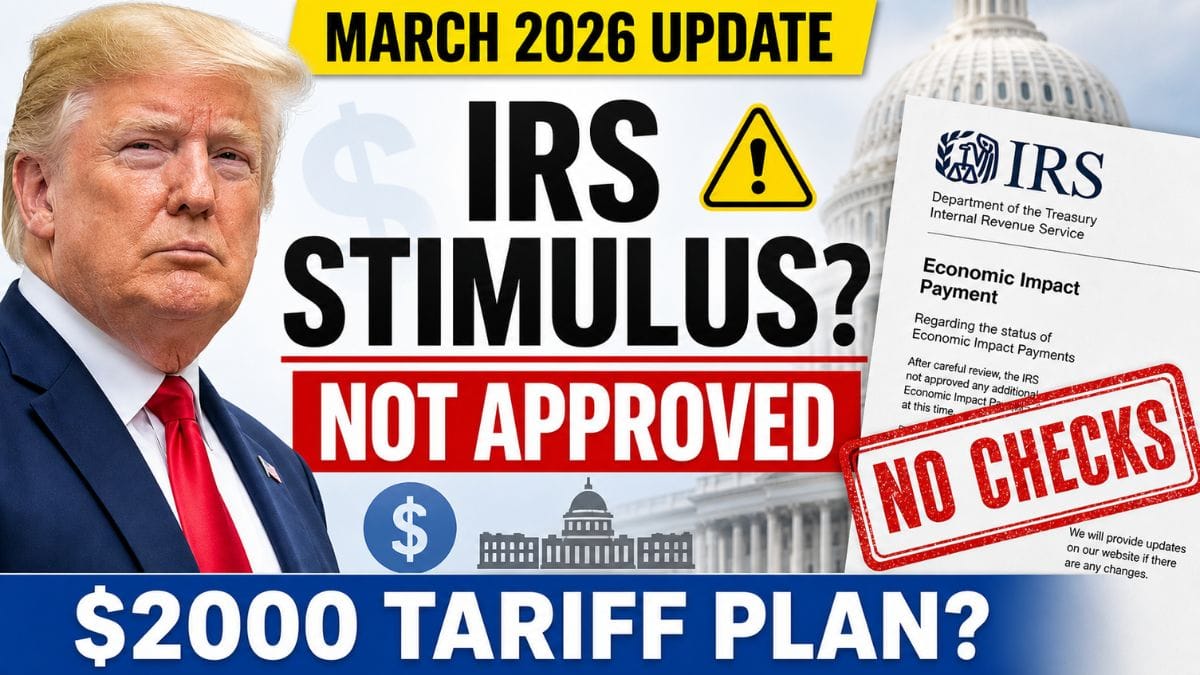
As March 2026 progresses, claims about new stimulus payments have circulated widely across social media and online forums. Many posts suggest that the Internal Revenue Service is preparing a fresh round of direct deposits or relief checks.
However, official information from Washington, D.C., and the IRS indicates otherwise. A closer review of current policy, legislation, and economic proposals helps clarify what is accurate and what remains speculative.
Status
At present, there are no new stimulus checks approved for distribution in March 2026. The United States Congress has not passed any legislation authorizing additional economic impact payments this year. Without such authorization, the IRS does not have the authority to issue new checks.
The most recent stimulus payments linked to the COVID-19 pandemic were distributed in 2021. While some taxpayers received payments of up to $1,400 in early 2025, those funds were tied to delayed or amended claims from earlier programs. The deadline to request those payments expired on April 15, 2025.
The following table summarizes the current situation:
| Payment Category | Current Status | Key Date |
|---|---|---|
| Pandemic Stimulus | Completed | 2021 |
| Recovery Rebate Claims | Closed | April 15, 2025 |
| New Stimulus 2026 | Not Approved | No active law |
This means there is no active federal program issuing stimulus payments at this time.
Claims
The persistence of rumors can be traced to a mix of online speculation and public statements about potential economic relief measures. Social media platforms often amplify early-stage proposals, sometimes presenting them as confirmed developments.
In reality, proposals discussed in political settings do not automatically translate into policy. For any stimulus payment to be distributed, it must go through a formal legislative process. This includes approval by both chambers of Congress and a presidential signature.
Without these steps, no federal agency, including the IRS, can initiate payments. As a result, current claims about imminent deposits should be viewed cautiously.
Tariffs
One of the most discussed proposals in recent weeks is the concept of a $2,000 “tariff dividend.” This idea involves distributing funds to citizens based on revenue generated from import tariffs.
Supporters of the proposal argue that increased tariff collections could provide a new source of public revenue. Under this concept, funds collected from foreign imports would be redirected to American households in the form of direct payments.
However, economic analysis raises questions about the feasibility of this approach. Estimates suggest that tariff revenue could reach approximately $207.5 billion by 2026. While this is a substantial figure, it falls short of the amount required to fund nationwide payments of $2,000 per person.
The financial comparison is outlined below:
| Measure | Estimated Value |
|---|---|
| Tariff Revenue (2026) | $207.5 billion |
| Cost of $2,000 Payments | Over $600 billion |
The difference between available revenue and projected costs presents a significant funding gap.
Authority
In addition to financial constraints, there are legal considerations. Federal spending programs, including direct payments to citizens, require congressional approval. The executive branch alone cannot establish or fund such programs without legislative support.
There have been reports of an emergency executive order introducing a 10% tariff. This measure includes a sunset clause, meaning it is set to expire after 150 days unless extended by Congress. Temporary measures of this nature do not provide a stable or long-term funding mechanism for large-scale payments.
As a result, the proposed tariff dividend remains in a preliminary stage without a clear path to implementation.
Context
The discussion around stimulus payments reflects broader economic concerns. Inflation, cost of living, and wage growth continue to influence household finances across the country. Policymakers are aware of these pressures, which is why proposals related to direct payments or tax relief continue to emerge.
However, the transition from proposal to policy depends on multiple factors, including budget considerations, political consensus, and economic priorities. Until these elements align, proposals remain under discussion rather than in effect.
Knowing this distinction helps prevent confusion about what benefits are currently available versus what may be considered in the future.
Outlook
Looking ahead, the possibility of new economic relief cannot be entirely ruled out. Future stimulus measures could take different forms, such as tax credits, targeted payments, or broader fiscal programs. However, any such initiative would require formal legislative action.
For now, there is no indication that new stimulus checks will be issued in March 2026. The IRS continues to operate within existing laws, and no new payment program has been enacted.
The tariff dividend proposal continues to be part of ongoing policy discussions, but it faces both financial and legal challenges. Without sufficient funding and congressional approval, it is unlikely to be implemented in the near term.
In summary, while public interest in stimulus payments remains high, the current situation is clear. No new checks have been authorized, and widely shared claims about imminent payments are not supported by existing legislation or official IRS guidance. Staying informed through verified sources remains essential for knowing developments in federal economic policy.
FAQs
Are stimulus checks coming in March 2026?
No, none are approved or scheduled.
When was the last stimulus paid?
The last major payments were in 2021.
Can I still claim past stimulus money?
No, the deadline ended April 2025.
What is the tariff dividend plan?
A proposal for $2000 payments from tariffs.