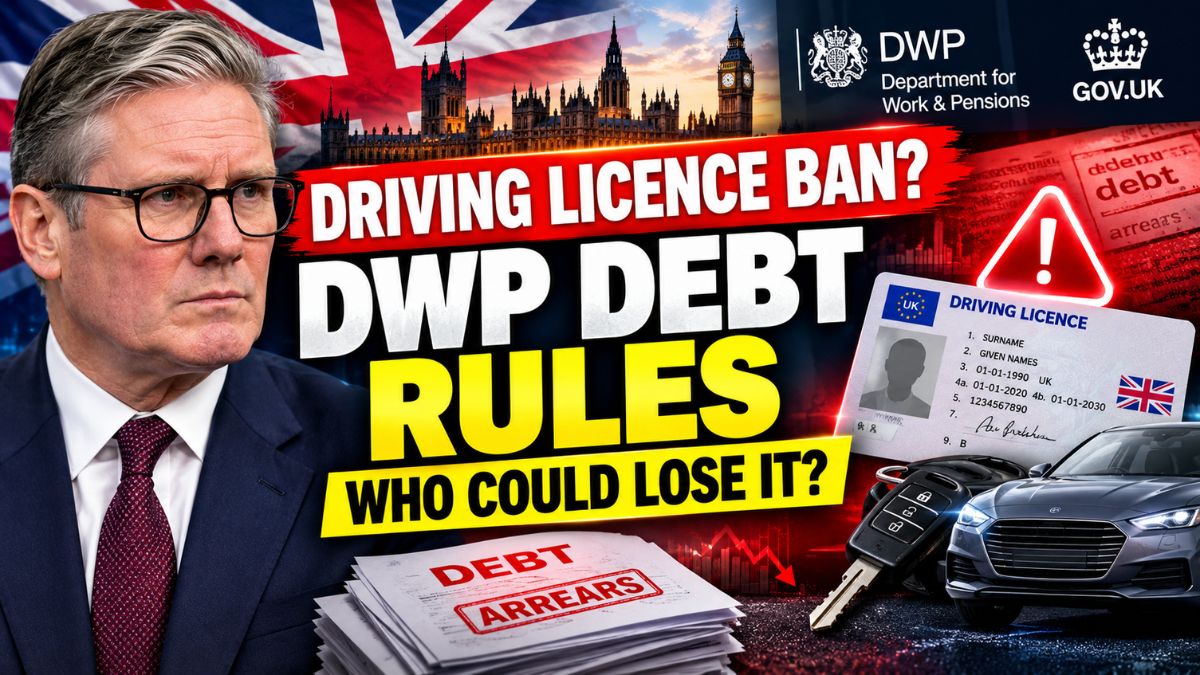
The Department for Work and Pensions (DWP) has gained new powers to recover certain benefit-related debts, including the ability to seek a temporary driving licence disqualification in the most serious cases.
The measures are part of a wider government effort to tackle benefit fraud and recover money owed to the state. They have attracted attention because driving is being used as one of the potential enforcement measures when someone persistently refuses to repay a debt.
However, the rules do not mean that every person who owes money to the DWP will automatically lose their driving licence. The circumstances in which a licence can be affected are much narrower.
The changes also give the DWP additional tools to identify whether people receiving benefits are still entitled to them and to recover debts directly from bank accounts in qualifying cases.
Rules
The new measures give the DWP broader powers to recover certain debts from people who have not repaid money they owe.
One of the most significant changes concerns direct deductions from bank accounts. The DWP can issue a direct deduction order to a bank, allowing money owed to the government to be recovered directly from an individual’s account.
The purpose is to reduce the reliance on voluntary repayment where a person has the financial means to repay but repeatedly fails to do so.
The government says these powers are aimed particularly at people who deliberately avoid repaying debts rather than those who are genuinely unable to pay.
The distinction is important because having a DWP debt does not, by itself, mean a person will face every available enforcement measure.
Licence
The driving licence measure is one of the most closely watched parts of the new rules.
In the most serious cases, the DWP can apply to a court to temporarily disqualify an individual from holding a driving licence.
However, the DWP cannot simply cancel a person’s licence because they owe money.
According to the department, the court must be satisfied that the debtor had the means to repay the debt but failed to do so without a good reason. The measure is therefore designed for cases involving persistent and deliberate avoidance.
This means the process involves the courts rather than an automatic administrative cancellation by the DWP.
The department has described the measure as an enforcement option for individuals who repeatedly refuse to engage with repayment efforts.
For affected claimants, this distinction is important. A person struggling financially and communicating with the DWP about repayment is in a different position from someone who has the ability to repay but deliberately refuses to do so.
Fraud
The new powers form part of a broader government crackdown on benefit fraud and error.
Benefit fraud can occur when someone deliberately provides false information or fails to report relevant changes in circumstances in order to receive money to which they are not entitled.
The DWP has been increasing its use of data and financial information to identify cases where benefit entitlement may need to be reviewed.
The government’s argument is straightforward: money paid incorrectly because of fraud should be recovered where possible, particularly when the person responsible has the means to repay it.
The measures are therefore intended to combine detection with debt recovery.
The UK government’s official DWP information provides further information about the department and its responsibilities.
Banking
Another significant part of the new approach involves access to financial information.
Financial institutions can be required to provide information that helps authorities determine whether a person remains entitled to benefits.
This can include information relating to bank accounts, savings and other financial circumstances relevant to benefit eligibility.
The purpose is to identify cases where a person’s financial situation may not match the information held by the DWP.
For example, some benefits have rules relating to income or capital. If someone’s circumstances change and they fail to report those changes, they could receive more money than they are entitled to.
Financial information can help the DWP identify potential discrepancies.
However, the existence of a bank account or savings does not automatically establish benefit fraud. Entitlement depends on the rules of the specific benefit and the individual’s circumstances.
Recovery
The direct deduction powers provide another route for recovering money owed.
The DWP can issue a direct deduction order to a bank in qualifying circumstances. This allows repayment to be taken directly from an individual’s account.
The measure is intended to make debt recovery more effective where traditional approaches have not resulted in repayment.
For claimants, this means ignoring correspondence about a DWP debt could become more consequential.
Someone who receives a debt notice should not assume that the issue will disappear if they do not respond. The department has made clear that it has additional enforcement mechanisms available under the new framework.
The best course for someone who believes a debt is incorrect or cannot afford to repay it is to engage with the DWP and seek clarification rather than simply ignoring the issue.
Courts
The court’s role is particularly important when it comes to driving disqualification.
The DWP’s published position says it can apply to a court in the most serious cases where someone has persistently and deliberately evaded repayment.
The court must be satisfied that the person had the means to repay and did not do so without good reason.
This provides an important safeguard against the driving measure being treated as an automatic penalty for ordinary benefit debt.
A court therefore has to consider the circumstances before imposing a temporary driving disqualification.
The measure should not be confused with the ordinary process for dealing with driving offences. This is a debt recovery mechanism rather than a penalty for speeding, dangerous driving or another road traffic offence.
Claimants
People receiving benefits such as Universal Credit may be affected by the wider debt recovery framework if they owe money to the DWP.
However, being a Universal Credit claimant does not mean that a driving licence is automatically at risk.
The relevant question is whether the person has a qualifying debt and how they respond to repayment demands.
Someone who cannot afford to repay a debt should communicate with the DWP rather than assume that financial difficulty will automatically be treated as deliberate refusal.
Similarly, anyone who believes a debt has been calculated incorrectly should seek a review or use the appropriate challenge process.
The rules are intended to distinguish between people who genuinely cannot repay and those who have the financial means but deliberately avoid their obligations.
Government
The government says the tougher measures are necessary to protect taxpayers and recover money that has been wrongly paid.
Andrew Western, Work and Pensions Minister for Transformation, said taxpayers deserve a system that pursues people who deliberately avoid repaying their debts.
The government’s position is that stronger enforcement tools will encourage people with outstanding debts to come forward and engage with the DWP.
The measures also form part of a broader effort to reduce losses associated with benefit fraud and error.
For the government, the objective is not simply to identify fraudulent claims but also to recover money that has already been paid incorrectly.
Concerns
The use of driving disqualification as a debt recovery tool has raised concerns among critics.
Driving can be important for employment, childcare, healthcare appointments and other everyday responsibilities, particularly for people living in areas with limited public transport.
Critics therefore argue that taking away someone’s ability to drive could create additional financial and practical difficulties.
The government, however, maintains that the measure is intended for the most serious cases involving persistent and deliberate non-payment.
The requirement for a court to be satisfied that the individual had the means to repay is a key part of that distinction.
The debate is ultimately about how far the government should be able to go when recovering public money while ensuring that people facing genuine financial hardship are not unfairly punished.
Impact
For most benefit claimants, the immediate impact of the new measures may be limited.
The driving licence provision is not an automatic consequence of receiving benefits or having a DWP debt. It is intended for cases where other efforts to recover the debt have failed and the individual is considered to have deliberately avoided repayment despite having the means to pay.
The banking powers could have a broader practical impact because financial information may be used to assess entitlement and support debt recovery.
Claimants should therefore keep their benefit records and financial information accurate and report changes when required.
Anyone receiving a letter from the DWP about an overpayment or debt should read it carefully and respond within the stated timeframe.



Advice
People who are worried about a DWP debt should not assume that they will immediately face a driving ban.
The first step is to establish why the money is allegedly owed, how much is outstanding and whether the debt is disputed.
If the debt is correct but repayment is difficult, contacting the DWP can allow the person’s circumstances to be considered.
If the person believes the decision is wrong, they may have options to challenge it depending on the type of decision involved.
Official information about benefits and government services is available through GOV.UK, while Universal Credit information can be found through the government’s Universal Credit service.
The new DWP powers represent a significant expansion of the tools available to recover benefit-related debts, but the driving licence provision is narrower than some headlines may suggest. A person does not automatically lose their licence simply because they receive Universal Credit, have a DWP overpayment or owe money to the government.
In the most serious cases, the DWP can ask a court to impose a temporary driving disqualification where the individual has the means to repay but persistently and deliberately refuses without good reason. At the same time, new financial information and direct deduction powers give the department additional ways to identify discrepancies and recover debts. For claimants, responding to DWP correspondence and addressing debts early is likely to be far more important than assuming that a driving ban will automatically follow.