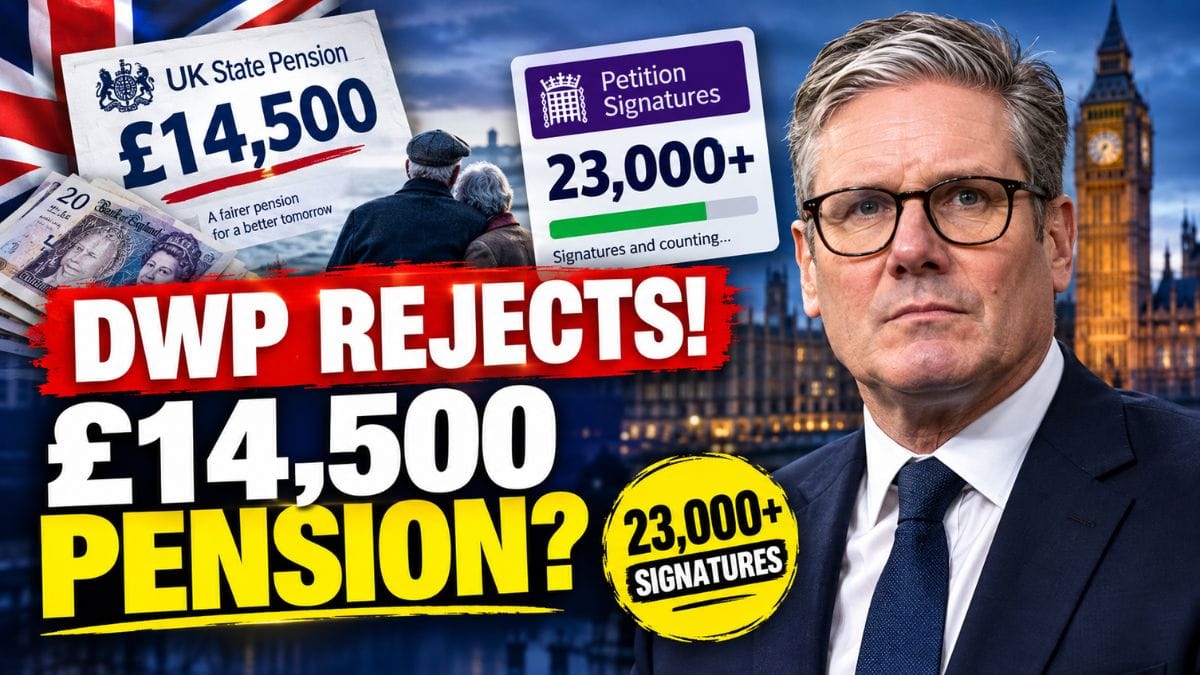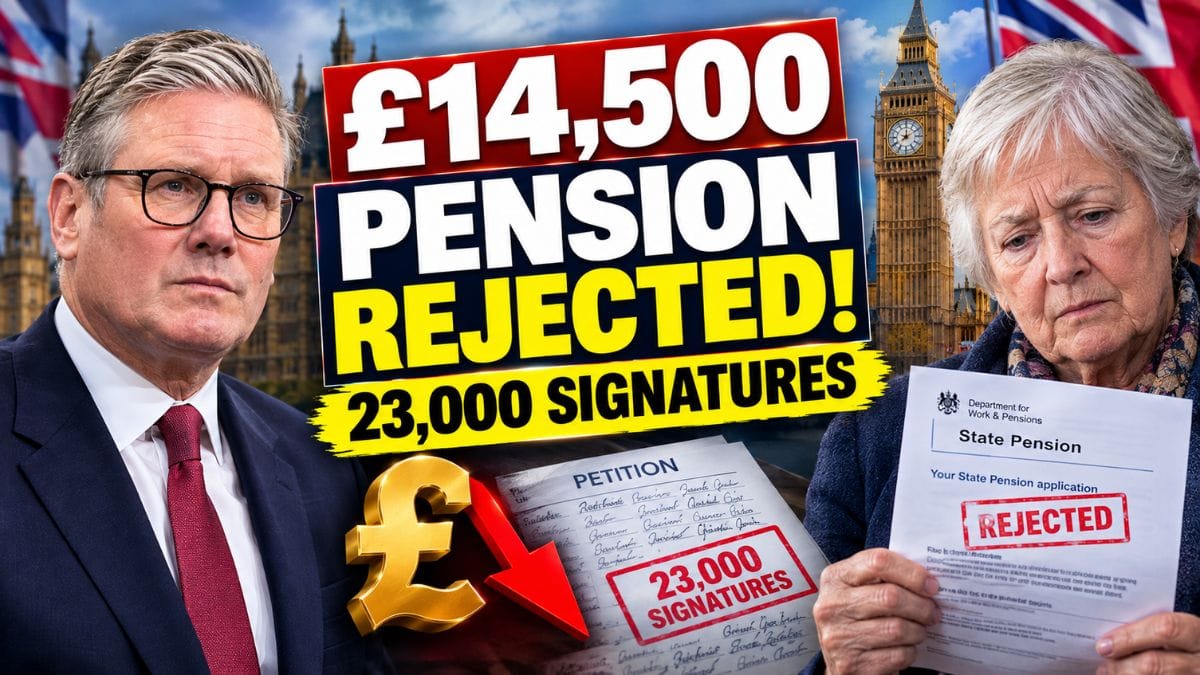
More than 23,000 people have signed a petition calling for the UK State Pension to be increased to at least £14,500 a year. The campaign argues that pensioners who have spent decades paying National Insurance should not receive less than the minimum amount younger workers can legally earn.
The Department for Work and Pensions (DWP) has rejected the proposal, saying the State Pension and National Minimum Wage serve different purposes and should not be directly compared.
The petition, created by Richard Sobey MBE, remains open until January 28, 2027. If it reaches 100,000 signatures, it can be considered for debate in Parliament.
The campaign therefore remains active, but the Government’s response means there is currently no commitment to introduce a £14,500 minimum State Pension.
Pension
The full new State Pension for 2026/27 is £241.30 a week.
Over 52 weeks, that works out at £12,547.60 a year. The weekly rate increased from £230.25 in 2025/26 following the annual State Pension increase.
The petition argues that the full State Pension should instead be at least £14,500 a year.
That would mean a weekly State Pension of approximately £278.85, assuming the amount were spread evenly across 52 weeks. Compared with the current full rate of £241.30, that would represent an increase of about £37.55 a week.
However, not everyone receives the full new State Pension. The amount an individual receives depends on their National Insurance record and other circumstances.
The GOV.UK State Pension guidance explains how entitlement is calculated.
Petition
The petition was created by Richard Sobey MBE and argues that the State Pension should provide at least a minimum standard of living for older people who have spent much of their working lives contributing through National Insurance.
The campaign compares the State Pension with statutory minimum wage rates.
Sobey’s argument is that if younger workers are legally entitled to minimum earnings above the full State Pension, pensioners should not receive less after a lifetime of work and National Insurance contributions.
The petition has attracted more than 23,000 signatures and remains open until January 28, 2027.
Reaching 100,000 signatures would make the petition eligible for consideration for debate in Parliament. It would not, by itself, require the Government to increase the State Pension.
Minimum Wage
The comparison has changed as minimum wage rates have increased.
From April 2026, workers aged 16 and 17 are entitled to at least £8 an hour. Workers aged 18 to 20 have a minimum rate of £10.85 an hour, while the National Living Wage for workers aged 21 and over is £12.71 an hour.
Assuming a 35-hour working week for 52 weeks, the annual figures are approximately:
| Age or rate | Hourly rate | Annual amount |
|---|---|---|
| 16-17 | £8.00 | £14,560 |
| 18-20 | £10.85 | £19,747 |
| 21+ National Living Wage | £12.71 | £23,132.60 |
| Full new State Pension | £241.30 weekly | £12,547.60 |
These figures are not directly equivalent measures. Minimum wage calculations assume someone is working the specified number of hours throughout the year, while the State Pension is a retirement benefit paid to eligible recipients.
That distinction is central to the Government’s response.
Government
The Government has said it does not plan to make the State Pension equal to the National Minimum Wage for under-18 workers.
Its response points to the different purposes of the two systems. The National Minimum Wage is intended to establish a legal minimum level of pay for workers, while the State Pension provides a foundation for retirement income.
The Government has also highlighted its commitment to the State Pension Triple Lock.
Under the Triple Lock, the State Pension is generally increased each year by whichever is highest of average earnings growth, inflation or 2.5%.
This mechanism means the State Pension can rise without being directly linked to minimum wage rates.
The GOV.UK State Pension rates page provides the official rates for the 2026/27 financial year.
Support
The Government has also pointed to other forms of financial support available to pensioners.
Pension Credit is particularly relevant to people on lower incomes. It can provide additional support where an individual’s qualifying income is below the applicable minimum guarantee.
For 2026/27, the standard minimum guarantee cited in the petition material is £227.10 a week for a single person and £346.60 for a couple, before additional amounts that may apply.
Other support can include the Warm Home Discount and Housing Benefit for eligible households. Eligibility varies according to income, circumstances and the particular scheme.
This means the amount a pensioner receives from the State Pension is not necessarily the same as their total income from Government support.
Triple Lock
The Triple Lock is an important part of the discussion because it determines how the State Pension changes from year to year.
Rather than setting the pension at a fixed relationship with wages or the minimum wage, the system uses three measures: earnings growth, inflation and a 2.5% floor.
The measure producing the highest increase is used under the current policy.
This means the value of the State Pension relative to minimum wages can change over time. Minimum wage rates and pension rates are set through separate policies, so there is no automatic mechanism that keeps them at the same level.
The petition is effectively asking for that relationship to change by establishing a minimum State Pension of £14,500 a year.



Outlook
The petition remains open until January 28, 2027, giving campaigners additional time to collect signatures.
If it reaches 100,000 signatures, it can be considered for debate in Parliament. The threshold is therefore an important procedural milestone, but it does not guarantee that the proposed £14,500 pension would become law.
The Government has also referred to the Pensions Commission, which is examining longer-term questions surrounding the UK’s pension system.
For retirees and people approaching retirement, the key issue is therefore not simply whether the State Pension matches the minimum wage. It also involves how the Triple Lock, National Insurance records, workplace pensions, private savings and means-tested support work together.
For now, the full new State Pension remains £241.30 a week for 2026/27, equivalent to £12,547.60 over 52 weeks. The proposed £14,500 level remains a campaign demand rather than an approved change, while the petition continues to collect signatures.