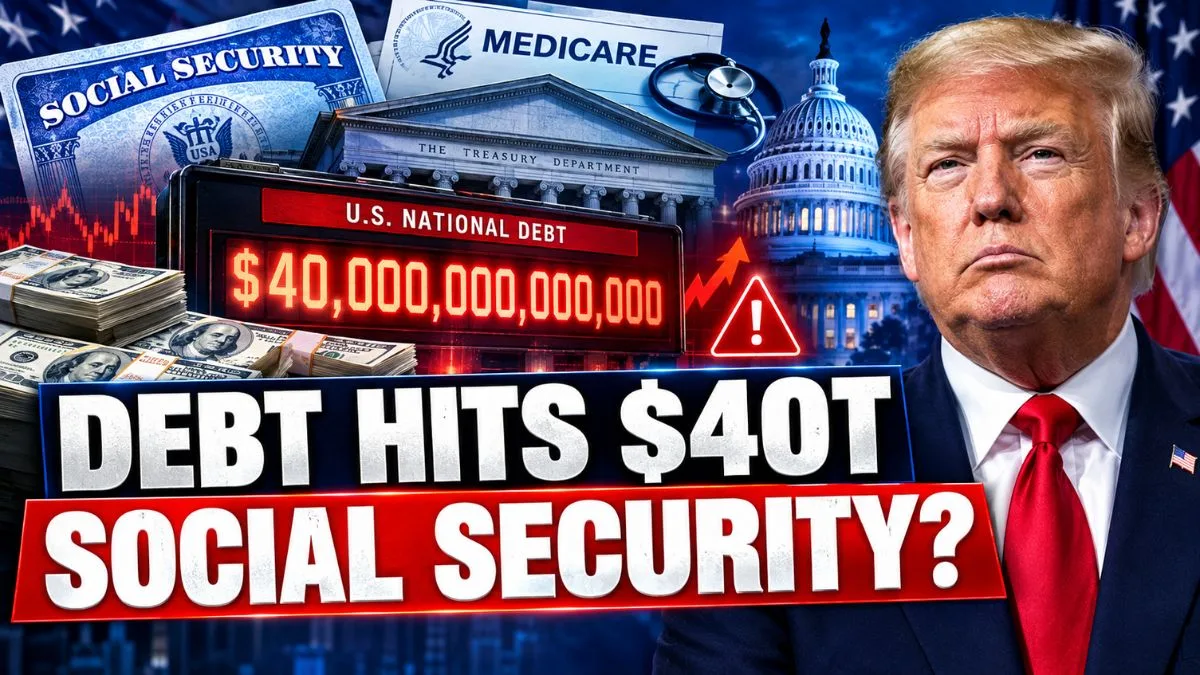
America’s federal debt has crossed the $40 trillion mark, but for millions of retirees, the more important question is not the size of the debt counter.
It is what happens to Social Security and Medicare if the federal government’s financial pressures continue to build.
The $40 trillion milestone does not automatically trigger cuts to either program. Social Security and Medicare have separate financing structures, dedicated revenues and trust funds. Their financial challenges also involve factors beyond the national debt itself.
However, the latest projections from the Social Security and Medicare trustees show that both programs face significant financing deadlines during the next decade. At the same time, federal interest costs and publicly held debt are projected to increase.
That combination could make future decisions about taxes, benefits, spending and borrowing more consequential.
Social
According to the 2026 Social Security and Medicare Trustees report, the Social Security Old-Age and Survivors Insurance, or OASI, Trust Fund is projected to exhaust its reserves in the fourth quarter of 2032.
If no legislative changes are made and the trust fund reaches that point, continuing program income would be sufficient to pay approximately 78% of scheduled OASI benefits.
That does not mean Social Security would suddenly stop sending checks.
The projection describes a financing shortfall under current law. Social Security would continue to receive incoming revenue, primarily from payroll taxes, but that revenue alone would not be enough to cover all benefits scheduled under current law.
The difference between scheduled benefits and payable benefits is why the trust fund date receives so much attention.
Financing
Social Security is primarily financed through payroll taxes collected from workers and employers. When the program collects more than it needs for current benefits and expenses, the surplus is credited to the trust funds and invested in special-issue U.S. Treasury securities.
When program costs exceed incoming revenue, the trust fund can be used to cover the difference.
The 2025 figures illustrate the pressure. Social Security’s OASI program recorded a $160 billion shortfall, while reserves declined from approximately $2.72 trillion to $2.56 trillion during the year.
A declining trust fund balance does not mean the money simply disappears. Rather, Treasury securities held by the trust fund are redeemed when needed to meet program obligations.
The longer-term issue is that demographic and financial pressures can cause benefit costs to grow faster than dedicated revenues.
Debt
The $40 trillion federal debt figure needs some context.
Not all federal debt is held by investors and institutions outside the government. Economists commonly distinguish between gross federal debt and debt held by the public.
Debt held by the public represents Treasury securities held by individuals, businesses, financial institutions, state and local governments, the Federal Reserve and foreign investors.
The Congressional Budget Office has projected that federal debt held by the public will rise from roughly 99% of GDP at the end of 2025 to 120% of GDP by 2036, under its baseline projections.
That matters because a government’s borrowing needs can affect how much of the federal budget is devoted to interest payments.
When interest expenses increase, lawmakers have fewer budgetary resources available for other priorities unless they raise revenue, reduce spending or borrow more.
Medicare
Medicare faces a separate financing challenge.
The program’s Hospital Insurance Trust Fund, which primarily finances Medicare Part A, is projected to exhaust its reserves in the second quarter of 2033, according to the 2026 trustees’ projections.
As with Social Security, the projected depletion date does not mean Medicare would simply disappear.
Instead, once the trust fund’s reserves are exhausted, incoming dedicated revenue would be insufficient to cover the full amount of scheduled Part A costs under current law.
The distinction is important because Medicare has several components with different financing arrangements. The Hospital Insurance Trust Fund primarily covers Part A services, while other parts of Medicare have different funding sources.
Consequently, a trust fund depletion date should not be interpreted as the date when the entire Medicare program ends.
Interest
Rising federal interest costs add another dimension to the problem.
The government must make interest payments on outstanding Treasury debt. When interest rates are higher, refinancing maturing debt and issuing new debt can become more expensive.
Treasury yields have moved significantly in recent years, with some longer-term yields reaching levels that have drawn attention from investors.
Higher yields can make government bonds more attractive relative to some riskier investments, while also increasing the federal government’s borrowing costs.
For financial markets, including cryptocurrency markets, those conditions can influence investor preferences and liquidity. Higher Treasury yields may provide investors with comparatively attractive returns from government securities, potentially reducing the amount of capital allocated to higher-risk assets.
That is a market consideration rather than a direct financing mechanism for Social Security or Medicare.
Options
The trust fund projections do not prescribe a single solution.
Congress could address the projected Social Security shortfall through changes to payroll tax revenue, benefit formulas, the taxable wage base, eligibility rules or other provisions.
Medicare’s financing gap could similarly be addressed through changes affecting revenues, payments, benefits or broader federal financing.
Different combinations would affect workers, retirees, taxpayers, employers and healthcare providers in different ways.
Additional federal borrowing is another theoretical option, but borrowing does not eliminate the underlying financing gap. It shifts costs into the federal budget and can increase future interest obligations.
This is why the debt level is relevant even though the national debt itself does not directly determine when Social Security or Medicare trust funds are depleted.
Retirees
For current and future retirees, the most important distinction is between scheduled benefits and projected payable benefits under current financing.
The trustees’ depletion dates are not predictions that benefits will suddenly fall to zero. They indicate when the respective trust funds are projected to lack sufficient reserves to pay all scheduled benefits under current law.
Congress has repeatedly changed Social Security and Medicare financing rules over their histories, and lawmakers could make further changes before the projected dates.
The timing of those changes matters because earlier adjustments can spread the effects across more workers and beneficiaries, while delaying action can narrow the range of options available.



Crypto
The federal debt story can also affect financial markets beyond government programs.
If Treasury yields remain elevated, investors may have greater incentive to hold relatively lower-risk government securities rather than allocate the same capital to speculative assets.
For cryptocurrency markets, that environment could affect demand for decentralized finance products, exchange liquidity, token fundraising and new project launches. Higher financing costs can also make capital more selective.
These effects are market risks rather than direct consequences of Social Security or Medicare trust fund depletion. Crypto prices remain influenced by many other factors, including monetary policy, regulation, market liquidity and investor sentiment.
The central issue for Social Security and Medicare is more straightforward. The $40 trillion debt milestone does not itself cut benefits or determine a trust fund’s future. The programs have their own financing systems, and the trustees’ projections show that both face significant funding challenges in the early 2030s. At the same time, rising federal debt and interest costs could make the broader budget environment more difficult. The eventual outcome will depend on decisions Congress makes about taxes, benefits, healthcare spending, borrowing and other federal priorities.