Social Security’s long-term funding outlook has raised concerns for retirees and workers planning for retirement. Under current projections, beneficiaries could face a substantial reduction in payments if policymakers do not address the program’s financing gap before the trust fund is depleted.
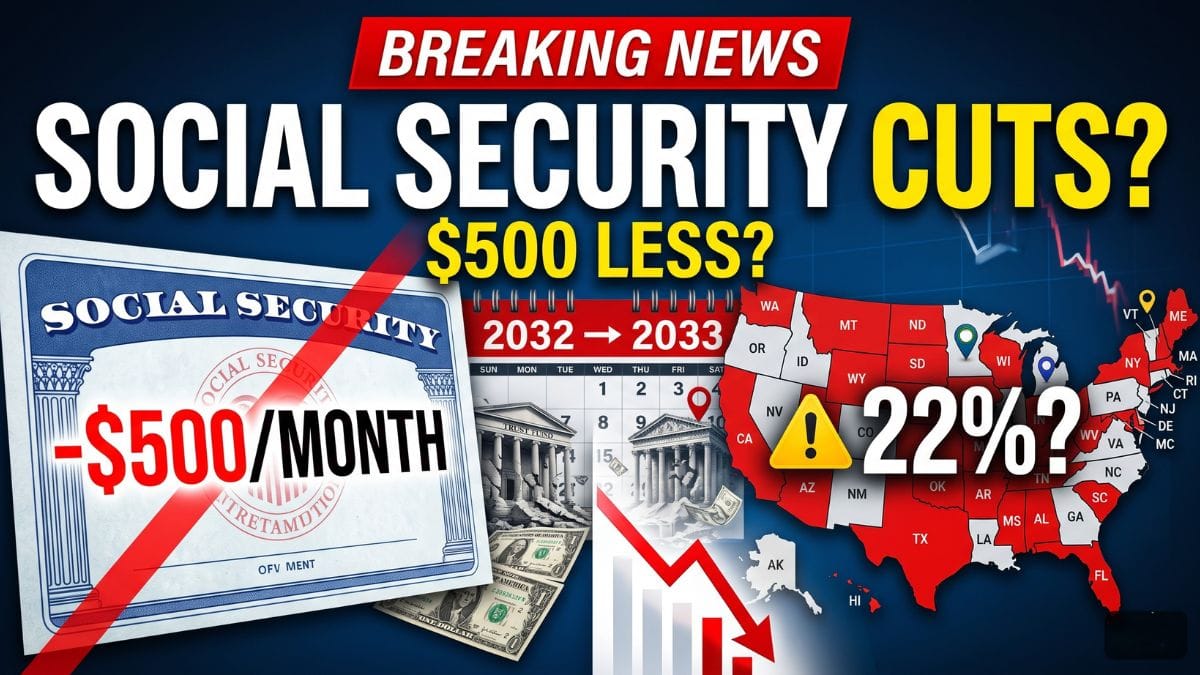
A recent Social Security Administration update projected that the Old-Age and Survivors Insurance (OASI) trust fund could become depleted in the fourth quarter of 2032. At that point, incoming payroll tax revenue would be enough to cover only about 78% of scheduled benefits under the projection.
That does not mean a 22% reduction is already scheduled or that every beneficiary will automatically lose that amount. Rather, the figure represents a projected shortfall if no changes are made to Social Security’s financing.
An analysis by the Committee for a Responsible Federal Budget (CRFB) estimated that a 22% reduction could cost a typical newly retiring dual-earning couple about $16,900 in annual benefits beginning in 2033. The impact would vary from person to person and from state to state.
States
The CRFB analysis identified 15 states where the average potential monthly reduction would exceed $500. These states also have some of the highest average Social Security benefits, meaning a percentage reduction can translate into a larger dollar loss.
Here are the estimated monthly reductions:
| State | Potential monthly reduction |
|---|---|
| Connecticut | $556 |
| New Jersey | $554 |
| New Hampshire | $554 |
| Delaware | $549 |
| Maryland | $541 |
| Washington | $531 |
| Minnesota | $530 |
| Massachusetts | $527 |
| Michigan | $523 |
| Utah | $523 |
| Virginia | $522 |
| Kansas | $520 |
| Pennsylvania | $519 |
| Rhode Island | $519 |
| Vermont | $516 |
These figures should be viewed as estimates rather than guaranteed reductions. The amount an individual could lose would depend on their actual benefit and any changes Congress makes to Social Security before the projected trust fund depletion date.
For example, a 22% reduction applied to a larger benefit produces a larger dollar decline than the same percentage applied to a smaller benefit. That helps explain why states with higher average Social Security payments appear prominently in this analysis.
Timing
The projected 2032 depletion date is important because it does not mean Social Security would stop paying benefits altogether.
Even if the OASI trust fund were depleted, Social Security would continue receiving payroll tax revenue. Based on the current projection, that revenue would cover roughly 78% of scheduled benefits.
The difference between scheduled benefits and incoming revenue is the reason analysts warn about potential reductions. Congress could make changes before depletion to increase revenues, reduce scheduled benefits, change eligibility rules or use some combination of measures.
The eventual outcome therefore remains uncertain.
For people who are several years away from retirement, this uncertainty makes planning particularly important. Social Security can be an important source of retirement income, but relying entirely on projected benefits may leave a household more exposed to future policy changes.
Delaying
One way some future retirees can increase their individual Social Security benefit is by delaying their claim.
People can generally begin claiming retirement benefits at age 62, but claiming before full retirement age results in a permanently reduced monthly benefit. Waiting beyond full retirement age can increase benefits through delayed retirement credits, up to age 70.
Fidelity estimates that, for a typical recipient, waiting until age 70 can increase monthly benefits by more than 77% compared with claiming at 62.
However, delaying is not automatically the best choice for everyone. Health, life expectancy, household income, employment and the need for current cash flow can all affect the decision. Married couples also need to consider how each spouse’s claiming decision affects household income and survivor benefits.
Options
People who have already claimed Social Security have fewer opportunities to change their benefit amount, but certain strategies may still apply in specific circumstances.
One option is withdrawing a Social Security application, although strict rules and deadlines apply. Another is voluntary suspension after reaching full retirement age. A suspension can allow delayed retirement credits to increase the benefit when payments resume.
These strategies are not suitable for every beneficiary and can have consequences for other benefits, including benefits received by family members. Anyone considering a change should review the current SSA rules and consider getting individualized financial advice.
Another possibility is earning additional income. Some older Americans continue working part time after reaching retirement age. According to Labor Department data cited by AARP, 38% of Americans age 65 and older were working part time as of 2024.
Part-time employment is not a solution for everyone, particularly people dealing with health limitations or caregiving responsibilities. But for those who can work, additional earnings can provide another source of retirement income and potentially reduce dependence on Social Security.
Planning
A potential Social Security reduction more than six years from now is not the same as a confirmed benefit cut. The projected 22% figure describes what could happen if the trust fund is depleted and policymakers make no changes to address the shortfall.
For retirees and future retirees, the practical response is to build flexibility into retirement plans. That could include increasing personal savings, reviewing when to claim Social Security, reducing future expenses or considering additional income sources.
The 15 states identified by the CRFB analysis have estimated average monthly losses of more than $500 under the projected reduction. But the actual effect on an individual beneficiary would depend on their benefit amount and future Social Security policy.
Social Security’s funding outlook is therefore a planning issue rather than a prediction that checks will definitely be cut by 22% in 2033. Keeping retirement income diversified can help households prepare for several possible outcomes while policymakers work on the program’s long-term finances.
FAQs
Could Social Security benefits be cut?
Benefits could be reduced if lawmakers do not address the funding shortfall.
When could the trust fund be depleted?
The OASI trust fund is projected to be depleted in the fourth quarter of 2032.
Will everyone lose $500 a month?
No. The potential loss depends on each person’s benefit and future policy.
Can delaying Social Security increase benefits?
Yes. Delaying retirement benefits can increase monthly payments up to age 70.