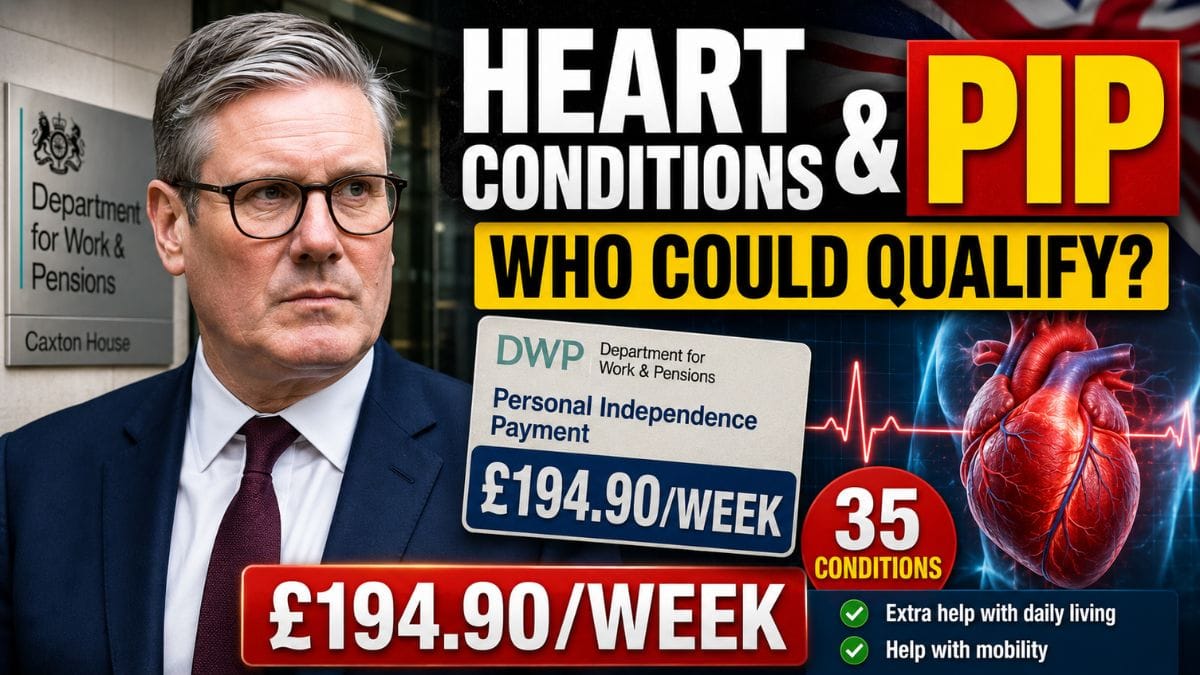
The Department for Work and Pensions (DWP) has published data covering 35 heart and vascular conditions associated with Personal Independence Payment (PIP) claims. The figures include more than 105,000 qualifying claims across the conditions listed in the latest data.
However, having one of these conditions does not automatically mean someone will receive PIP. The benefit is based primarily on how a person’s health condition affects their ability to carry out daily activities and move around, rather than simply the name of their diagnosis.
PIP rates increased by 3.8% in April 2026 as part of the annual benefit uprating. Depending on the combination of components and rates a claimant qualifies for, the maximum weekly amount can reach £187. This is sometimes described as around £748 over four weeks, although PIP is normally paid every four weeks rather than as a fixed monthly payment.
Conditions
The DWP data identifies 35 heart and vascular conditions associated with PIP claims. The figures below show the number of qualifying claims recorded for each condition:
| Heart or vascular condition | Qualifying claims |
|---|---|
| Aneurysm – aortic | 679 |
| Aneurysm – cerebral | 2,107 |
| Aneurysms – Other / type not known | 867 |
| Atrial fibrillation/flutter | 4,523 |
| Bradycardia | 169 |
| Cardiac arrhythmia – Pacemaker/implantable defibrillator fitted | 1,030 |
| Cardiac arrhythmias – Other / type not known | 1,839 |
| Heart block | 576 |
| Tachycardia | 3,647 |
| Cardiac failure | 16,660 |
| Cardiomyopathy | 4,469 |
| Atrioseptal defect (ASD) | 555 |
| Coarctation of the aorta | 139 |
| Fallots tetralogy | 222 |
| Heart disease – Congenital – Other / type not known | 4,044 |
| Patent ductus arteriosus (PDA) | 24 |
| Ventriculoseptal defect (VSD) | 440 |
| Heart transplantation | 307 |
| Hypertension | 6,248 |
| Angina | 8,846 |
| Ischaemic heart disease – Other / type not known | 10,489 |
| Myocardial infarction | 11,795 |
| Pericarditis | 257 |
| Aortic valve disease | 1,341 |
| Malformations of the heart – Congenital – Other / type not known | 1,131 |
| Mitral valve | 650 |
| Pulmonary valve disease | 227 |
| Tricuspid valve disease | 78 |
| Arterial disease excluding coronary – Other / type not known | 2,122 |
| Atherosclerosis (PVD / Claudication) | 2,092 |
| Buerger’s disease | 128 |
| Raynaud’s disease/phenomenon | 2,420 |
| Deep vein thrombosis | 3,404 |
| Peripheral venous disease – Other / type not known | 1,708 |
| Cardiovascular disease – Other / type not known | 10,528 |
Payments
PIP has two separate components: daily living and mobility. Each component has a standard and enhanced rate, and a claimant can receive one or both depending on how their condition affects them.
Following the April 2026 uprating, the weekly daily living rates are £76.55 for the standard rate and £114.80 for the enhanced rate. The mobility component is £30.20 at the standard rate and £80.10 at the enhanced rate.
A claimant receiving enhanced daily living and enhanced mobility would receive £194.90 per week under these rates. Therefore, the £187 figure sometimes cited in connection with PIP does not represent the current maximum weekly PIP award.
Eligibility
A diagnosis alone does not guarantee a PIP award. The DWP assesses how a health condition affects a person’s ability to complete specific daily living and mobility activities.
For example, someone with a heart condition may experience fatigue, breathlessness, pain or reduced physical stamina. If these difficulties affect relevant activities and meet the required criteria, they may contribute to eligibility.
The assessment considers the practical effects of a condition rather than relying solely on its medical label. This is why people with the same diagnosis can receive different PIP awards.
Claims
The data shows that some conditions are associated with substantially more PIP claims than others. Cardiac failure accounts for 16,660 qualifying claims in the supplied figures, while myocardial infarction has 11,795.
Other conditions with large numbers of claims include cardiovascular disease in the “other / type not known” category, with 10,528, and ischaemic heart disease in the corresponding category, with 10,489.
These figures should not be interpreted as an eligibility ranking. A condition having more recorded claims does not mean that it automatically provides a stronger basis for a PIP award.
Assessment
The DWP’s list is also not an exhaustive list of every condition that can result in PIP. Other health conditions can qualify when they cause sufficient difficulties with daily living or mobility.
This distinction is important because PIP is intended to help with additional costs associated with disability or long-term health conditions. The focus is therefore on functional limitations and their effects on everyday life.
Claimants generally need to show that their difficulties meet the relevant PIP criteria and have affected them for the required period. Evidence from healthcare professionals and other supporting information can help explain the impact of the condition.
Outlook
The latest DWP figures provide a snapshot of PIP claims linked to a range of heart and vascular conditions, but the presence of a condition on the list should not be viewed as an automatic entitlement to £748 a month. PIP rates depend on the components and levels awarded, and payments are normally made every four weeks.
For people with heart or vascular conditions, the central issue is how their condition affects everyday activities and mobility. The DWP assessment looks at those practical difficulties rather than simply confirming a diagnosis. Anyone considering a claim should check the current eligibility rules and provide evidence that clearly explains how their condition affects their daily life.
FAQs
Do heart conditions automatically qualify for PIP?
No. Eligibility depends on how the condition affects daily life.
How many heart conditions are listed?
The supplied DWP data covers 35 heart and vascular conditions.
What is the maximum PIP rate?
The combined enhanced rates currently total £194.90 weekly.
Does PIP have two components?
Yes. PIP includes daily living and mobility components.