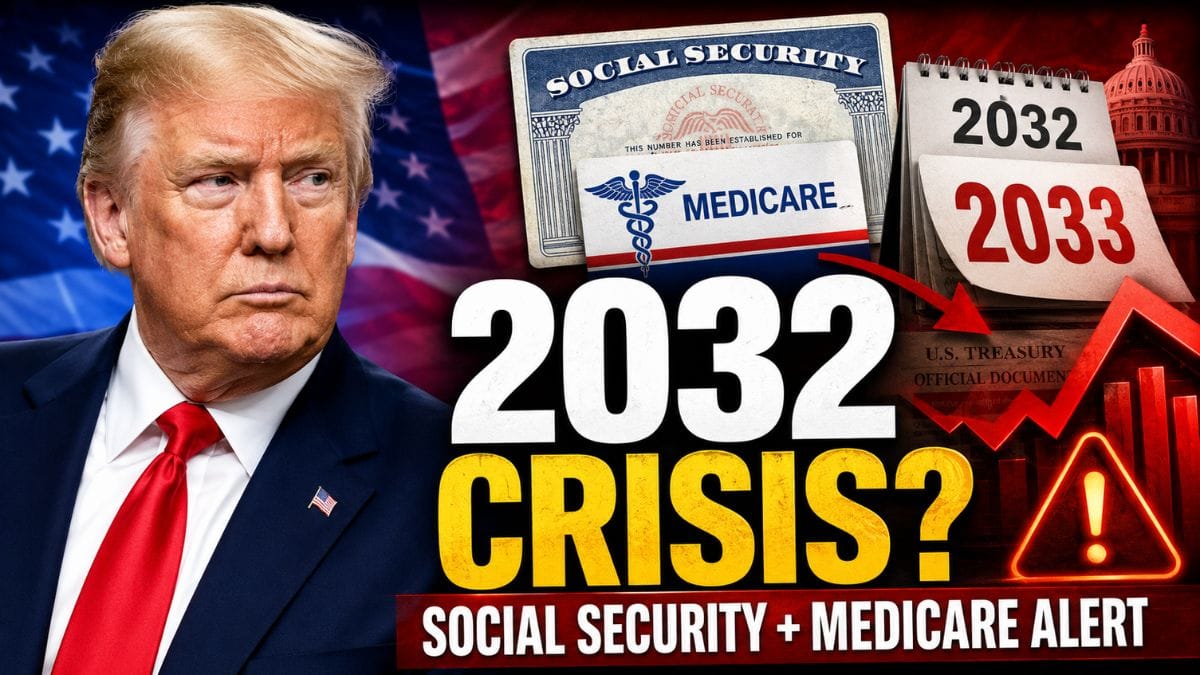
The latest annual report from the Social Security and Medicare Boards of Trustees offers an updated look at the long-term financial condition of the two largest federal entitlement programs. Released on June 9, the report shows that the projected dates for depletion of key trust funds have moved slightly closer than previously estimated. Under current projections, the Social Security trust fund is expected to reach depletion in 2032, while Medicare’s Hospital Insurance fund follows in 2033. Both timelines are now one quarter earlier than last year’s forecast.
The findings do not indicate sudden changes in program operation, but they do reflect gradual shifts in demographic trends, revenue assumptions, and healthcare spending patterns that continue to shape the outlook.
Outlook
Under intermediate assumptions, the Old-Age and Survivors Insurance (OASI) Trust Fund, which supports Social Security retirement benefits, is projected to pay full scheduled benefits through the fourth quarter of 2032. After that point, incoming payroll tax revenue is expected to cover about 78% of scheduled benefits.
For Medicare, the Hospital Insurance (HI) Trust Fund, which finances Medicare Part A services such as inpatient hospital care, is projected to remain fully funded through the second quarter of 2033. Once reserves are exhausted, continuing revenue would be sufficient to cover approximately 89% of scheduled benefits.
These projections are based on long-range economic and demographic assumptions that are updated annually and are subject to change over time.
Social
Social Security continues to serve as a primary source of retirement income for millions of Americans. The program is financed mainly through payroll taxes collected from current workers, which are then used to pay benefits to current retirees.
The report notes that recent changes in economic assumptions, including labor force participation and tax policy adjustments affecting older households, have reduced expected revenue compared with prior projections. As a result, the trust fund is projected to reach depletion slightly earlier than previously estimated.
| Program | Projected Depletion | Full Benefits Until | Post-Depletion Coverage |
|---|---|---|---|
| OASI (Social Security) | 2032 | Q4 2032 | 78% |
| Medicare HI (Part A) | 2033 | Q2 2033 | 89% |
The gap between scheduled benefits and projected revenue reflects the difference between promised benefits under current law and the funds expected to be available at that time.
Medicare
Medicare financing is divided into multiple trust funds. The Hospital Insurance Trust Fund, which supports inpatient and related services, is the part projected to face depletion in 2033.
At the same time, the Supplementary Medical Insurance (SMI) Trust Fund, which covers Medicare Part B and Part D services such as physician visits and prescription drugs, operates under a different structure. It is considered financially stable because it is automatically funded through beneficiary premiums and federal contributions that adjust annually to meet expected costs.
However, the report highlights ongoing pressure from rising healthcare costs, particularly increased spending on prescription drugs and greater use of higher-cost specialty treatments. While funding remains sufficient under current rules, spending growth continues to be an area of attention for policymakers.
Drivers
Several long-term factors are contributing to the projected financial pressures on both programs.
Demographic change remains the primary driver. As the population ages, the number of beneficiaries grows faster than the number of workers paying payroll taxes. This shifts the balance between incoming revenue and outgoing benefit payments.
Economic assumptions also play a role. Lower taxable wage growth and revisions to labor force participation reduce expected payroll tax receipts. In addition, certain tax policy changes affecting Social Security benefits for higher-income retirees have modestly affected projected revenues.
For Medicare, cost growth in healthcare services continues to be a key factor. Advances in medical technology, increased use of specialty drugs, and longer life expectancy all contribute to higher per-beneficiary spending over time.
Impact
If no policy changes are made before depletion, the trust funds would not cease operations but would instead rely solely on incoming revenue.
For Social Security, this would result in an estimated 22% reduction in scheduled retirement benefits starting in 2032. For Medicare Part A, projected reductions would be about 11% beginning in 2033.
These adjustments are automatic under current law and reflect the difference between scheduled benefits and available revenue. The implications extend beyond beneficiaries, affecting household financial planning, employer-sponsored retirement benefits, and demand for private savings and insurance products.
There is also a potential fiscal impact at the federal level. If policymakers choose to prevent benefit reductions, additional general revenue transfers could be required, which would influence broader budget deficits and debt levels.
Reform
Policy discussions around Social Security and Medicare typically focus on gradual adjustments intended to improve long-term balance.
For Social Security, options include incremental changes to retirement age thresholds, adjustments to benefit formulas, revised tax treatment of higher-income beneficiaries, and potential increases in payroll tax revenue. Some proposals also explore investment changes to improve returns on trust fund reserves, though such ideas involve broader policy considerations.
For Medicare, reform efforts often focus on controlling cost growth while maintaining access. Approaches include expanding value-based care models, improving coordination of services, adjusting provider payment systems, revising Medicare Advantage incentives, and strengthening efforts to manage prescription drug spending.
Most analysts emphasize that earlier policy adjustments would allow for smaller, more gradual changes over time, while delayed action would require more abrupt corrections.
The 2026 Trustees Report reflects a steady continuation of long-term fiscal pressures facing both Social Security and Medicare. While the programs remain fully operational under current law, the updated projections highlight the importance of long-range planning as demographic and economic trends continue to evolve.
The updated projections show that the financial timelines for Social Security and Medicare trust fund depletion are gradually moving closer. While the programs are not facing immediate disruption, the gap between scheduled benefits and projected revenue continues to narrow. The report underscores the importance of considering policy adjustments over time to maintain long-term stability and avoid sharper changes in the future.
FAQs
When will Social Security trust funds be depleted?
Current projections place depletion in 2032 under intermediate assumptions.
Will Social Security stop paying benefits after 2032?
No, benefits would continue at about 78% using payroll tax revenue.
When is Medicare Hospital Insurance expected to be depleted?
The projected date is 2033 based on current estimates.
Why are these timelines moving earlier?
Changes in demographic and economic assumptions reduced projected revenue.