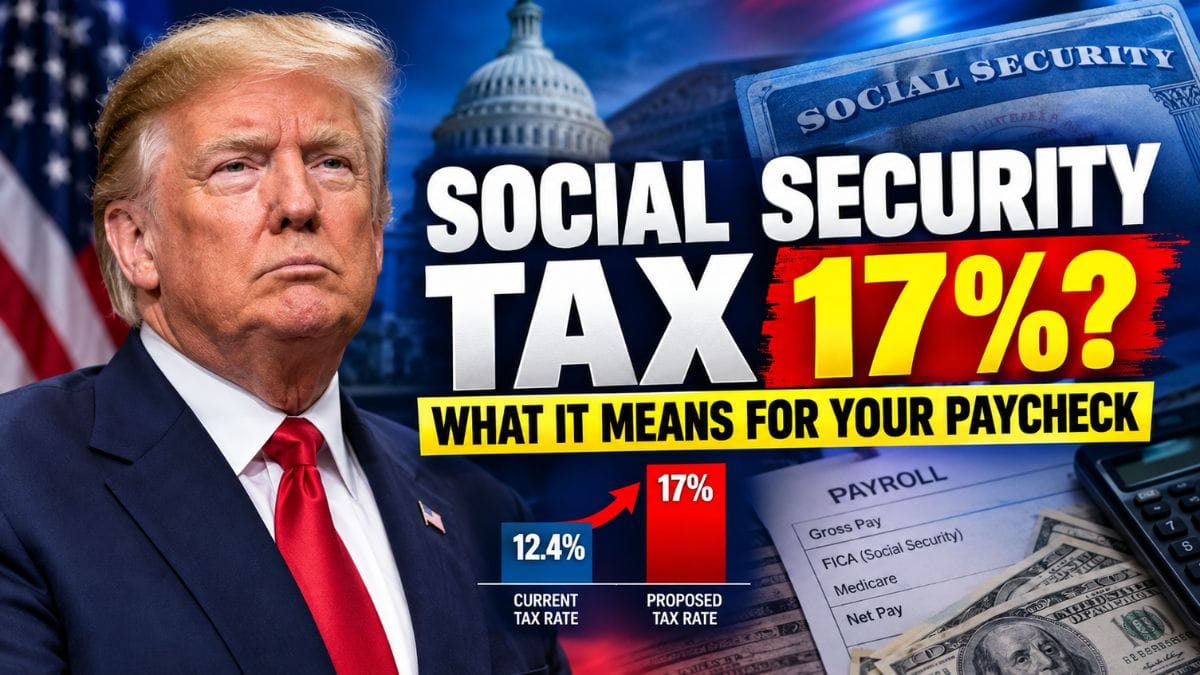
Social Security’s long-term finances could eventually put more pressure on workers, employers and self-employed Americans. One estimate suggests that if lawmakers tried to close the program’s projected funding gap entirely through payroll taxes, the combined Social Security tax rate could rise from 12.4% to about 17%.
For a worker earning around $62,000 a year, that type of increase could amount to several thousand dollars in additional annual taxes. The exact amount would depend on how a future tax change is structured, however, and no 17% payroll tax is currently scheduled under existing law.
The issue has gained attention because the Social Security trustees project that the retirement trust fund will be depleted in 2032. That date does not mean benefit payments would automatically stop. Instead, Social Security would continue collecting payroll tax revenue, but that revenue is projected to be insufficient to pay the full benefits scheduled under current law.
For workers, the eventual outcome could depend on whether lawmakers choose higher taxes, changes to benefits, additional federal revenue or a combination of approaches.
Funding
Social Security is primarily financed through payroll taxes paid by workers and employers. The current combined tax rate for Social Security is 12.4%, with employees generally paying 6.2% and employers paying another 6.2%.
The Social Security Administration explains how Social Security is financed, including the role of payroll taxes and trust fund reserves.
The system’s finances have become more challenging as the population ages. More Americans are receiving benefits, while the number of workers supporting each beneficiary has changed over time.
Social Security’s trust funds have helped cover the difference between dedicated tax revenue and scheduled costs. But those reserves are not unlimited.
The latest projections from the Social Security trustees put depletion of the retirement trust fund in 2032. The 2025 Social Security Trustees Report provides the official projections and financial details.
Shortfall
Trust fund depletion is sometimes described as Social Security “running out of money,” but that wording can be misleading.
Even after the retirement trust fund is depleted, Social Security would continue receiving payroll taxes and other dedicated revenue. The issue is that projected revenue would not be enough to cover 100% of scheduled benefits under current law.
The trustees estimate that continuing income would cover about 78% of scheduled retirement and survivor benefits after the retirement trust fund is depleted. The often-cited 22% figure represents the difference between those scheduled benefits and projected incoming revenue.
That distinction is important for workers trying to understand the 2032 date. It is a projected financing shortfall, not a date when Social Security checks are expected to disappear entirely.
The size of the eventual gap could also change as economic conditions, wages, employment, demographics and legislation change.
Tax Impact
One estimate from the Cato Institute suggests that addressing Social Security’s long-term financing gap through payroll taxes alone could require the combined rate to increase from 12.4% to roughly 17%.
For a worker earning approximately $62,000 annually, the estimate translates into roughly $2,600 to $3,000 in additional annual taxes.
That figure should be viewed as a policy estimate rather than a scheduled tax increase. The actual cost would depend on the design of any legislation, including which earnings are taxed and how the additional burden is divided between workers and employers.
Under the current system, employees generally pay half of the 12.4% Social Security tax through payroll deductions, while employers pay the other half.
Self-employed workers generally pay both portions through the self-employment tax system, although the tax code provides a deduction related to the employer-equivalent share.
Households
A higher payroll tax would affect take-home pay for employees if the employee share increased. It could also raise costs for employers if they were required to contribute more.
The household impact would vary according to income, employment status and the specific structure of a future policy.
For example, an additional tax of several thousand dollars a year would represent a much larger share of disposable income for some households than for others. Workers with limited emergency savings could have less room to absorb a higher payroll deduction.
Romina Boccia of the Cato Institute has argued that a substantial payroll tax increase could be difficult for many households to manage. That is an assessment of the potential household impact rather than an indication that such an increase has been enacted.
The broader point is that Social Security financing choices can affect both current income and longer-term retirement planning.
Alternatives
Higher payroll taxes are not the only possible response to Social Security’s financing gap.
Lawmakers could consider changes to the taxable wage base, benefit formulas, eligibility rules or other federal revenues. They could also combine several changes rather than relying on one measure.
The Social Security Administration’s Office of the Chief Actuary provides estimates of how different policy options could affect the program’s finances.
Different approaches would distribute costs differently.
A payroll tax increase would generally place more financing responsibility on workers and employers. Changes to benefit formulas could affect current or future beneficiaries, depending on the proposal. Additional federal revenue could shift some of the financing burden to the broader federal budget.
There is therefore no single automatic adjustment tied to the 2032 date. The trustees’ projections identify the financial gap, while Congress would determine any legislative response.



Workers
For workers, the important distinction is between a projection and an enacted policy.
A combined 17% Social Security payroll tax is one estimate of what might be required if payroll taxes alone were used to address the long-term financing gap. It is not the tax rate workers are currently required to pay.
The 2032 trust fund projection also does not mean Social Security benefits would immediately fall to zero. Based on current projections, payroll tax revenue would continue supporting a portion of scheduled benefits after trust fund depletion.
The eventual policy response could involve taxes, benefits, federal revenues or several measures at once. Each approach would affect workers and beneficiaries differently.
That makes the 2032 date an important point in the Social Security debate, but not a predetermined outcome for individual paychecks. For households, the practical question is how policymakers ultimately decide to divide the cost of keeping the program financially sustainable.