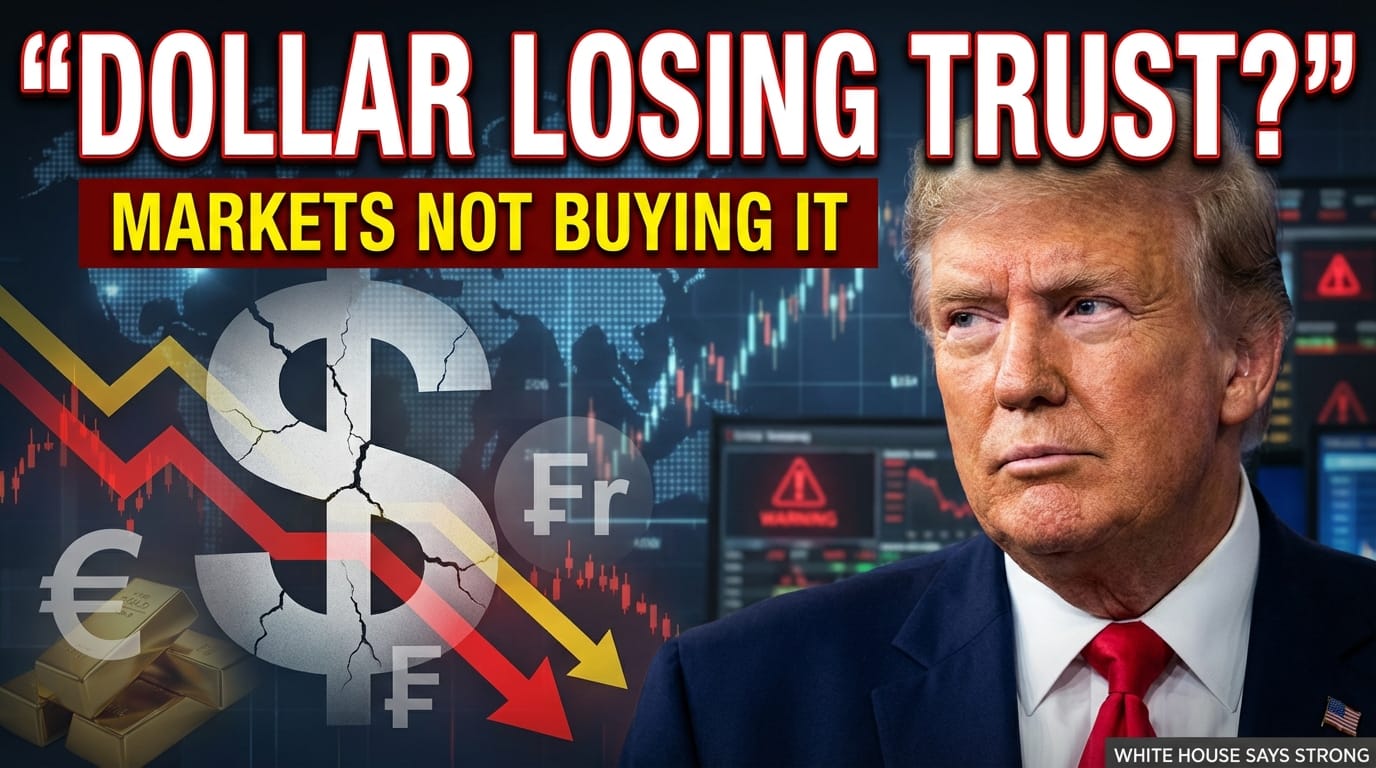
The White House continues to signal its support for a strong US dollar, but financial markets appear unconvinced. Despite official rhetoric, investors have kept their distance from the currency amid rising policy uncertainty, shifting trade dynamics, and questions over future monetary policy.
The US dollar index has recovered modestly in recent days, yet it remains about 1 percent lower for the year so far. That decline follows a steep 9 percent drop in 2025, marking the currency’s weakest annual performance in eight years. Together, these moves reflect a growing gap between official statements and investor sentiment.
Performance
The dollar’s recent struggles began in earnest last year. In April 2025, shortly after President Donald Trump announced a new round of so-called “Liberation Day” tariffs, the currency fell more than 5 percent in a matter of days. Nearly a year later, those losses have not been fully recovered.
Foreign exchange strategists at Goldman Sachs said the problem is not short-term market noise but a more durable shift in expectations. In a recent note, they argued that heightened policy uncertainty is likely to prevent the dollar from regaining lost ground. Investors who entered the year expecting stronger support for economic growth have instead been confronted with renewed tariff threats and unpredictable trade policy.
Confidence
For decades, the dollar has benefited from its role as the world’s primary reserve currency, a status often described as an “exorbitant privilege.” That position has made dollar-denominated assets a traditional safe haven during periods of global stress.
However, some strategists now question whether that advantage can be taken for granted. Thierry Wizman, global and foreign exchange strategist at Macquarie Bank, said the dollar’s reserve status is closely tied to the United States’ role as a guarantor of global security and a rules-based economic order. Developments over the past year, he argued, have encouraged investors to consider reallocating away from the dollar and to search for alternatives.
Policy
Uncertainty around US monetary policy has added another layer of complexity. Markets are assessing the potential impact of President Trump’s nominee to replace Federal Reserve Chair Jerome Powell, former Fed governor Kevin Warsh.
Although Warsh is widely viewed as a monetary hawk, news of his nomination provided only a brief lift to the dollar. Investors quickly shifted focus to President Trump’s own comments, in which he suggested that interest rates are “way high” and indicated a clear preference for rate cuts. Trump said he would not have nominated Warsh had he supported raising rates, reinforcing expectations of a more accommodative stance from the central bank.
Diversification
Even as the dollar remains central to the global financial system, traders are increasingly looking to diversify their exposure. Currencies such as the euro and Swiss franc, along with assets like gold, have attracted renewed interest as hedges against geopolitical risk and policy volatility.
Macquarie’s Wizman said the so-called dollar diversification trade is far from over. Historically, periods of dollar weakness driven by geopolitical shifts and domestic policy uncertainty have lasted for years, and sometimes for a decade or more. Under current conditions, he warned, the dollar may struggle to maintain its dominant status indefinitely.
Alternatives
The move away from the dollar has coincided with a strong rally in commodities. Gold rose more than 60 percent during 2025, one of its strongest annual performances on record, and remains up over 70 percent year on year despite a recent pullback. Other metals, including silver, platinum, copper, and steel, have also continued to climb into early 2026.
For now, the dollar remains the backbone of the international monetary system. But as policy uncertainty persists and investors seek protection elsewhere, official assurances alone may not be enough to restore confidence.
FAQs
How did the US dollar perform in 2025?
It fell about 9 percent, its largest annual drop in eight years.
What is the dollar’s performance so far this year?
The dollar index is down roughly 1 percent year to date.
Why are investors cautious on the dollar?
Policy uncertainty and trade tensions have weighed on confidence.
What role does Fed policy play in dollar weakness?
Expectations of lower interest rates have pressured the currency.