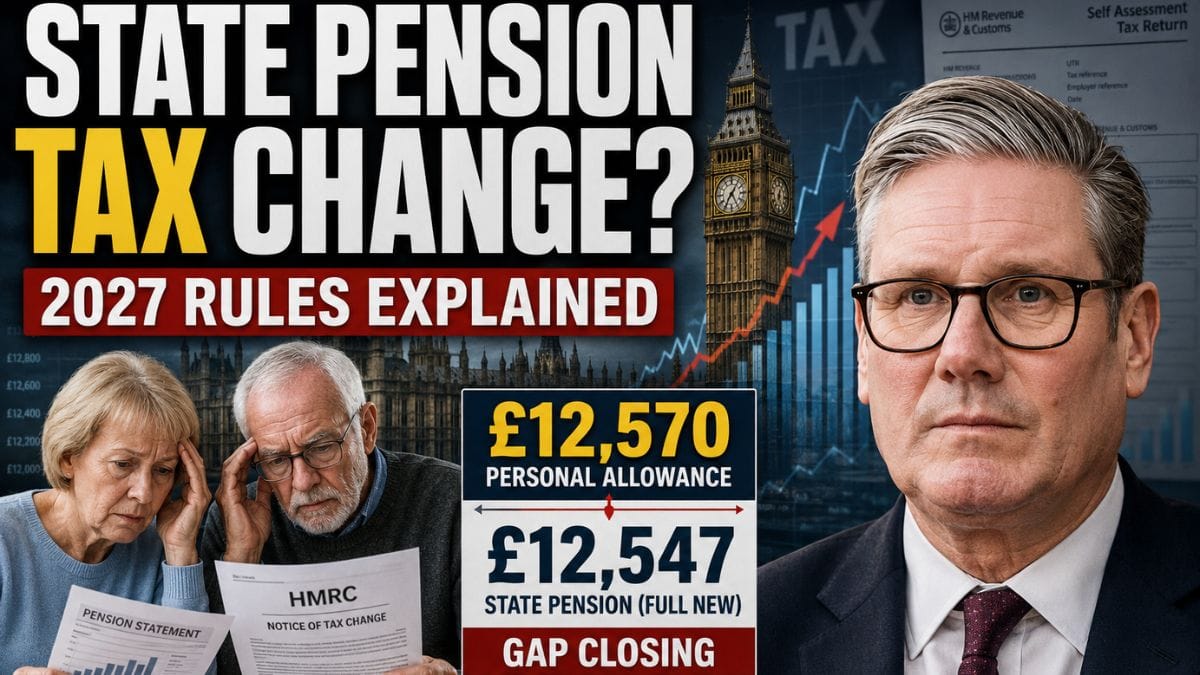
A planned tax change affecting state pension income is set to reshape how some retirees are treated under HMRC rules in the coming years. While the government has confirmed that pensioners relying solely on the state pension will not be pushed into paying income tax, the policy sits against a backdrop of rising pension values that are gradually approaching the personal allowance threshold.
The change is expected to become more relevant from the April 2027 tax year onward, as the full new state pension continues to rise under the triple lock system.
Threshold
At present, individuals in the UK can earn up to £12,570 per year before paying income tax, known as the personal allowance. The full new state pension currently stands at £241.30 per week, or approximately £12,547.60 per year, placing it just below that threshold.
This narrow gap is expected to close over time. Because the state pension increases each April based on the highest of wage growth, inflation, or 2.5 percent, future rises are likely to push it above the tax-free allowance unless policy adjustments are made.
Pressure
The concern for policymakers is not immediate taxation for current pensioners, but what happens as pension values continue to grow. By April 2027, projections suggest the full new state pension could exceed the personal allowance limit.
Without intervention, some retirees whose only income is the state pension could technically become liable for income tax, even if only marginally. This is the situation the government is attempting to prevent.
Proposal
Under proposals outlined in the Autumn Budget 2025, Labour stated that pensioners receiving only the state pension and no additional income would be exempt from income tax. The intention is to ensure that basic state pension income remains tax-free for those without supplementary earnings.
However, the exact structure of this exemption has not yet been published. Officials have indicated that HM Revenue and Customs would likely need to create a specific allowance or mechanism to identify eligible pensioners.
Administration
Tax and pension specialists expect that HMRC would need to maintain a system that distinguishes between pensioners who rely solely on the state pension and those with additional private or occupational income.
Kate Smith, head of public affairs at Aegon UK, noted that while the policy direction is clear, the practical implementation remains uncertain. One likely approach would be an annually updated allowance designed to keep pace with pension increases under the triple lock.
Senior HMRC officials have previously suggested that legislative changes may be required, potentially through a future finance bill.
Government
The Treasury has confirmed that no pensioner whose only income is the full new or basic state pension, without increments, will pay income tax during this Parliament.
Officials have also pointed to broader pension income trends. With the triple lock in place, around 12 million pensioners are expected to see income increases this year. The government has also highlighted that the UK continues to offer one of the highest personal allowances among major economies.
At the same time, ministers have acknowledged that further technical details of the policy are still being developed and will be published later.
Outlook
Chancellor Rachel Reeves has previously stated that the government is actively working on the implementation framework. The key challenge is ensuring that tax rules keep pace with annual pension increases while avoiding unnecessary tax burdens on low-income retirees.
Wider changes
Alongside tax adjustments, the state pension system is also undergoing long-term structural changes linked to retirement age.
The qualifying age for the state pension is scheduled to rise from 66 to 67 between April 2026 and April 2028. A further increase to 68 has already been legislated, planned for the mid-2040s.
These changes reflect longer life expectancy trends and aim to balance the long-term sustainability of the pension system.
Planning
To qualify for the full new state pension, individuals typically need 35 years of National Insurance contributions. Those with gaps in their record may be able to make voluntary contributions, though these are generally limited to the previous six tax years.
Government tools such as the state pension forecast service allow individuals to estimate their future entitlement and assess whether additional contributions may improve their retirement income.
As pension values rise and tax thresholds remain frozen until 2031, the interaction between HMRC rules and state pension growth is likely to remain a key issue for policymakers and retirees in the years ahead.
FAQs
Will state pensioners pay income tax soon?
Most pensioners with only state pension income are expected to remain exempt.
Why is the state pension close to the tax threshold?
Annual increases under the triple lock are pushing it toward the personal allowance.
What is the personal allowance?
The amount you can earn before paying income tax, currently £12,570.
Will retirement age change?
Yes, it is rising from 66 to 67 and later to 68.