People approaching State Pension age in the UK are being reminded that certain working-age benefits can no longer be claimed once they reach retirement age. While the State Pension provides a core income for millions, it also marks a shift in eligibility for several Department for Work and Pensions (DWP) benefits.
Recent figures show that around 13.2 million people across Great Britain currently receive the State Pension. The weekly payment can be up to £241.30 under the New State Pension system or £184.90 under the Basic State Pension, depending on National Insurance contributions.
Pension
The State Pension is a contributory benefit based on National Insurance records. To qualify for any payment, individuals typically need at least 10 qualifying years of contributions, with the full amount requiring many more depending on the scheme.
The State Pension age is gradually increasing. It is currently moving from 66 to 67, with those born between 6 March 1961 and 5 April 1977 set to reach pension age at 67. A further rise to 68 has already been legislated for the mid-2040s, although exact timing may be reviewed in future policy updates.
Changes
Reaching State Pension age does not just trigger pension entitlement. It also changes eligibility for a range of other benefits, particularly those aimed at working-age individuals or those seeking employment support.
The transition is important because some benefits stop entirely at pension age, while others remain available but under different conditions or assessment rules.
Benefits
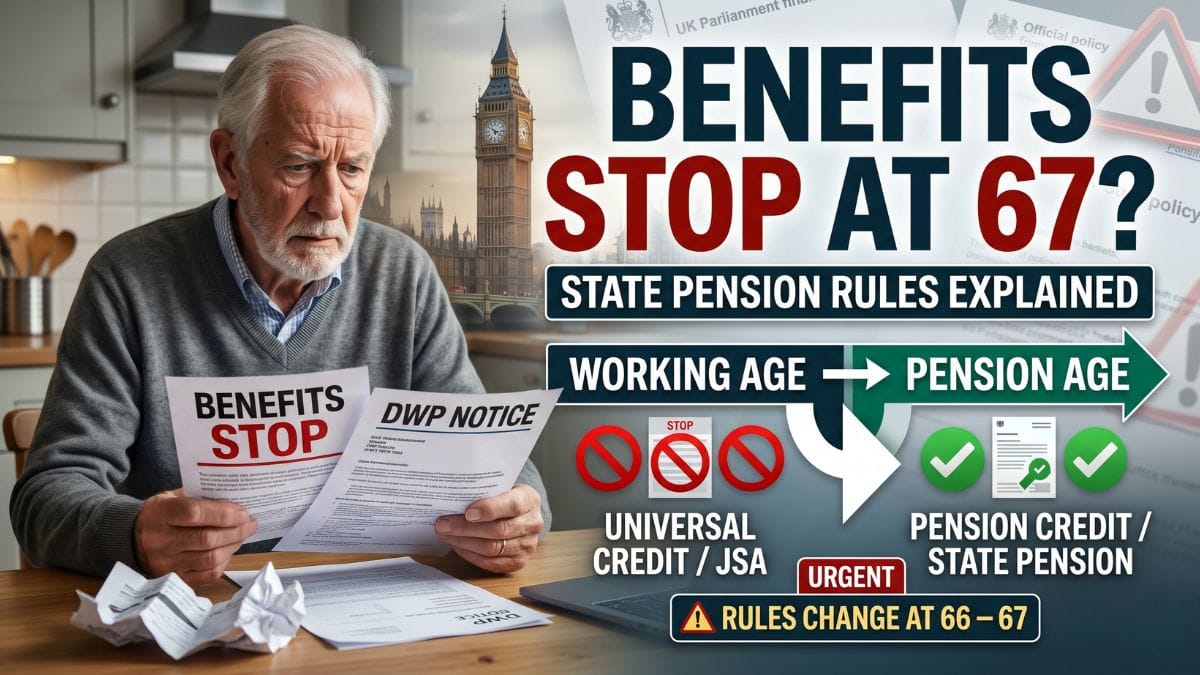
Once you reach State Pension age or Pension Credit age, several DWP working-age benefits can no longer be claimed. These include income-based Jobseeker’s Allowance, income-related Employment and Support Allowance, Income Support, and Universal Credit.
In addition, new claims for Jobseeker’s Allowance and contributory or new-style Employment and Support Allowance also end once State Pension age is reached. These rules reflect the shift from working-age support to pension-age support systems.
Disability
Rules around disability-related benefits also change at State Pension age. New claims for Personal Independence Payment (PIP), Disability Living Allowance (DLA), or Adult Disability Payment (ADP) are not normally accepted once pension age is reached.
However, existing awards may continue or be renewed in specific circumstances, particularly if the claim relates to the same health condition and is renewed within 12 months of the previous award ending.
Bereavement-related payments such as Bereavement Support Payment and Widowed Parent’s Allowance also cannot be newly claimed after reaching State Pension age.
Support
Not all benefits stop at retirement age. Some forms of support remain available, although eligibility may depend on income or personal circumstances.
Child Benefit continues to be available through HMRC regardless of age. Carer’s Allowance may also still be claimed, although the amount received can be affected by State Pension income. Other benefits such as Guardian’s Allowance and Statutory Sick Pay can also remain in place depending on conditions.
Pension Credit
Pension Credit becomes a key support mechanism for many pension-age households on lower incomes. It can top up weekly income and may also provide access to additional assistance such as Housing Benefit, Council Tax Support, and help with health costs.
Other schemes, including Winter Fuel Payment and Cold Weather Payment in certain regions, may also be available depending on eligibility criteria and location.
In Scotland, additional support such as the Winter Heating Payment and Pension Age Winter Heating Payment may also apply under separate arrangements.
Transition
The transition from working-age benefits to pension-age support can be complex, particularly for couples where one partner has reached State Pension age and the other has not. In these cases, benefit entitlement may depend on joint income assessments and specific eligibility rules.
Guidance tools such as the Turn2us benefit calculator are often used to help individuals understand what support they may still qualify for after retirement age.
Outlook
The overall system reflects a shift in government support from employment-focused benefits to pension-based income and supplementary assistance. While some benefits stop at State Pension age, others remain available in adjusted form or through separate eligibility routes.
Knowing these changes in advance can help individuals plan for retirement income and avoid unexpected gaps in support.
Bottom line
Reaching State Pension age in the UK changes access to a range of benefits. Working-age support such as Universal Credit and Jobseeker’s Allowance stops, while pension-age support systems such as Pension Credit and housing-related assistance may become more relevant.
The State Pension remains the main source of income for many retirees, but eligibility for additional support depends on individual circumstances and income levels.
FAQs
What benefits stop when you reach State Pension age?
Universal Credit, Jobseeker’s Allowance, Income Support, and related working-age benefits stop.
Can you claim PIP after State Pension age?
New claims are not allowed, but existing awards may continue in some cases.
What is the full new State Pension amount?
Up to £241.30 per week depending on National Insurance record.
What benefits can pensioners still claim?
Pension Credit, Housing Benefit, Council Tax Support, and some disability-related support.