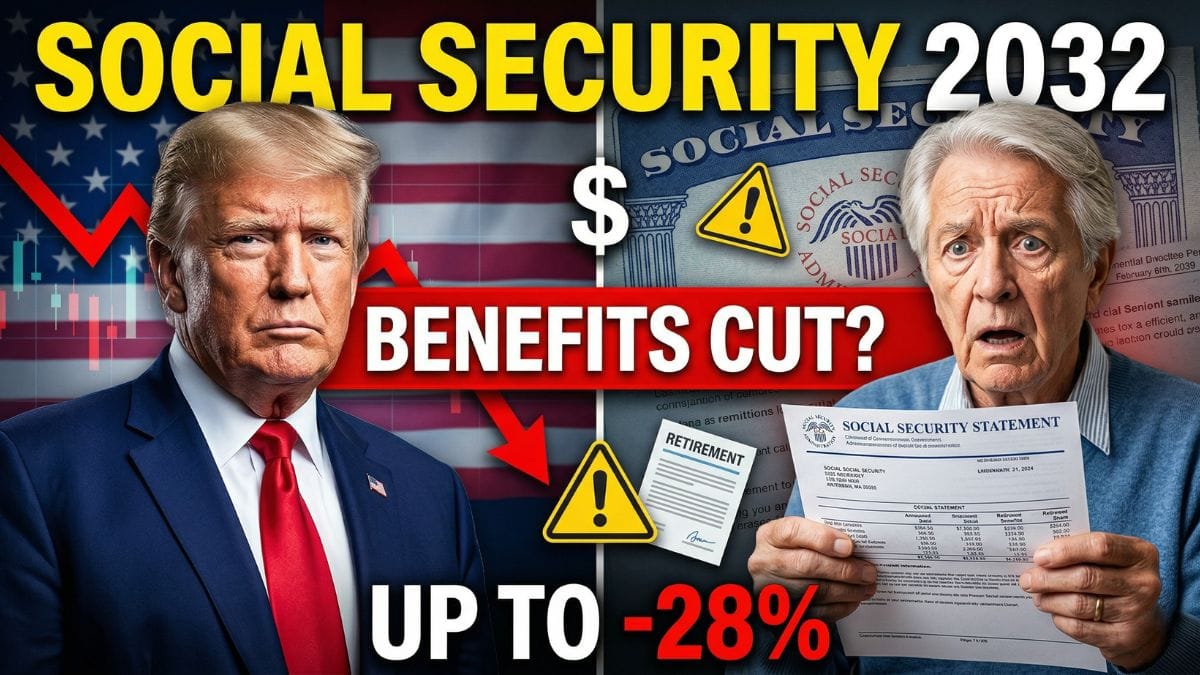
Social Security remains a central source of income for millions of Americans, particularly retirees. However, current projections suggest that by 2032, the program may face a significant financial milestone. If no legislative action is taken, beneficiaries could see reduced payments. This is not a sudden collapse, but rather a gradual adjustment tied to how the system is structured. Knowing what may happen helps individuals plan more effectively for the future.
Social Security operates primarily as a pay-as-you-go system. Payroll taxes collected from current workers are used to fund benefits for current recipients. When revenues exceed payouts, the surplus is stored in the Old-Age and Survivors Insurance trust fund.
In recent years, however, the system has paid out more than it collects. The difference has been covered by drawing down trust fund reserves. According to projections, these reserves could be depleted by 2032.
At that point, Social Security would continue operating, but only with incoming tax revenue. This revenue is expected to cover about 70 percent to 80 percent of scheduled benefits.
Effects
A reduction to 70 percent to 80 percent of benefits would have a measurable impact on monthly income. For many retirees, Social Security represents a substantial portion of their financial support.
The table below illustrates how different benefit levels could be affected:
| Current Monthly Benefit | Estimated Reduction | Adjusted Benefit |
|---|---|---|
| $1,500 | 20% | $1,200 |
| $2,000 | 25% | $1,500 |
| $2,500 | 28% | $1,800 |
These estimates are based on current projections and may vary depending on future economic conditions and policy decisions. Even so, the possibility of reduced income highlights the importance of preparing for different scenarios.
Mechanism
The potential for benefit reductions is tied to legal requirements. By law, Social Security cannot distribute more funds than it receives once the trust fund reserves are exhausted.
This means that if no changes are made before 2032, adjustments to benefits would occur automatically. They would not require additional legislation or policy changes at that point.
Initial reductions could be smaller, possibly around 7 percent, followed by larger adjustments in subsequent years. Over time, reductions could approach 20 percent to 28 percent, depending on revenue and demographic trends.
Drivers
Several long-term factors have contributed to the current funding outlook.
First, life expectancy has increased. People are living longer and receiving benefits for more years. Second, birth rates have declined, resulting in fewer workers entering the labor force. Third, the ratio of workers to beneficiaries has decreased, reducing the amount of payroll tax revenue available per recipient.
Together, these trends have created a structural imbalance. The system now relies more heavily on reserves, which are gradually being depleted.
Policy
Policymakers have proposed various approaches to address the projected shortfall. Each option involves trade-offs and has been the subject of ongoing debate.
| Policy Option | Description | Considerations |
|---|---|---|
| Increase payroll taxes | Raise contribution rates | Higher cost for workers |
| Remove income cap | Tax higher earnings fully | Affects high-income earners |
| Raise retirement age | Delay eligibility | Longer working years |
| Adjust benefits | Modify formulas | Lower payouts for some |
No single solution has gained broad consensus. In practice, a combination of measures may be required to restore long-term balance.
Outlook
The timeline for action is narrowing, but outcomes are still uncertain. If reforms are implemented before 2032, changes could be phased in gradually, reducing the impact on current and near-term retirees.
If no action is taken, automatic reductions would begin once reserves are depleted. This would not eliminate Social Security, but it would change the level of support provided.
For individuals, the situation underscores the value of planning. Relying solely on projected benefits may carry some risk, given the uncertainty around future policy decisions.
Preparation
Planning for retirement in this context involves considering a range of possibilities. Individuals may choose to increase personal savings, review retirement timelines, or diversify income sources.
Delaying the start of Social Security benefits, when possible, can also increase monthly payments. Additionally, managing expenses and maintaining flexibility in financial plans may help offset potential reductions.
Social Security remains a key component of retirement security, but it is most effective when combined with other sources of income.
In summary, the projected 2032 funding shortfall does not signal the end of Social Security. Instead, it points to a likely adjustment in benefits if no policy changes are made. Knowing these projections allows individuals and policymakers alike to make informed decisions in the years ahead.
FAQs
Will Social Security stop in 2032?
No, payments will continue at reduced levels.
How much could benefits decrease?
They may drop by 20% to 28%.
Why is there a funding gap?
Fewer workers and longer retirements.
Can lawmakers fix the issue?
Yes, through taxes or policy changes.