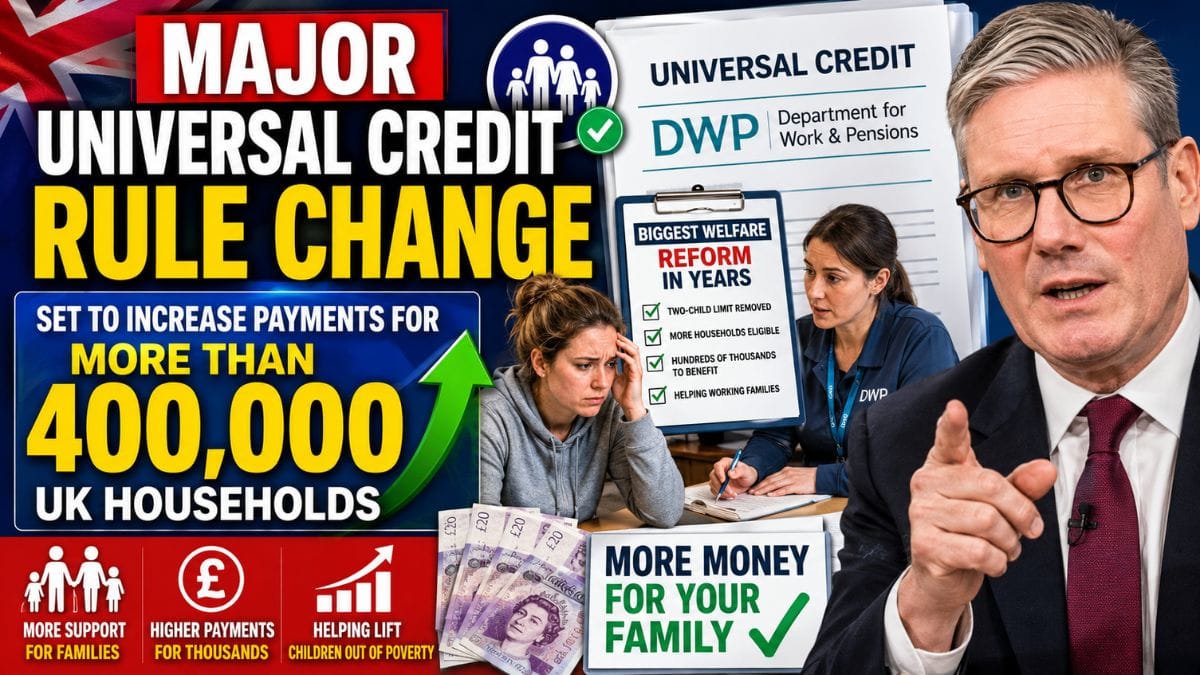
More than 400,000 households across the UK are expected to receive higher Universal Credit payments after the Government removed the two-child benefit limit. The policy change marks one of the biggest recent reforms to the welfare system and is expected to increase financial support for many families.
The Department for Work and Pensions (DWP) says the change will affect hundreds of thousands of households across England, Scotland, and Wales. While the increase will vary depending on individual circumstances, the reform is expected to provide additional support to families previously affected by the restriction.
Change
The two-child limit previously restricted Child Tax Credit and the child element of Universal Credit to the first two children in most households.
The policy was officially abolished on April 6 after Chancellor Rachel Reeves confirmed its removal in the Autumn Budget announced in November.
The Government said the decision reflects a change in its approach to supporting families with children through the benefits system.
Impact
According to the DWP, around 436,780 households are expected to benefit from the removal of the two-child limit.
Those households are home to approximately 1,544,900 children across Britain.
The Government also estimates that removing the policy could lift around 450,000 children out of poverty by the end of the 2029/30 financial year.
| Estimated Impact | Figures |
|---|---|
| Households expected to benefit | 436,780 |
| Children living in those households | 1,544,900 |
| Children projected to be lifted out of poverty by 2029/30 | 450,000 |
Universal
Universal Credit is a monthly payment that helps people with living costs.
It is available to eligible people who:
- Are on a low income.
- Are in work.
- Are unemployed.
- Cannot work because of their circumstances.
The amount someone receives depends on their household income, savings, and personal circumstances.
Employment
DWP figures show that many families affected by the previous two-child limit are already in employment.
According to the latest data, around 58% of households impacted by the policy have at least one person in work.
This means the change affects both working families and those who are not currently employed.
Poverty
The Government believes removing the two-child limit will reduce child poverty over time.
However, the full impact will not be immediately reflected in the UK’s official poverty statistics.
Because the statistics are produced using a 12-month reporting period, the effects of the policy are expected to appear in the 2026/27 figures, which are likely to be published in spring 2028.
Previous
Before the policy was abolished, the two-child limit affected a record 469,780 households across Britain during the year ending April 2025.
Those households included around 1.7 million children.
As with the more recent figures, most affected households were working families rather than households without employment.
| Previous Two-Child Limit Data | Figures |
|---|---|
| Households affected | 469,780 |
| Children affected | 1.7 million |
| Working households | 59% |
Regional
The impact of the previous policy varied across different parts of the country.
Greater Manchester recorded around 111,720 children living in households affected by the two-child limit.
Some of the highest proportions were recorded in:
| Area | Children Affected |
|---|---|
| Blackley and Middleton South | 7,720 |
| Salford | 6,130 |
Other constituencies, including Manchester Central, Bolton South and Walkden, Manchester Rusholme, and Gorton and Denton, also recorded relatively high proportions of children affected.
By comparison, constituencies such as Cheadle and Altrincham and Sale West recorded much lower percentages.
Outlook
The removal of the two-child limit represents a significant change to Universal Credit and Child Tax Credit policy. According to the DWP, more than 436,000 households are expected to receive increased financial support as a result of the reform. While the exact increase will depend on each family’s circumstances, the policy is expected to provide additional assistance to many households across the UK, with its wider effects becoming clearer as future benefit and poverty data are published.
FAQs
What is the two-child limit?
It limited benefits to the first two children in most households.
How many households will benefit?
Around 436,780 households are expected to benefit.
Does the change affect working families?
Yes. Many affected households are already in work.
When was the policy removed?
The two-child limit was abolished on April 6.