The UK Department for Work and Pensions (DWP) has introduced new bank account verification powers as part of a wider effort to reduce benefit fraud and incorrect payments. The measures allow banks and other financial institutions to check specified account information against eligibility rules for certain government benefits.
The government expects the new system to help save taxpayers £1.2 billion by 2030/31. The checks are designed to identify potential problems involving undeclared savings, capital above permitted limits and claimants who may have remained outside the UK longer than benefit rules allow.
The first Eligibility Verification Notice was issued on October 26, 2026, activating provisions introduced under the Public Authorities (Fraud, Error and Recovery) Act 2025.
The changes have attracted attention because they introduce a new way for the DWP to obtain limited financial information through banks. However, the system does not give the department unrestricted access to personal bank accounts, shopping records or everyday spending.
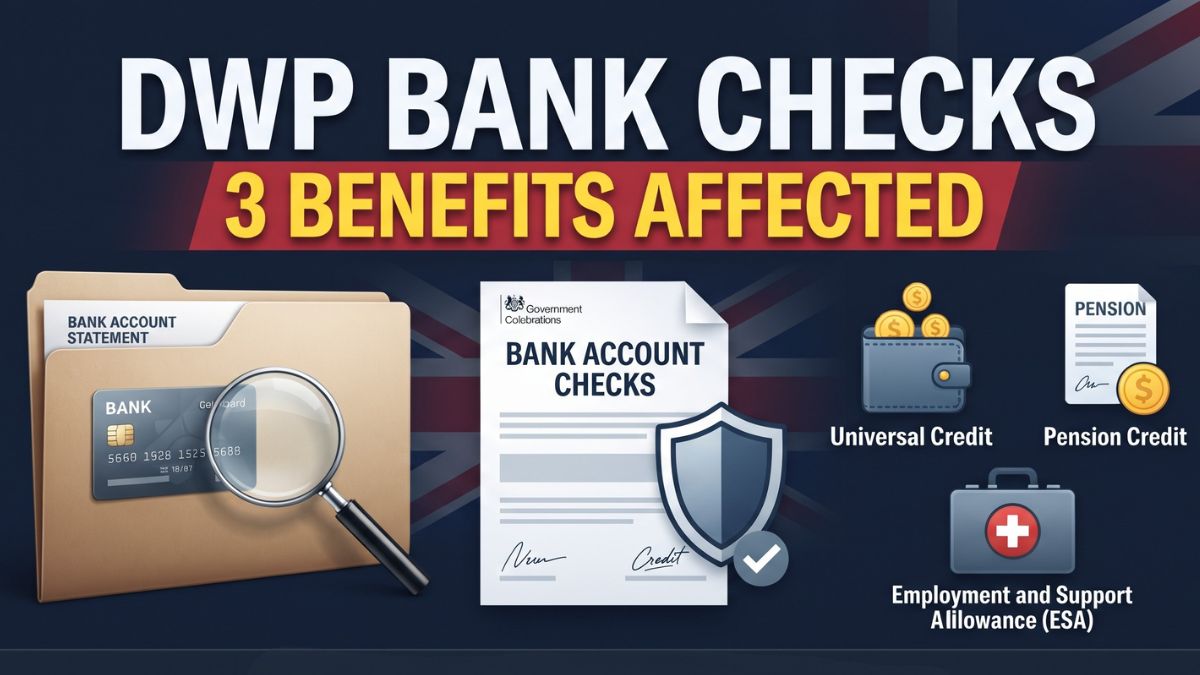
The initial measures cover Universal Credit, Pension Credit and Employment and Support Allowance (ESA). A bank account being identified by the system does not automatically mean that someone has committed fraud or will lose their benefits.
Here is what the new DWP bank checks involve, which benefits are covered, and how the government plans to use the information.
Changes
The new Eligibility Verification Measure (EVM) gives the DWP additional powers to request checks from banks and other financial institutions.
Under the previous arrangements, the department relied on information provided by claimants, existing verification procedures and investigations to identify potential benefit eligibility problems.
The new system adds another layer of verification by allowing financial institutions to identify specified account information that may indicate a claimant no longer meets certain eligibility conditions.
The first Eligibility Verification Notice was issued on October 26, 2026. This marked the activation of measures established under the Public Authorities (Fraud, Error and Recovery) Act 2025.
The government has identified two initial areas of concern:
- Undeclared savings or capital that exceed benefit eligibility limits.
- Extended periods spent outside the UK that may breach benefit residence or absence rules.
According to government estimates cited in the announcement, these two issues cost taxpayers approximately £1.5 billion during 2025-2026 in connection with Universal Credit and Pension Credit.
The government intends to use the new powers to identify potential eligibility discrepancies earlier and reduce incorrect payments.
Benefits
The new bank verification arrangements initially apply to three benefits administered by the DWP.
| Benefit | What the checks may identify |
|---|---|
| Universal Credit | Savings above applicable capital limits and potentially excessive overseas stays |
| Pension Credit | Undeclared savings and capital affecting eligibility |
| Employment and Support Allowance | Financial information relevant to benefit eligibility |
Universal Credit and Pension Credit are particularly relevant because both can be affected by a claimant’s financial circumstances.
For example, Universal Credit generally has capital limits that can affect entitlement. Savings above £6,000 may reduce payments, while capital exceeding £16,000 will usually mean a person is not eligible, subject to applicable exceptions.
Pension Credit also has rules concerning income and savings. The treatment of capital depends on the claimant’s circumstances and the applicable benefit rules.
Employment and Support Allowance has different eligibility requirements depending on the type of ESA and the claimant’s circumstances.
Importantly, the new bank verification powers do not automatically apply to every benefit administered by the DWP.
Personal Independence Payment (PIP), for example, is not included in the initial three-benefit scope of the measure.
Checks
Under the new framework, the DWP can issue an Eligibility Verification Notice requiring a financial institution to examine specified accounts against particular eligibility indicators.
Banks will not be asked to investigate every aspect of a claimant’s financial life. Instead, they must look for information relevant to the conditions set out in the notice.
The checks may cover qualifying linked accounts, including certain joint accounts, where the statutory requirements are met.
If an account matches a specified indicator, the financial institution may be required to provide limited identifying and financial information.
This can include:
- Names and identifying details of account holders.
- Relevant account numbers and sort codes.
- Information about qualifying linked accounts.
- Capital held in relevant accounts.
- Details showing how an account meets a specified eligibility indicator.
- Relevant dates associated with overseas account use.
The purpose is to provide the DWP with information that can help determine whether additional enquiries are necessary.
A matching account does not establish that the claimant has deliberately withheld information or received benefits incorrectly.
The department must assess the circumstances before reaching a decision.
Privacy
One of the main questions surrounding the new rules concerns how much access the DWP will have to people’s bank accounts.
The government has stated that the Eligibility Verification Measure does not provide unrestricted access to banking information.
Banks are not required to provide the department with ordinary shopping records, individual purchases, transaction amounts or payment recipients under this measure.
This means the system is not designed to show officials where someone buys groceries, how much they spend on clothing or which shops they visit.
Instead, the information is restricted to the specified eligibility indicators and relevant account details.
The statutory Code of Practice also places restrictions on the information that can be requested.
Generally, notices cannot request information more than one year old, although exceptions apply to the date on which an account first met an eligibility indicator.
These safeguards are intended to ensure that information collection remains proportionate to the purpose of checking benefit entitlement.
The government has also indicated that independent oversight will apply during the initial implementation and testing phase.
Payments
A bank account being flagged under the new system does not automatically mean that benefit payments will stop.
This is an important distinction for people receiving Universal Credit, Pension Credit or ESA.
The purpose of an Eligibility Verification Notice is to identify information that may require further investigation.
For example, a bank may identify an account suggesting that a claimant has savings above a relevant threshold. The DWP may then need to contact the claimant and examine the information before deciding whether the benefit calculation is correct.
Similarly, evidence suggesting that someone has spent an extended period abroad does not automatically prove that they have breached benefit rules.
The department must consider the relevant circumstances and applicable regulations.
Decisions about benefit eligibility cannot be based solely on information obtained through an Eligibility Verification Notice.
If the DWP identifies an incorrect payment, it must follow the relevant assessment and decision-making procedures.
This approach is intended to distinguish between deliberate fraud, administrative mistakes and situations where a claimant has misunderstood reporting requirements.
Savings
The government expects the new bank verification system to generate £1.2 billion in savings by 2030/31.
The projected savings are linked to preventing incorrect payments and identifying potential fraud involving undeclared capital and overseas stays.
The figure is part of a broader government programme to reduce benefit fraud, administrative errors and outstanding benefit debt.
According to the government’s announcement on October 26, the wider programme is expected to deliver £14.6 billion in savings over five years.
The Public Authorities (Fraud, Error and Recovery) Act 2025 also provides additional powers relating to information gathering and debt recovery.
The government argues that identifying incorrect claims earlier could reduce the amount of money paid incorrectly and limit the accumulation of overpayments.
However, the £1.2 billion figure is a forecast, not money already recovered.
The actual savings will depend on the results of the testing phase, the number of discrepancies identified and the effectiveness of subsequent investigations.
Budget
The government’s October 28, 2026, Budget introduced further measures intended to strengthen benefit fraud prevention.
These include funding to recruit more than 2,000 additional specialist DWP staff to investigate suspected fraud and errors involving Universal Credit claims.
According to the Budget measures described in the supplied information, the recruitment programme is expected to begin in April 2027.
The additional staffing is forecast to generate approximately £175 million in savings by 2031-2032.
The government has also outlined additional checks involving Pension Credit and Universal Credit.
Pension Credit claimants will face measures requiring them to confirm the amount of capital they hold.
For Universal Credit, the Budget includes restrictions on access to repeat New Claims Advances where a previous advance remains outstanding. Exemptions are intended to protect people facing exceptional circumstances.
Together, these measures are designed to improve verification at different stages of the benefits process.
The government has said that its wider programme of fraud and error reforms could generate more than £20 billion in total savings over the forecast period.
Workforce
The bank verification programme is also being introduced alongside changes to the DWP’s existing workforce.
Earlier in October 2026, the department announced plans to bring approximately 2,700 outsourced employees involved in Universal Credit verification operations into its direct workforce.
The move is intended to increase the department’s direct operational capacity.
According to civil service workforce statistics for March 2026, the DWP employed 96,925 people. This was approximately 640 fewer than the Ministry of Justice at the time.
Bringing outsourced verification staff into the department could increase its workforce as the government expands checks on benefit applications and existing claims.
The additional staff are expected to support verification activities and help identify potential incorrect payments.
The workforce changes also form part of a wider effort to strengthen the department’s ability to investigate cases that require further assessment.
Enforcement
The government has highlighted several benefit fraud cases to explain why it believes stronger verification measures are necessary.
Some recent prosecutions involved claimants providing inaccurate information about their relationships or personal circumstances.
Examples cited in the supplied information include:
- Colin Hegarty, who fraudulently claimed more than £70,000 after presenting himself as single.
- Bethany Elwood, who was sentenced in connection with a £78,000 Universal Credit fraud involving false information about her relationship.
- Catherine Wieland, who was sentenced in connection with approximately £23,000 in fraudulent Personal Independence Payment claims.
These cases demonstrate how inaccurate information about personal circumstances can affect benefit entitlement.
However, there is an important distinction between these prosecutions and the new bank verification arrangements.
PIP is not currently included in the three benefits covered by the Eligibility Verification Measure.
The new bank checks specifically cover Universal Credit, Pension Credit and Employment and Support Allowance.
Any extension to additional benefits would require the appropriate legal authority.
Claimants
People receiving the affected benefits should continue reporting changes in their circumstances accurately and promptly.
This includes changes that may affect income, savings, household circumstances and periods spent outside the UK.
Claimants should also keep relevant financial records and respond to requests for information from the DWP.
If someone receives a notice asking them to clarify their savings or circumstances, they should review the information carefully and provide accurate details.
It is also important to remember that having savings or travelling abroad does not automatically mean someone is committing benefit fraud.
Different benefits have different eligibility rules, and certain exceptions may apply depending on the claimant’s situation.
Anyone unsure about how a particular financial change affects their benefits can consult the official government guidance or seek independent welfare advice.
The official information is available through the UK government’s benefits and support website.
Outlook
The DWP’s new bank verification powers represent a significant change in how the department can identify potential benefit eligibility problems.
By allowing banks to check specified account information, the government hopes to identify undeclared savings and potentially excessive overseas stays before incorrect payments accumulate.
However, the measure does not give the DWP unrestricted access to bank accounts, nor does it automatically suspend benefits when an account matches an eligibility indicator.
The initial programme covers Universal Credit, Pension Credit and Employment and Support Allowance, with further enquiries required before decisions can be made about individual claims.
The government expects the new system to save £1.2 billion by 2030/31, while additional staffing and Budget measures form part of a wider effort to reduce benefit fraud and administrative errors.
For claimants, the main practical consideration remains the same: provide accurate information, report relevant changes and respond to official requests. The new checks are intended to strengthen eligibility verification, but they do not remove the need for individual assessments or the safeguards established under the law.
FAQs
What are the new DWP bank checks?
They allow banks to check specified account information against benefit eligibility rules.
Which benefits are covered by the new checks?
The initial checks cover Universal Credit, Pension Credit and Employment and Support Allowance.
Can DWP access my everyday bank transactions?
No. The measure does not provide unrestricted access to purchases or transaction histories.
Will a flagged bank account stop my benefits?
No. The DWP must conduct further checks before making an eligibility decision.