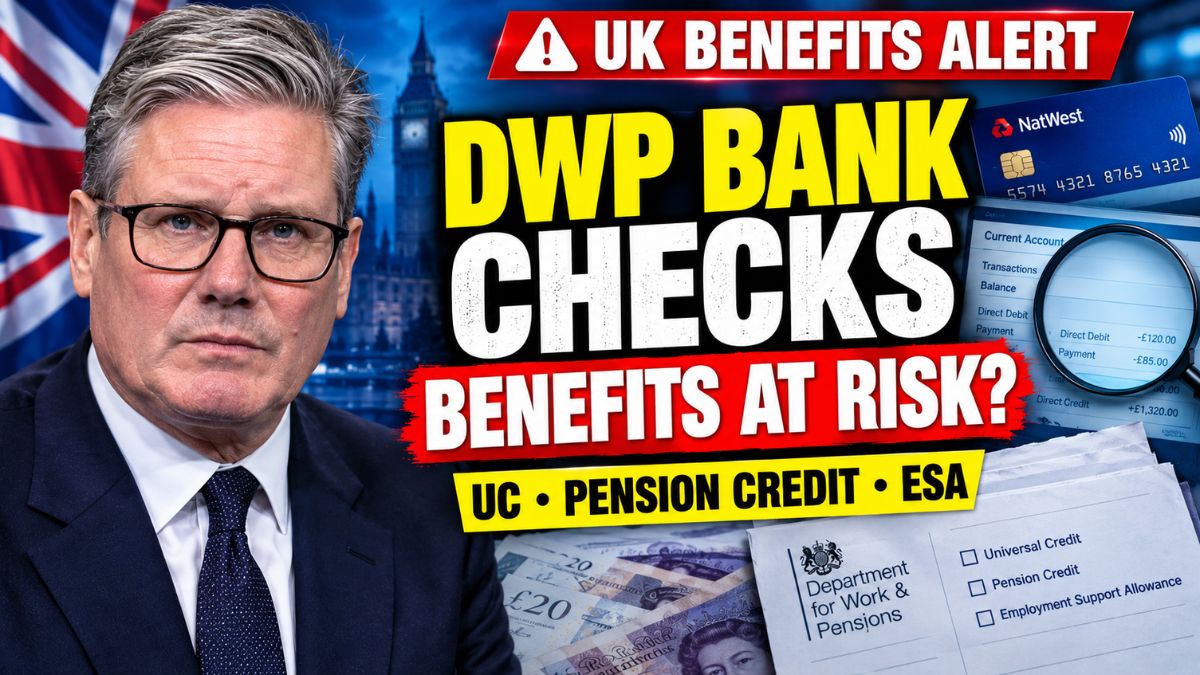
The UK Department for Work and Pensions (DWP) has explained how new bank checks will work for people claiming Universal Credit, Pension Credit and New Style Employment and Support Allowance (ESA). The measures are intended to help identify incorrect benefit payments, reduce fraud and ensure that public money reaches people who meet the eligibility requirements.
Under the Eligibility Verification Measure, banks and other financial institutions may be required to check specific information about accounts receiving certain DWP benefits after receiving an Eligibility Verification Notice. They can then notify the department when an account matches an eligibility indicator that may require further investigation.
The system has raised questions about what information banks can share, whether the DWP can access people’s online banking and what happens if an account is flagged. The department has set out limits on the information that can be disclosed, along with the steps that may follow if a check identifies a potential problem.
Importantly, a bank check does not automatically mean that a claimant has committed fraud or will lose their benefits. The purpose is to identify accounts that may need further examination, with decisions about entitlement and payments remaining the responsibility of DWP staff.
Benefits
The Eligibility Verification Measure applies to people claiming three specified benefits: Universal Credit, Pension Credit and New Style Employment and Support Allowance.
Universal Credit provides financial support to eligible people on lower incomes, including those who are working, unemployed or unable to work because of certain circumstances. Pension Credit helps eligible pensioners with living costs, while New Style ESA supports people whose health conditions or disabilities affect their ability to work, subject to the relevant contribution and eligibility requirements.
The DWP uses eligibility rules to determine whether a person qualifies for these benefits and how much they should receive. Changes in circumstances or incorrect information can sometimes result in payments being made when a claimant is no longer eligible or receiving more money than they are entitled to.
The new measure is designed to help identify potential discrepancies by allowing financial institutions to check specified account information against eligibility indicators supplied by the department.
According to the DWP, these indicators are based on benefit eligibility rules. They help banks identify accounts that may need to be checked by the department.
The process can include linked accounts and accounts held jointly with another person. An account may belong to a benefit claimant or someone who is not claiming benefits themselves.
However, an account being flagged does not establish that a benefit has been paid incorrectly. It indicates that the information may require further investigation by the DWP.
Information
The DWP has clarified that banks and other financial institutions can share only specific categories of information under the measure.
The information that may be disclosed includes:
- The names of all account holders.
- Details of relevant accounts, including linked and joint accounts.
- Account numbers.
- Sort codes, where applicable.
- Information about the amount of money held in relevant accounts.
- Dates of transactions that took place in another country.
This information can help the DWP identify accounts that may require additional checks under the eligibility rules for the relevant benefit.
For example, information about account balances could be relevant where a benefit has a capital limit or where a claimant’s financial circumstances need to be verified. The precise relevance depends on the benefit being claimed and the rules that apply to the individual.
Joint and linked accounts may also be included in the process. This means that the account holder’s relationship to the benefit claimant does not necessarily prevent an account from being considered under the measure.
However, the information-sharing rules place limits on what financial institutions can disclose. The measure is not intended to provide the DWP with unrestricted access to all financial activity.
Claimants should also distinguish between information being checked for eligibility purposes and a formal decision about their entitlement. The bank supplies specified information, while the DWP remains responsible for assessing the claim and deciding whether any action is necessary.
Restrictions
Although the Eligibility Verification Measure allows certain account information to be shared, the DWP has stated that banks cannot disclose several other categories of financial information through this process.
These restrictions include:
- Full bank statements or complete transaction histories.
- Details of how a person spends their money.
- Sensitive personal information about political opinions or religious beliefs.
- Specific locations associated with transactions.
The restrictions are intended to limit the information available through the measure to what is needed for eligibility checks.
For example, the department may receive permitted information about the amount of money held in a relevant account, but the measure does not allow banks to provide a complete record of everyday purchases or a full list of transactions.
Similarly, the system does not give the DWP permission to examine sensitive personal information unrelated to the purpose of checking benefit eligibility.
The department has also clarified that it cannot log into a claimant’s online banking account or monitor account activity in real time through this measure.
These limits are important because bank checks can involve accounts belonging to people who are not themselves claiming benefits. The rules restrict the categories of information that may be shared and the purposes for which it can be used.
Financial institutions may face penalties if they disclose information outside the permitted rules. The DWP must also comply with applicable data protection requirements when handling the information it receives.
Reviews
If information supplied by a bank indicates that a benefit payment may be incorrect, the DWP can review the relevant claim.
A review may establish that the claimant remains fully eligible, that their payment amount needs to be adjusted or that further enquiries are required. In some cases, the department may conclude that a person no longer qualifies for the benefit.
The initial bank check is therefore only one part of the process. The department may need additional information before it can reach a decision.
During a review, the DWP may contact the claimant with questions about their circumstances or ask them to provide documents or other evidence to support their claim.
The information requested will depend on the issue being examined. For example, the department may need clarification about financial circumstances, account ownership or a change that could affect eligibility.
The DWP has emphasised that any decision about benefit entitlement or payments will be made by its staff rather than by the bank.
This distinction means that financial institutions do not decide whether someone should continue receiving Universal Credit, Pension Credit or New Style ESA. Their role is to check the specified information and notify the department when an eligibility indicator is met.
A flagged account should therefore not automatically be interpreted as evidence of wrongdoing. The review is intended to establish whether the information affects the person’s entitlement.
Contact
If the DWP decides that further information is needed, it will contact the claimant through the appropriate channel.
People with an online account may receive a message through their Universal Credit journal or another relevant online service. Claimants without an online account may be contacted by telephone, letter or text message.
The department advises people to respond as soon as possible to requests for information. Delays can complicate a review and may result in benefit payments being delayed or stopped while the necessary checks are completed.
Claimants should read requests carefully and provide the information requested within the stated timeframe. If they do not understand a question or cannot provide a document immediately, they should contact the DWP through an appropriate official channel to explain the situation.
It is also important to be alert to scams. A message claiming to be from the DWP should not automatically be trusted simply because it mentions a bank check. People should verify unexpected requests through official government contact details rather than sharing banking passwords, security codes or other confidential login information.
The measure does not give the DWP permission to log into online banking accounts, and claimants should never provide their online banking credentials in response to an unsolicited message.
Overpayments
The bank-checking measure is intended partly to help identify incorrect benefit payments. If a review finds that someone has received more money than they were entitled to, the DWP may take steps to recover the overpayment under the applicable rules.
Overpayments can arise for different reasons. A claimant may have failed to report a change in circumstances, supplied incorrect information or received payments that continued after their eligibility changed. Administrative errors can also contribute to incorrect payments.
The consequences depend on the circumstances and the relevant benefit rules. Claimants may be required to repay money they were not entitled to receive, even where an overpayment was not deliberate.
Providing false or incomplete information, or failing to report a relevant change, can also have more serious consequences in cases involving suspected fraud. Depending on the circumstances, this may include further investigation, prosecution or a financial penalty.
However, not every overpayment indicates fraud. The DWP must consider the individual circumstances and apply the relevant rules when deciding what action to take.
Claimants can reduce the risk of avoidable problems by keeping their details up to date, reporting changes promptly and retaining records of information supplied to the department.
Anyone who disagrees with a decision about their entitlement or an alleged overpayment should read the decision notice carefully and check the available review or appeal procedures.



Privacy
The DWP has stated that information received through the Eligibility Verification Measure will be used to help check benefit entitlement, identify incorrect payments and support further enquiries where necessary.
The department cannot use the measure as unrestricted access to a person’s financial life. The information that can be requested and shared is limited by the rules governing the scheme and applicable data protection requirements.
Banks and other financial institutions must follow those requirements when responding to Eligibility Verification Notices. The restrictions on full statements, spending details, sensitive personal information and specific transaction locations are intended to keep the process focused on eligibility checks.
At the same time, claimants should understand that the measure may involve accounts beyond the one into which their benefits are paid. Linked and joint accounts can be relevant where the applicable rules and eligibility indicators require them to be considered.
The practical effect will depend on the information available, the type of benefit involved and whether the check identifies a matter that needs further investigation.
Official information about benefits and eligibility can be found on the GOV.UK website. Claimants can also consult the government’s guidance on Universal Credit and Pension Credit for information about their responsibilities and reporting changes.
The central point is that the bank-checking process is designed to identify potential discrepancies, not to make automatic decisions about individual claimants. Banks can share specified information when the relevant conditions are met, but the DWP remains responsible for reviewing claims and deciding whether benefit payments should change. For people receiving Universal Credit, Pension Credit or New Style ESA, keeping records accurate and responding promptly to official requests can help prevent avoidable delays and repayment problems.