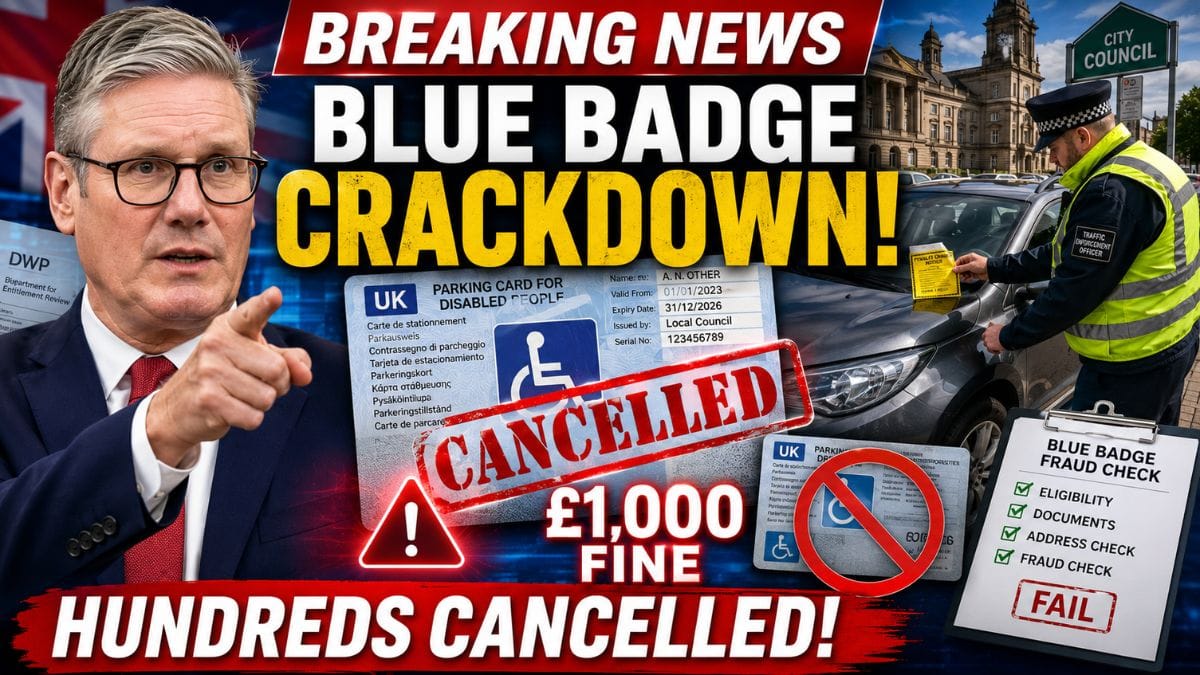
Blue Badge holders are being reminded to check that their permits are being used correctly after the Government expanded efforts to tackle fraud across the UK. The latest enforcement activity has already led to hundreds of Blue Badges being cancelled, with officials warning that misuse could result in confiscation of the badge, prosecution, and fines.
The campaign is part of a wider initiative aimed at protecting disabled parking spaces for those who genuinely need them. Authorities are increasingly using data matching and targeted enforcement to identify permits that are no longer valid or are being used unlawfully.
Crackdown
A joint investigation involving the Government’s Public Sector Fraud Authority and Wirral Council identified 459 Blue Badges that should no longer have been in circulation.
The operation uncovered permits that had expired, badges belonging to deceased holders, and other cases where permits were being used incorrectly.
According to the Government, the latest investigation prevented an estimated £363,000 in fraud. Nationally, Blue Badge fraud detected over the past two years is valued at more than £34 million.
Checks
The investigation relied on the Government’s National Fraud Initiative, which compares local authority records with Department for Work and Pensions (DWP) data.
By matching information across databases, officials can identify Blue Badges that may no longer be valid and notify local councils for further action.
Following the review, enforcement teams have increased patrols in locations where misuse is more common, including shopping centres and areas near schools.
Warning
Traffic enforcement officers have the authority to confiscate a Blue Badge immediately if they believe it is being used unlawfully.
People found misusing a Blue Badge could face:
| Misuse | Possible Outcome |
|---|---|
| Using an expired badge | Badge confiscated |
| Using a deceased person’s badge | Prosecution and fine |
| Family member using the badge without the holder | Up to £1,000 fine |
| Fraudulent use of a permit | Investigation and prosecution |
Officials stress that genuine Blue Badge holders who follow the rules have nothing to worry about.
Checklist
Blue Badge holders are encouraged to check that:
- The badge holder is still alive.
- The permit has not expired.
- The badge is only used when the disabled person is travelling.
- Family members are not using the badge for their own parking.
- The information linked to the permit is accurate and up to date.
Using a Blue Badge after the holder has died, or allowing someone else to use it when the holder is not present, is considered misuse under the rules.
Eligibility
Some people qualify for a Blue Badge automatically.
This includes individuals who receive:
| Qualifying Benefit |
|---|
| Higher rate mobility component of Disability Living Allowance (DLA) |
| Eligible mobility component of Personal Independence Payment (PIP) |
| War Pensioners’ Mobility Supplement |
| Qualifying Armed Forces Compensation Scheme payments |
| Registration as severely sight impaired |
People with physical or hidden disabilities that make walking difficult or unsafe may also qualify, depending on their circumstances and local council assessment.
Applications
Applications for a Blue Badge in England, Scotland, and Wales can be made through the Government’s online Blue Badge service.
Applicants are generally asked to provide:
- Proof of identity.
- Proof of address.
- A recent passport-style photograph.
- National Insurance number, if applicable.
- Evidence of qualifying benefits or medical conditions.
Where applicants do not automatically qualify, councils may request additional medical evidence before making a decision.
Timescale
Application processing times vary between councils.
Many local authorities advise that applications can take up to 12 weeks or longer, particularly if a mobility assessment or additional evidence is required.
If an application is refused, applicants can ask their local council to review the decision and may submit further medical evidence to support their case.
Reminder
Blue Badges are issued to individuals rather than vehicles. They can only be used when the badge holder is travelling in the vehicle, either as the driver or a passenger.
If a Blue Badge holder dies, the permit should be returned to the council that issued it as soon as possible. Continuing to use the badge after the holder’s death is considered fraud and remains one of the most common forms of Blue Badge misuse identified by councils.
FAQs
Why are Blue Badges being cancelled?
To prevent fraud and misuse of permits.
Can family members use my Blue Badge?
Only when you are travelling with them.
What is the penalty for Blue Badge misuse?
Fines of up to £1,000 may apply.
How long does a Blue Badge application take?
Usually up to 12 weeks or longer.