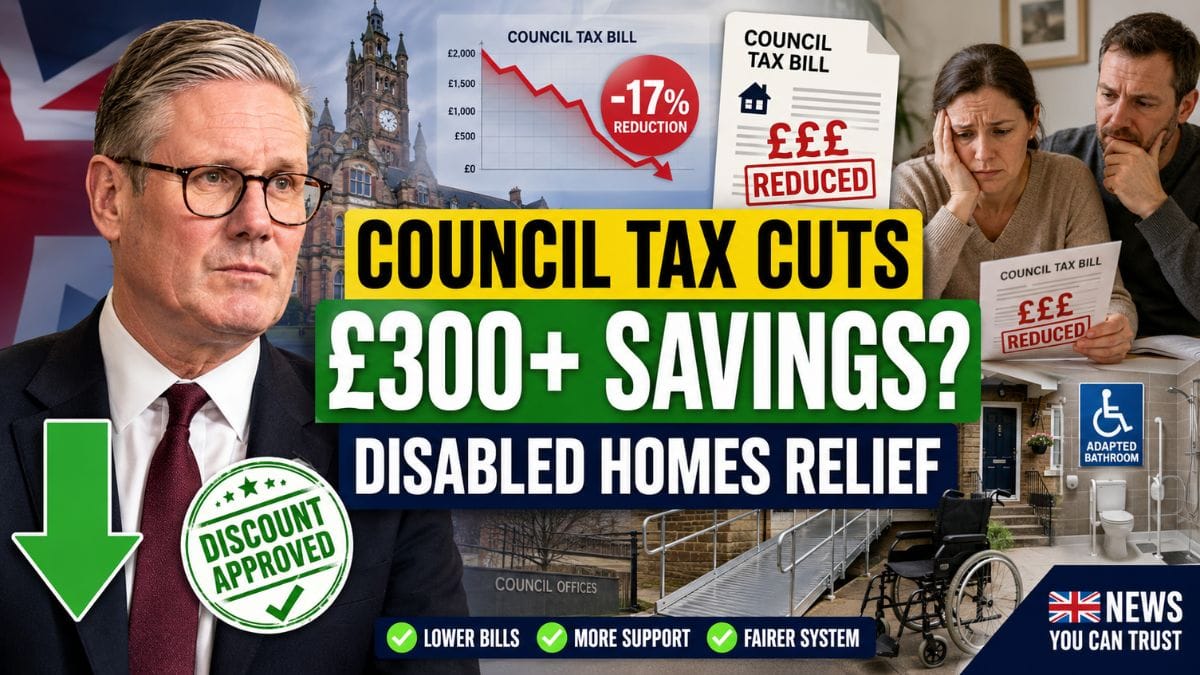
Some households with disabled members may be able to reduce their Council Tax bill by hundreds of pounds, even if they are not receiving disability benefits. The support is available through a little-known local authority discount called the Disabled Band Reduction Scheme, which is based on the needs of the property rather than benefit status.
Scheme
The Disabled Band Reduction Scheme is designed to reduce Council Tax bills where a home has been adapted or effectively enlarged to support a disabled resident.
Instead of relying on benefit claims, eligibility is determined by whether the property includes essential features linked to disability needs. This can include extra rooms, additional bathrooms or kitchen space, or modifications required for mobility or medical care.
If approved, the household’s Council Tax band is treated as one band lower than its official classification. In cases where the property is already in the lowest band, A, the bill is instead reduced by 17 percent.
Savings
The level of savings depends on the property’s original Council Tax band and local rates.
For example, a Band E property in the City of London costing £1,625.02 per year could be reduced to Band D, lowering the annual bill to £1,329.56. That represents a saving of more than £300 per year.
For Band A properties, where no lower band exists, councils apply a fixed 17 percent reduction instead of a band shift.
While the exact savings vary across the UK, eligible households can often save several hundred pounds annually.
Eligibility
To qualify, the property must meet specific criteria linked to disability-related use. This may include:
- Additional internal space required for wheelchair use
- A room used for medical treatment, such as dialysis
- Extra bathroom or kitchen facilities needed for daily living
- Space required for essential medical equipment
Importantly, the home must be the main residence of at least one disabled person. This can be an adult or a child, and does not necessarily need to be the Council Tax payer.
Unlike many other support schemes, receipt of disability benefits is not required, which is why some eligible households may not realise they qualify.
Discounts
In addition to the Disabled Band Reduction Scheme, other Council Tax reductions may apply depending on household circumstances.
One of the most significant is the discount for people classified as severely mentally impaired. In some cases, this can reduce a Council Tax bill by up to 100 percent.
A full exemption is typically available when the person with severe mental impairment lives alone, or only with others who are also disregarded for Council Tax purposes, such as full-time students.
A 50 percent reduction may apply where all other residents are disregarded for Council Tax calculations.
However, if a person with severe mental impairment lives with another adult who is not disregarded, the discount is usually limited to 25 percent.
Disregarded
Certain groups are not counted for Council Tax purposes, which can affect eligibility for reductions. These include:
- People under 18
- Full-time students
- Apprentices on qualifying schemes
- Student nurses
- Foreign language assistants registered with the British Council
- People under 25 receiving Education and Skills Funding Agency support
- Severely mentally impaired individuals
- Live-in carers (not related to the person they care for)
- Diplomats
These classifications can significantly change how a household’s Council Tax bill is calculated.
Application
Households that believe they may qualify can apply through their local council or via the official Gov.uk portal. Councils typically require evidence of the property adaptations or medical necessity linked to the disability.
Because rules can vary slightly between local authorities, applicants are usually advised to check local guidance before submitting a claim.
Outlook
While the scheme is not widely publicised, it remains an established form of Council Tax relief across the UK. For eligible households, it can provide meaningful annual savings without requiring changes to income or benefits status.
However, eligibility is strictly assessed based on property use and household composition, meaning not all disabled residents will qualify automatically.
For those who do meet the criteria, the reduction can provide ongoing financial relief at a time when household costs remain elevated.
FAQs
Can you get Council Tax reduction without disability benefits?
Yes, eligibility is based on property adaptations, not benefits.
How much can you save under the scheme?
Typically one band reduction or 17% off the bill.
Does the disabled person need to be the bill payer?
No, they only need to live in the property.
What if my home is already Band A?
You receive a 17% discount instead of a band drop.