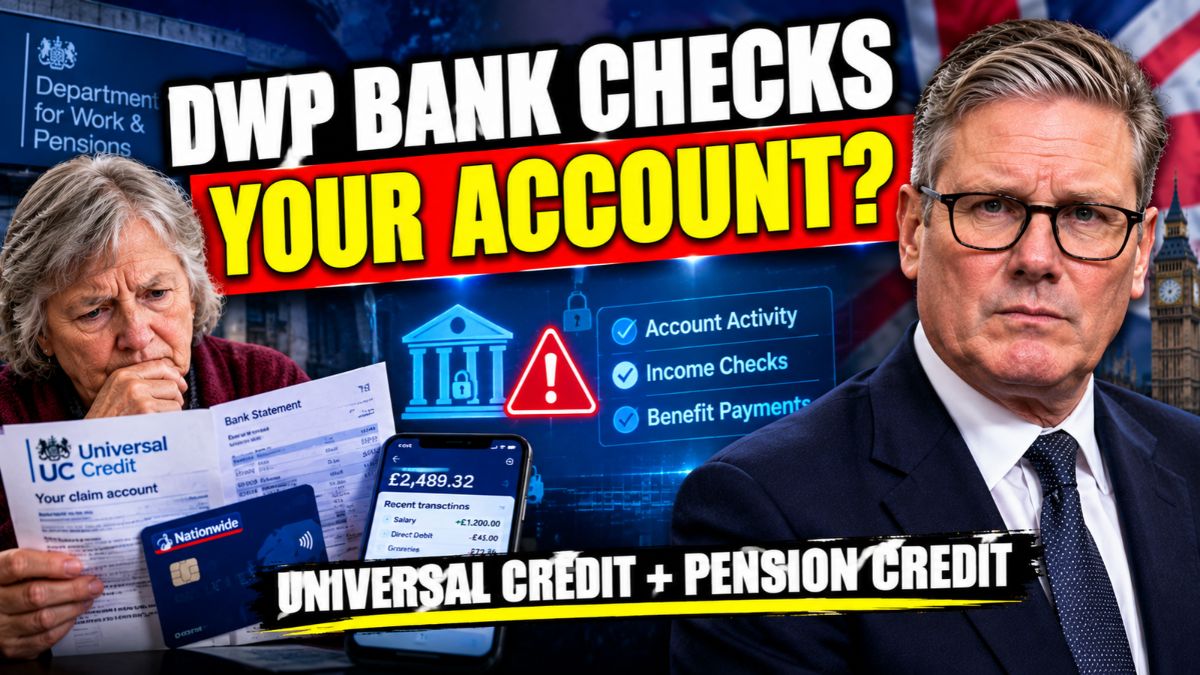
The Department for Work and Pensions (DWP) is introducing new measures to help identify benefit payments that may have been made incorrectly. Under the Public Authorities (Fraud, Error and Recovery) Act 2025, the department has gained powers to require certain financial institutions to check information about accounts linked to people receiving specified benefits.
The changes have attracted attention because they expand the government’s ability to identify potential eligibility issues through information held by banks and other financial institutions. However, the new arrangements do not mean that DWP officials can freely browse every claimant’s bank statements or monitor all transactions in real time.
The measures are intended to help identify cases in which financial circumstances may not match the rules for receiving a benefit. They also introduce a separate process for recovering certain debts owed to the government, including some benefit overpayments.
For claimants, the important questions are what information banks may have to provide, which benefits are covered, how the checks work, and what happens if a potential problem is identified.
Powers
The new bank information measures are part of legislation designed to reduce fraud and errors in the welfare system. The Public Authorities (Fraud, Error and Recovery) Act 2025 provides a legal framework for eligibility checks and the recovery of certain public money.
One of its central mechanisms is the Eligibility Verification Measure (EVM). Under this process, a relevant financial institution may be required to examine specified accounts against indicators supplied by the DWP.
The purpose is to identify accounts that may meet a condition associated with benefit eligibility. For example, a check might identify a potential issue involving the financial eligibility rules for a means-tested benefit.
The bank carries out the relevant check and reports information required under the measure. The DWP can then use that information to determine whether further investigation or contact with the claimant is necessary.
The existence of a potential match does not, by itself, establish that a claimant has committed fraud or received money incorrectly. Financial information can have different explanations, and a benefit decision must be considered in light of the relevant rules and individual circumstances.
The legislation is intended to improve the identification of possible errors while giving the department a formal process for requesting information from institutions that fall within its scope.
Information
The information covered by an Eligibility Verification Measure can include identifying and account-related details. The precise information required depends on the measure and the applicable regulations.
The reported scope includes:
- Names of account holders.
- Details of relevant accounts, including certain linked or joint accounts.
- Account numbers and sort codes.
- Information about balances or the amount of money held in relevant accounts.
- Dates associated with transactions carried out in another country, where covered by the request.
These details can help the DWP identify accounts that may meet a specified eligibility indicator. Account ownership, balances and certain transaction information can be relevant when the rules of a benefit depend on a claimant’s financial circumstances.
However, the distinction between checking for eligibility indicators and obtaining a complete financial history is important. The new arrangements are not described as giving DWP officials unrestricted access to live bank transactions or full bank statements through the EVM process.
The scope of information that can be requested is governed by the legislation and relevant rules. It should not be assumed that every account holder will have every type of information disclosed, or that all information held by a bank will automatically be passed to the department.
For the official legal framework, readers can consult the Public Authorities (Fraud, Error and Recovery) Act 2025.
Checks
Under the EVM system, the DWP specifies indicators that financial institutions must use when carrying out the required checks. Banks and other institutions within scope must examine relevant accounts to determine whether they match those indicators.
The process is different from asking a bank to send every statement for every person claiming benefits. Instead, the institution checks the information it holds against the specified criteria and reports relevant matches in accordance with the legal requirements.
For example, a check could flag a potential issue involving the amount of money held in an account associated with a means-tested benefit. The department could then consider whether the information indicates that the claimant’s circumstances need to be reviewed.
A flagged account does not automatically mean a benefit will be stopped. A match is a signal that may require further consideration, rather than conclusive proof that the claimant is ineligible.
This distinction matters because bank accounts can contain money belonging to more than one person, and financial circumstances can change over time. The department must consider the applicable benefit rules and the information relevant to the individual case before reaching a decision.
Financial institutions are required to comply with valid measures within the scope of the legislation. Failure to comply can lead to financial penalties under the relevant provisions.
Benefits
The new eligibility verification powers do not apply indiscriminately to every benefit administered by the DWP. The measures described in the department’s update focus on specified benefits, including Universal Credit, Pension Credit and New Style Employment and Support Allowance (ESA).
Each benefit has its own eligibility conditions, so the financial information relevant to one may differ from that relevant to another.
Universal Credit is a means-tested benefit for eligible people on low incomes, whether they are working, unemployed or unable to work. Savings and other capital can affect entitlement. Under the general rules, a claimant with more than £16,000 in capital is usually ineligible, although specific rules and exceptions may apply in particular circumstances.
Pension Credit helps eligible people over State Pension age with a low income. Its financial eligibility rules differ from those of Universal Credit, including the way savings and other income are assessed.
New Style ESA is primarily based on National Insurance contribution conditions and is not subject to the same general savings limit as Universal Credit. That makes it important to distinguish between checking financial information and determining eligibility under the rules of a particular benefit.
The use of bank information must be understood in the context of each scheme. A balance that affects one means-tested benefit does not necessarily have the same effect on another.
Official guidance on Universal Credit, including the rules around savings and capital, is available through the government’s Universal Credit information page.
Savings
Savings are one reason the DWP may need to verify financial information for means-tested benefits. Universal Credit eligibility depends partly on the amount of capital a claimant has, which can include money in bank accounts, savings and certain investments.
Under the general Universal Credit rules, people with capital of £6,000 or less are not normally affected by the capital rules. Capital above £6,000 can reduce the amount of Universal Credit payable, while capital exceeding £16,000 usually means a person cannot receive Universal Credit.
These thresholds make accurate financial information important. If a claimant’s savings change, they may need to report the change to the DWP. Failing to report relevant information can result in an incorrect payment, which may subsequently have to be repaid.
However, not every payment into a bank account counts as savings in the same way. Certain payments may be treated differently under benefit rules, and the treatment of particular assets depends on the circumstances. Joint accounts and money held on behalf of another person can also require careful consideration.
Claimants should not assume that a bank balance alone provides the complete picture of their eligibility. The relevant benefit rules determine how capital is assessed and whether a particular amount should be included.
Anyone who is uncertain about how savings affect their claim can check the official guidance or seek independent welfare rights advice before making assumptions about their entitlement.
Recovery
The legislation also provides for Direct Deduction Orders, a separate mechanism intended to help the DWP recover certain debts directly from bank accounts in eligible cases.
These orders are distinct from the Eligibility Verification Measure. The EVM is concerned with checking information against eligibility indicators, while a Direct Deduction Order concerns the recovery of money in circumstances permitted by law.
The government has indicated that it expects to make between 5,000 and 20,000 Direct Deduction Orders annually. The aim is to recover some money that has been paid incorrectly, including eligible benefit overpayments.
A direct recovery mechanism does not mean that the department can automatically take any amount from any claimant’s account. Its use is subject to the relevant legal conditions and procedures.
Anyone contacted about an alleged overpayment should read the notice carefully, check the amount and reason given, and seek clarification if the figures appear incorrect. If a claimant disputes a decision, they should review the available challenge and appeal procedures.
It is also important to distinguish an overpayment from deliberate fraud. Payments can be incorrect because of a claimant’s mistake, an administrative error or a change in circumstances that was not processed correctly. The reason for an overpayment can affect how a case is handled.
Overpayments
Benefit overpayments remain a significant issue for the UK welfare system. The figures cited in the department’s reporting put total overpayments at £9.9 billion in 2025/26, equivalent to 3.2% of relevant benefit expenditure.
The reported breakdown attributed 2.2 percentage points to fraud, 0.6 percentage points to claimant error and 0.4 percentage points to official error.
These categories are important because they describe different causes. Fraud involves deliberate wrongdoing, whereas claimant error can arise when information is missing or incorrect without deliberate deception. Official error refers to mistakes made by the administration of the system.
The DWP has presented stronger verification and recovery powers as part of its effort to reduce losses. The government has also stated an ambition to save £1.5 billion by 2029/30 through its fraud and error measures.
However, the effectiveness of the system will depend on how the powers are implemented, how accurately potential matches are assessed and whether people can correct mistakes before they lead to adverse decisions.
For claimants, the practical lesson is to keep benefit records accurate and respond promptly to requests for information. People should also retain relevant documents, such as bank records and correspondence, so they can explain their circumstances if a discrepancy arises.
Concerns
The expanded bank-checking powers have prompted concerns about privacy, proportionality and the potential for mistakes. Civil liberties organisations, including Big Brother Watch, have warned that broader access to financial information could increase government surveillance of people’s private lives.
Supporters of the measures argue that checking relevant financial information can help identify incorrect payments and protect public funds. Critics, meanwhile, question whether the checks could affect people who have done nothing wrong or create additional administrative burdens for banks and claimants.
A key issue is how potential matches are handled. Financial information can be incomplete or open to interpretation, particularly where accounts are jointly held or money belongs to someone other than the claimant. A process that identifies a possible eligibility issue therefore needs safeguards against incorrect conclusions.
Transparency is another consideration. Claimants need to understand why their circumstances may be reviewed, what information can be used and how they can challenge a decision they believe is wrong.
The distinction between a financial check and a finding of wrongdoing is essential. An account matching an eligibility indicator is not, on its own, evidence of fraud. Any decision affecting entitlement should be based on the relevant rules and the evidence available.
Protection
People receiving benefits can take several practical steps to reduce the risk of problems with their claims.
First, report changes in circumstances when required. For Universal Credit, this can include changes to savings, household circumstances, employment or other information relevant to entitlement.
Second, keep records of financial transactions and benefit communications. These records can help explain unusual deposits, joint-account arrangements or changes in savings if questions arise.
Third, read any DWP notice carefully. If the department requests information or says that a payment may have been incorrect, check the details and deadlines. Do not ignore a letter simply because the figures appear wrong.
If a decision is incorrect, claimants can ask for an explanation and may have the right to request a mandatory reconsideration or appeal, depending on the decision involved. Independent organisations such as Citizens Advice can help explain the available options.
People who receive Pension Credit can consult the government’s official Pension Credit guidance for information about eligibility and reporting requirements. Those receiving New Style ESA should review the rules that apply to their particular claim rather than assuming the same capital limits used for Universal Credit apply to them.



Outlook
The DWP’s new bank information powers represent a change in how the government can identify potential eligibility issues in parts of the benefits system. Banks and other covered financial institutions may be required to check relevant accounts against specified indicators and provide information in accordance with the legislation.
The measures do not amount to unrestricted live access to every claimant’s transactions. They also do not mean that every person receiving benefits will automatically lose payments or face an investigation.
For claimants, the most important steps remain straightforward: understand the rules of the benefit being received, report relevant changes, keep accurate records and respond to official requests. If the DWP raises a concern, people should check the evidence and use the available review procedures if they disagree with the decision.
The longer-term impact of the powers will depend on how effectively they identify genuine errors while protecting privacy and ensuring that eligible claimants are treated fairly.