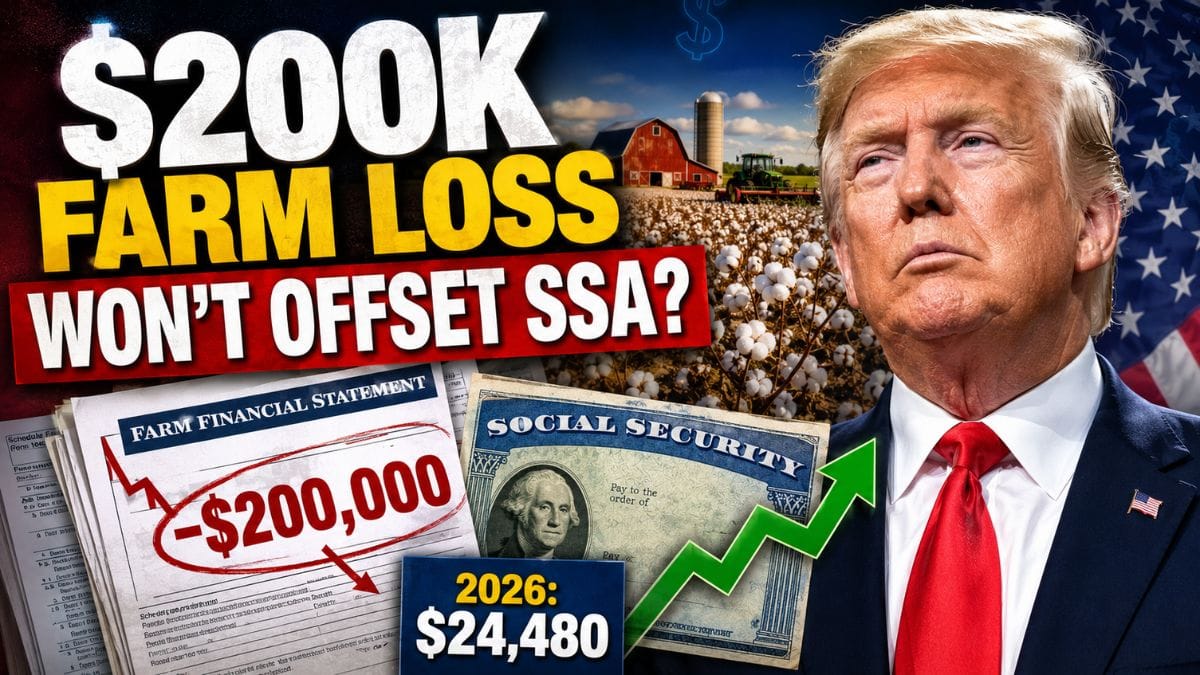
A bad farming year can create a substantial tax loss, but that loss does not necessarily carry the same value into Social Security calculations. For farmers who receive Social Security before reaching full retirement age, the distinction can matter when a farm moves from a major loss to a profitable year.
Consider a cotton farmer who lost about $200,000 during one growing season and then returned to profitability the following year. Federal tax rules may allow some of the prior loss to reduce taxable income in the later year, subject to applicable limitations. Social Security uses a different calculation.
That means a farmer cannot automatically assume that an old net operating loss (NOL) will reduce the self-employment earnings Social Security uses for benefit purposes.
Losses
Farm income is generally reported on Schedule F, while self-employed workers use Schedule SE to calculate net earnings from self-employment.
For federal income-tax purposes, an eligible NOL from an earlier year may be carried forward under the tax rules that apply to the taxpayer. This can reduce taxable income in a profitable year, depending on the amount available and applicable limitations.
Social Security, however, does not simply follow the final taxable-income figure.
Federal Social Security regulations specifically provide that a deduction for a net operating loss sustained in another taxable year is disregarded when calculating net earnings from self-employment.
This creates an important difference. The same farmer can have a lower federal taxable income because of a prior NOL while still having current-year self-employment earnings that Social Security recognizes.
Earnings
For a farmer who has claimed retirement benefits before full retirement age, current earnings can also affect the retirement earnings test.
In 2026, a person who is under full retirement age for the entire year can earn $24,480 before the earnings test applies. Social Security withholds $1 in benefits for every $2 earned above that threshold.
For self-employed workers, the relevant calculation includes net earnings from self-employment. An old NOL carryforward from another tax year is not used to erase those current-year earnings for Social Security purposes.
That distinction can create an unexpected result for someone whose farm has recovered sharply.
Suppose a farmer had a large loss in one year and a significant profit the next. The tax return might reflect the benefit of the prior NOL, while Social Security can still consider the current year’s qualifying self-employment earnings when applying the earnings test.
Farmers should therefore avoid using their final federal taxable income as a substitute for the Social Security earnings calculation.
Recovery
The earnings test can reduce benefits temporarily, but withheld benefits are not necessarily lost forever.
When a beneficiary reaches full retirement age, Social Security recalculates the retirement benefit to account for months when benefits were withheld because of the earnings test. That adjustment can result in a higher monthly benefit going forward.
This is particularly relevant for someone whose farm income fluctuates substantially from year to year.
A profitable crop can therefore have two different effects. In the short term, it may cause some Social Security benefits to be withheld if the farmer is below full retirement age and exceeds the applicable earnings limit. Over the longer term, those strong earnings can potentially improve the worker’s Social Security earnings record.
Benefits
Social Security retirement benefits are generally based on a worker’s highest 35 years of indexed earnings.
That means a strong farming year can be valuable beyond the current tax year. If the farmer has fewer than 35 years of covered earnings, or if the new year produces more than one of the lower years already included in the benefit calculation, the higher earnings may increase the eventual benefit.
The annual taxable maximum also matters because Social Security does not credit earnings above the applicable maximum for benefit calculations.
For farmers with highly variable incomes, this 35-year formula can make individual profitable years especially important. A year affected by drought, crop damage or other financial difficulties may produce relatively low Social Security earnings, while a later recovery can help replace that weaker year.
The prior $200,000 loss does not reduce the current year’s Social Security earnings simply because it may have tax value under the NOL rules.
Planning
Farmers approaching year-end may want to keep their tax and Social Security calculations separate.
First, they can work with their tax professional to determine how much of an earlier NOL can be used under current tax rules. The resulting federal taxable income should not automatically be treated as the figure Social Security will use.
Second, farmers receiving Social Security before full retirement age can estimate their current-year net self-employment earnings and compare them with the applicable earnings-test limit.
Third, reviewing the Social Security earnings record can show whether a profitable year might replace a lower year in the 35-year benefit calculation.
These calculations can be especially important when farm income changes dramatically between seasons. A large tax loss from a previous year may still provide meaningful tax benefits, but it does not function as a general-purpose credit against future Social Security earnings.



Records
Good records can make these calculations easier. Farmers should keep documentation of farm income, deductible expenses, prior-year losses and information reported to Social Security.
Because farming income can fluctuate significantly, estimating earnings before the end of the year may also help with retirement-income planning.
The key point is that the tax code and Social Security system do not necessarily treat an old farming loss in the same way. A $200,000 loss may have value under federal income-tax rules, while Social Security can still count qualifying current-year self-employment earnings without allowing that prior NOL to offset them.
For a farmer who has moved from a difficult crop year to a profitable one, the stronger earnings can affect benefits today if the earnings test applies, but they can also strengthen the Social Security earnings record and potentially improve future retirement benefits.