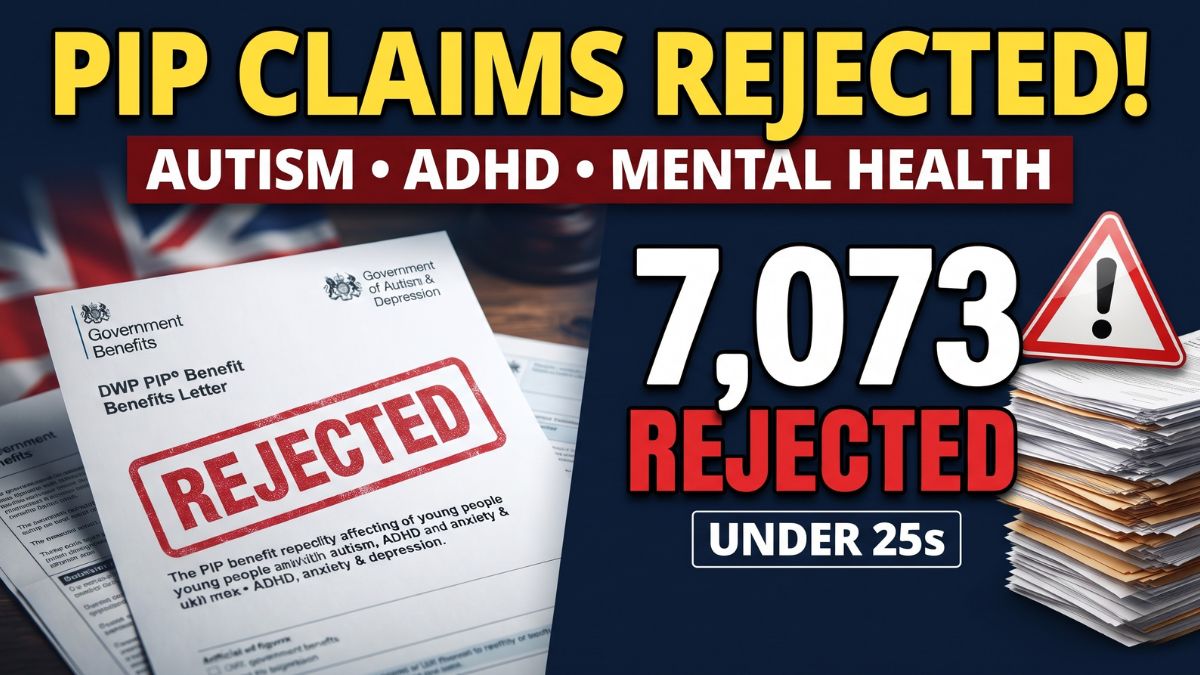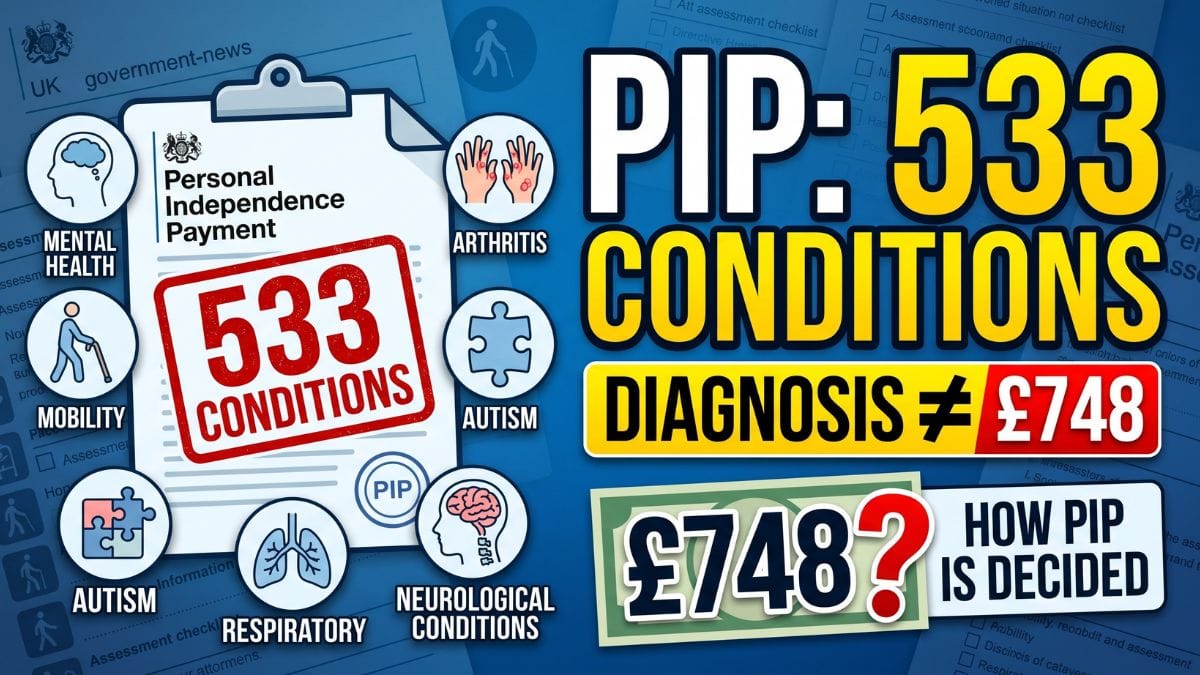
The Department for Work and Pensions has published data covering 533 condition categories associated with Personal Independence Payment claims, giving a detailed picture of the health conditions recorded among people receiving the benefit.
PIP is designed to help people with the additional costs of a long-term physical or mental health condition or disability. However, having a condition included in the DWP data does not automatically mean a person qualifies for PIP.
The assessment focuses on how a person’s condition affects specific daily living and mobility activities. The amount received depends on the level of difficulty experienced and the points awarded under the assessment rules.
The latest figures cited in the data show more than four million PIP claims as of April 2026.
Conditions
The 533 categories cover a wide range of physical and mental health conditions.
They include common conditions such as anxiety and depressive disorders, autism, ADHD, osteoarthritis, fibromyalgia, rheumatoid arthritis, chronic obstructive pulmonary disease, asthma and back conditions.
The list also contains less common conditions, including Huntington’s disease, motor neurone disease, muscular dystrophy, cystic fibrosis, Ehlers-Danlos syndrome and various rare neurological and genetic disorders.
Cancer and other serious illnesses also appear in the data. Categories include breast cancer, prostate cancer, bowel cancer, lung cancer, brain and spinal cord cancers, leukaemia and lymphoma.
The figures represent the number of claims associated with each recorded condition. They should not be interpreted as a list of conditions that automatically qualify for an award.
Assessment
PIP eligibility is based primarily on how a health condition affects a person’s ability to carry out certain activities.
For the daily living component, these activities can include preparing food, eating and drinking, managing medication or treatment, washing and bathing, dressing, communicating and managing money.
The mobility component considers difficulties with planning and following journeys and moving around.
This means two people with the same diagnosis could receive different PIP awards. One person may experience substantial difficulties with particular activities, while another may be able to complete them with little or no assistance.
The name of the condition is therefore only part of the picture.
Payments
PIP has two separate components: daily living and mobility. Each component has a standard rate and an enhanced rate.
Using the rates provided in the source material, the daily living component is £76.55 a week at the standard rate and £114.80 at the enhanced rate.
The mobility component is £30.20 a week at the standard rate and £80.10 at the enhanced rate.
A person receiving the enhanced rate for both components would therefore receive £195.05 a week, based on those figures.
That is important when looking at claims that PIP is worth “£748 a month”. PIP is normally quoted as a weekly benefit, and the monthly equivalent depends on how the calculation is made. Four weekly payments of £187, for example, would equal £748, but that is not the same as a standard monthly rate.
| PIP component | Standard weekly rate | Enhanced weekly rate |
|---|---|---|
| Daily living | £76.55 | £114.80 |
| Mobility | £30.20 | £80.10 |
Eligibility
PIP is not based on National Insurance contributions, and it is not generally means-tested.
Having savings or being employed does not automatically prevent someone from receiving PIP.
Instead, the assessment considers the difficulties caused by a person’s condition and whether those difficulties meet the relevant legal criteria.
The condition normally needs to have lasted, or be expected to last, for at least 12 months. There are also specific rules covering the claimant’s age, residence and other circumstances.
People approaching State Pension age should be particularly careful about which benefit applies to their circumstances, because PIP has different rules depending on when a person developed their disability or health condition.
Data
The DWP’s condition data provides useful information about the range of health problems recorded among PIP claimants.
Some of the largest categories in the figures supplied include anxiety and depressive disorders, with 435,330 claims, while autism accounts for 227,526. Primary generalised osteoarthritis is listed with 218,067 claims, and fibromyalgia with 179,051.
Other sizeable categories include learning disability, rheumatoid arthritis, depressive disorder, chronic obstructive pulmonary disease, back pain and schizophrenia.
These figures should be treated as administrative data rather than a ranking of which conditions are most severe.
A high number of claims can reflect how common a condition is in the wider population, how it is recorded by the DWP and how frequently it affects activities covered by the PIP assessment.
Claims
The list of 533 categories is extensive, ranging from blood disorders and cancers to neurological, respiratory, musculoskeletal, mental health and digestive conditions.
However, there is no simple rule stating that every person diagnosed with one of those conditions will receive PIP.
For someone considering a claim, the more relevant question is how their condition affects their ability to complete the activities used in the assessment.
Keeping evidence about symptoms, treatment, difficulties with daily tasks and mobility can help explain the practical impact of a condition. Medical evidence may also form part of the assessment, although eligibility is ultimately determined under the PIP rules.
The DWP’s list of 533 condition categories demonstrates how broadly PIP covers physical and mental health problems, but a diagnosis alone does not guarantee an award. The amount a person receives depends on the effect of their condition on qualifying daily living and mobility activities. Anyone considering a claim should therefore focus on describing the difficulties they experience in everyday life rather than relying solely on the name of their diagnosis.
FAQs
Do all 533 conditions qualify for PIP?
No. Eligibility depends on how the condition affects daily life.
Is PIP based on National Insurance?
No. PIP is not based on National Insurance contributions.
Can people with savings get PIP?
Yes. PIP is not generally means-tested.
What are the PIP components?
PIP has daily living and mobility components.


Can the same condition give different awards?
Yes. Awards depend on how the condition affects each person.