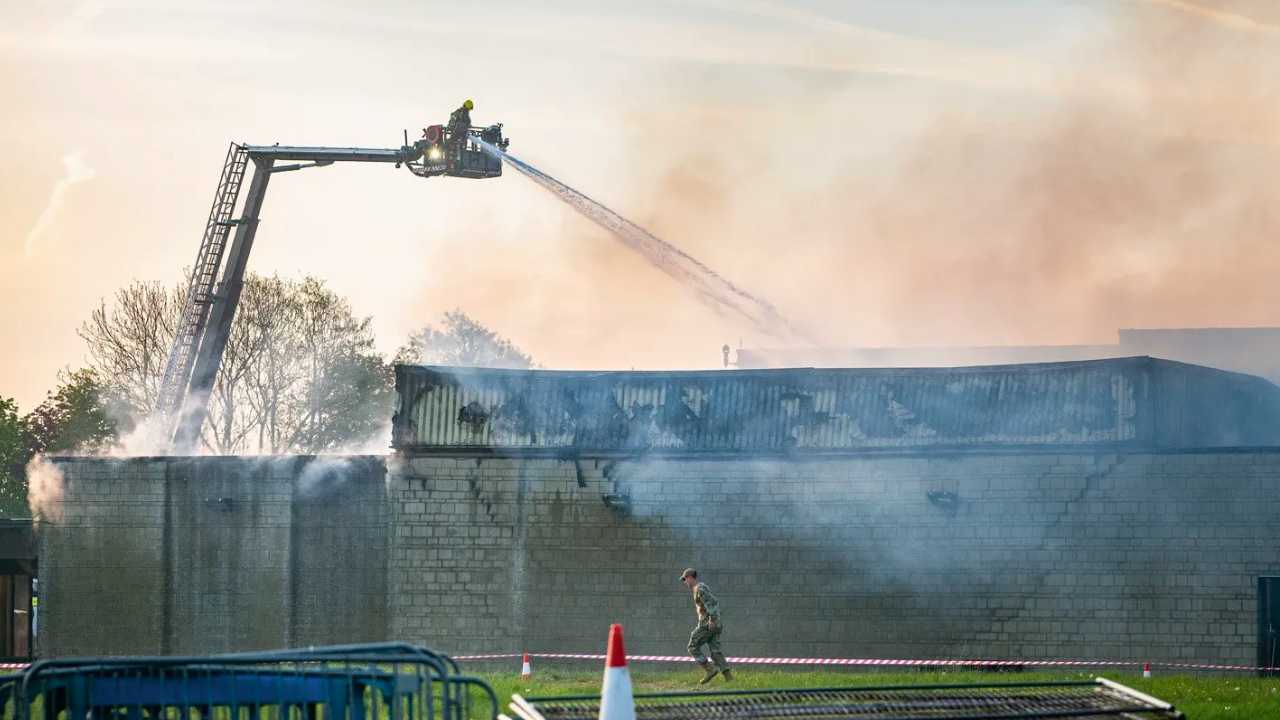
A significant fire incident at RAF Fairford, a strategically important US Air Force-operated base in Gloucestershire, has drawn attention not only for its immediate operational disruption but also for its broader financial and security implications.
As one of the United Kingdom’s most critical military logistics hubs supporting US operations, any disruption at the site raises questions around infrastructure resilience, defence spending, and insurance exposure within military and contractor ecosystems.
Incident overview and immediate response
The fire broke out at RAF Fairford, prompting a rapid emergency response involving both military and civilian fire services. According to early reports from BBC News coverage, thick smoke was visible across surrounding areas, indicating the scale of the blaze.
Authorities quickly secured the perimeter while firefighting teams worked to contain the spread. Although there were no immediate reports of casualties, the scale of the fire raised concerns about damage to high-value equipment and operational facilities.
RAF Fairford plays a pivotal role as a forward deployment base for US strategic bombers and aerial refuelling assets. Any disruption here is not merely localised; it has implications across broader NATO operations and global deployment readiness.
Strategic importance of RAF Fairford
RAF Fairford is one of the few European bases capable of supporting long-range US bombers such as the B-52 and B-2. It acts as a staging ground for missions spanning Europe, the Middle East, and beyond.
Recent geopolitical tensions have heightened the base’s importance. As highlighted in reporting by The Telegraph, the site has been actively used in operations related to the dynamics of the Middle Eastern conflict, reinforcing its role as a critical node in global defence logistics.
This elevates the fire incident from a local emergency to a matter of strategic interest. Infrastructure resilience at such facilities is closely tied to national and allied defence preparedness.
Also Read: HMRC Letters on Unclaimed Child Trust Funds – Thousands Contacted Across UK
Financial and insurance implications
From a business and finance perspective, incidents of this nature trigger multiple layers of economic impact. Military bases like RAF Fairford house equipment and infrastructure worth hundreds of millions of pounds.
Damage assessment will likely involve a complex interplay between US Department of Defence funding, UK infrastructure agreements, and private contractors responsible for maintenance and logistics.
Insurance exposure is particularly significant. Defence contractors operating on-site often carry specialised policies covering equipment, facilities, and operational downtime. A large-scale fire can result in substantial claims, affecting underwriting models and premiums across the defence sector.
Additionally, repair and reconstruction efforts could inject short-term economic activity into the local region, benefiting construction firms and specialised engineering providers. However, this is offset by the immediate financial burden and potential operational delays.
Operational disruption and risk management
Operational continuity is a key concern following the incident. RAF Fairford’s role in hosting rotational deployments means that any damage to runways, hangars, or fuel storage facilities could disrupt scheduled missions.
Defence planners typically maintain contingency options, including alternative bases across Europe. However, shifting operations involves logistical complexity and additional costs, particularly when dealing with heavy strategic assets.
This incident underscores the importance of robust risk management frameworks within military infrastructure. Fire prevention systems, redundancy planning, and rapid response protocols are critical in minimising both operational and financial fallout.
Broader implications for defence investment
The Fairford fire is likely to influence future investment decisions in military infrastructure across the UK and allied nations. Governments may reassess funding allocations towards facility upgrades, particularly in fire suppression technology and resilience planning.
For private sector stakeholders, including defence contractors and insurers, the incident serves as a reminder of the unique risk profile associated with military operations. It may lead to tighter compliance standards and more stringent contractual requirements for on-site service providers.
Universal Credit Update 2026 – Two Child Limit Removed and Payment Changes Explained
There is also a potential policy dimension. As defence collaboration between the UK and US continues to deepen, incidents like this highlight the need for clearly defined financial responsibilities and risk-sharing mechanisms.
Ultimately, while the immediate focus remains on containment and recovery, the longer-term impact will likely be felt across defence budgeting, insurance markets, and infrastructure planning.
US Air Force Fairford Fire – FAQs
What caused the RAF Fairford fire?
The exact cause is under investigation by authorities.
Were there any injuries reported?
No confirmed injuries have been reported so far.
Why is RAF Fairford important?
It supports US strategic bomber and NATO operations.
Will operations be disrupted?
Some disruption is possible depending on the damage.