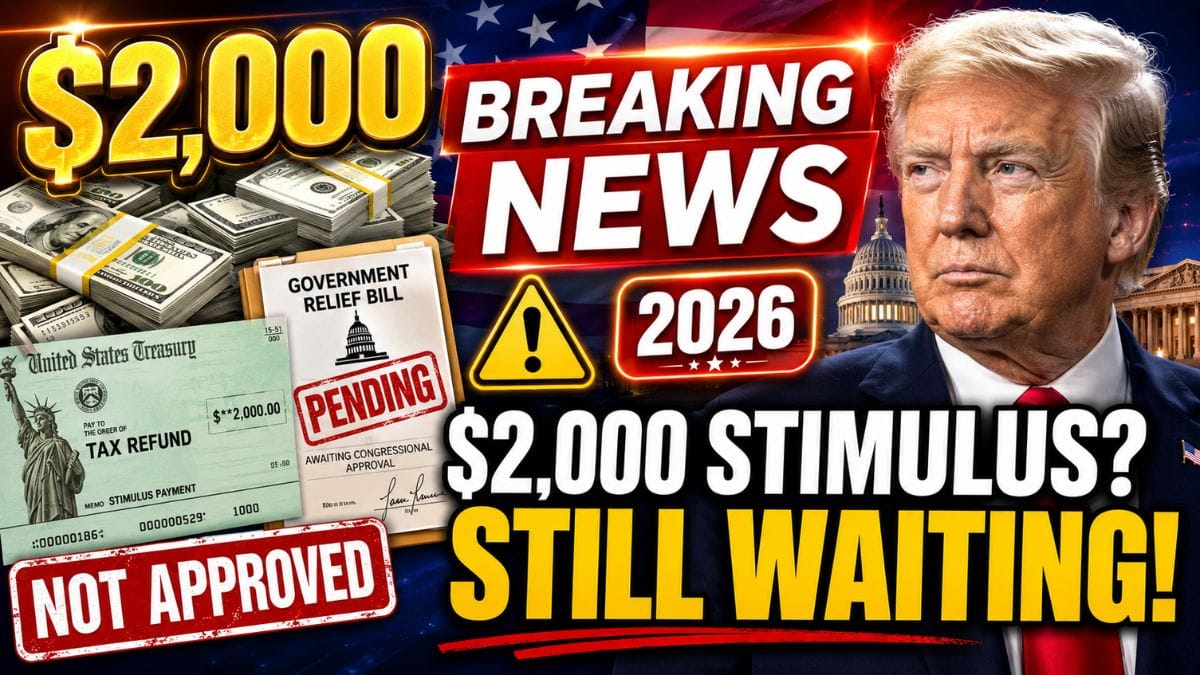
Many Americans continue to watch for updates on a proposed $2,000 stimulus check that President Donald Trump has discussed since returning to the White House. With inflation and the cost of living remaining major concerns for households, the idea of another direct payment has attracted significant attention.
However, despite repeated comments from the President and members of his administration, there is currently no approved $2,000 stimulus check for Americans in 2026. The proposal remains under discussion, and no legislation has been passed authorizing the payments.
President Donald Trump has suggested that revenue generated from his administration’s tariff policies could be used to provide financial payments to many Americans.
According to Trump’s public statements, the proposed payment would primarily benefit middle and lower-income households, although no official income limits have been announced.
At this stage, the proposal remains a policy idea rather than an approved federal program.
Proposal
Trump has repeatedly promoted the concept of a $2,000 “dividend” or tax rebate funded by tariff revenue collected by the federal government.
In posts on Truth Social and during public appearances, he argued that increased tariff collections could allow the government to return some of that money directly to Americans.
During a White House Christmas event, Trump also stated that 2026 could become “the largest tax refund season of all time,” though he did not provide details about how the payments would be structured.
Current Status
Despite the public discussion, there is currently no law authorizing $2,000 stimulus checks.
A White House official recently said that the administration remains committed to exploring ways to use tariff revenue for the benefit of Americans. However, officials have also acknowledged that no payment timeline has been established.
White House Press Secretary Karoline Leavitt previously stated that the President wants the proposal to move forward and that economic advisers are evaluating available options.
Treasury Secretary Scott Bessent has also suggested that any financial benefit could take several forms, including tax reductions rather than direct checks.
Congressional Approval
Any nationwide payment program would require congressional approval before funds could be distributed.
National Economic Council Director Kevin Hassett indicated that Congress would need to approve legislation authorizing the payments. As of now, no bill creating a $2,000 stimulus program has been enacted.
Without congressional action, the federal government cannot issue the proposed payments.
Expert Views
Several economists and policy experts have questioned whether the proposal is financially and legally feasible.
Some experts argue that the total cost of sending $2,000 payments to millions of Americans could exceed the revenue generated from tariffs.
Others note that federal taxation and government spending require separate legislative approval, meaning tariff collections cannot automatically be redirected into stimulus payments without Congress passing new legislation.
Legal Questions
Another factor affecting the proposal is the ongoing legal uncertainty surrounding some of the administration’s tariff policies.
Court challenges continue over whether certain tariffs were imposed under proper legal authority. If courts ultimately rule against parts of the tariff program, future revenue projections could change.
That uncertainty makes it difficult to determine whether tariff revenue would be available to support any proposed payment program.
What Americans Should Know
At this time, there are no official payment dates, no IRS application process, and no confirmed eligibility requirements for a $2,000 stimulus check.
Americans should be cautious about websites, emails, or social media posts claiming that payments are available to claim now. Government stimulus payments are announced only after legislation has been approved and official guidance has been issued.
The table below summarizes the current status.
| Category | Current Update |
|---|---|
| Proposed Payment | $2,000 |
| Proposed By | President Donald Trump |
| Funding Source | Proposed tariff revenue |
| Congressional Approval | Not approved |
| IRS Payment Schedule | None announced |
| Application Available | No |
| Current Status | Proposal under discussion |
Looking Ahead
The administration has indicated that discussions are continuing, but no formal legislative proposal has been approved.
Any future payment would require Congress to pass legislation before Americans could receive funds. Until that happens, the proposal remains under consideration rather than an active federal stimulus program.
For now, Americans should rely on official announcements from the White House, Congress, and the IRS for updates instead of unofficial claims circulating online.
The proposed $2,000 stimulus check continues to generate public interest, but it has not become law. While administration officials say the idea remains under review, there is no confirmed payment schedule, no approved legislation, and no IRS distribution plan. Any future payments would depend on congressional approval and the completion of the legislative process.
FAQs
Has the $2,000 stimulus check been approved?
No. It remains a proposal.
Who proposed the $2,000 payment?
President Donald Trump.
Will Congress need to approve it?
Yes. Congressional approval is required.
Has the IRS announced payment dates?
No official payment schedule exists.