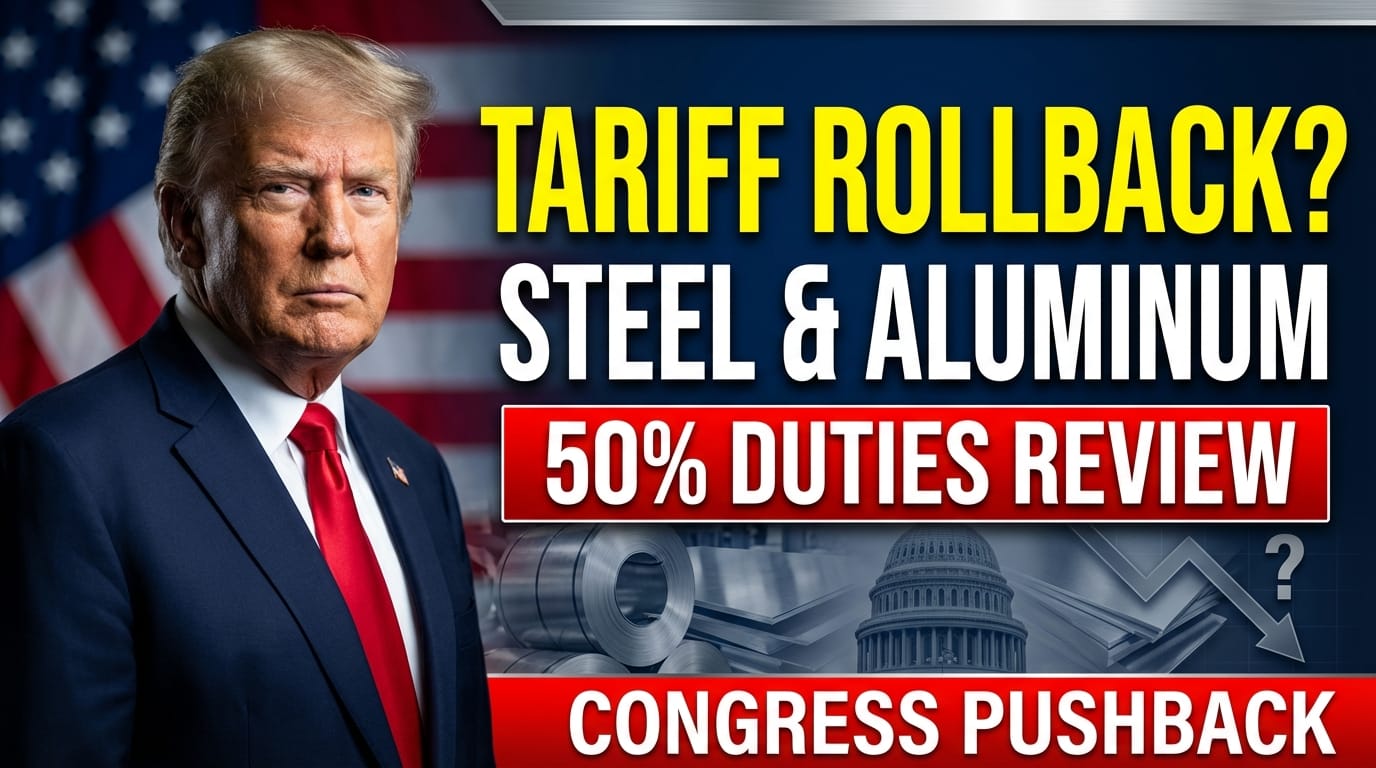
President Donald Trump is weighing changes to his tariff policy, including a potential rollback of some duties on steel and aluminum products. The move comes as his administration faces political pushback in Congress and growing scrutiny over the economic effects of trade measures ahead of the midterm elections.
The debate reflects competing pressures. The White House has defended tariffs as a tool to protect domestic industries and strengthen negotiating leverage. At the same time, rising consumer costs and bipartisan concern in Congress have complicated the political landscape.
Metals
According to reporting by the Financial Times, the administration is reviewing the current 50 percent tariffs on steel and aluminum products. Officials are considering exempting certain items, halting the expansion of tariff lists, and launching more targeted national security investigations into specific goods.
The Commerce Department oversees these Section 232 national security tariffs. Last year, the administration doubled duties on steel and aluminum and expanded them to thousands of derivative products, including appliances, machinery parts, and auto components.
Officials cited in the report suggested that some tariffs may be contributing to higher consumer prices for everyday goods such as food containers and household appliances.
Treasury Secretary Scott Bessent said any narrowing of tariffs would ultimately be decided by the president. He indicated that changes, if implemented, would likely involve clarifications or exemptions for incidental products rather than a broad reversal.
Congress
Tariffs faced a rare challenge in the House of Representatives this week. Six Republicans joined nearly all Democrats in voting to pass Joint Resolution 72, which seeks to terminate the national emergency declaration used to impose tariffs on Canada.
The House vote followed a procedural defeat for Republican leadership, which had attempted to delay consideration of tariff-related resolutions. The final vote margin of 219 to 211 signaled bipartisan concern over the economic impact of the duties.
The Republicans who crossed party lines included Representatives Thomas Massie, Don Bacon, Brian Fitzpatrick, Jeff Hurd, Kevin Kiley, and Dan Newhouse.
President Trump had publicly warned that lawmakers opposing tariffs could face political consequences. Nevertheless, the defections highlighted divisions within the party, particularly as lawmakers confront voter concerns about the cost of living.
A report from the Tax Foundation estimates that current tariffs could increase average household costs by approximately $1,000 in 2025 and $1,300 in 2026.
Courts
The Supreme Court has added February 20 as a potential decision day in a closely watched case involving Trump’s broader tariff authority. The justices heard arguments in November regarding the legality of the so-called Liberation Day tariffs, which imposed duties ranging from 10 percent to 50 percent on imports from most U.S. trading partners.
During oral arguments, several justices questioned the scope of presidential authority under existing trade laws. A ruling against the administration could prompt alternative legal approaches, though those may involve more procedural steps.
The outcome could significantly shape the administration’s trade strategy in the months ahead.
Economic Impact
A report from the Federal Reserve Bank of New York concluded that American consumers and companies bear most of the cost of tariffs. The study estimated that roughly 90 percent of tariff costs are passed through to domestic buyers.
The report examined tariff effects when average rates rose from 2.6 percent to 13 percent in the previous year. Researchers noted that foreign exporters did not substantially lower their prices in response, leading to near full pass-through into U.S. import prices.
The findings contrast with administration arguments that foreign producers absorb much of the tariff burden.
Trade Deals
Despite domestic debate, the administration continues to pursue trade agreements. The United States and Taiwan finalized a reciprocal trade arrangement setting a 15 percent U.S. tariff rate on Taiwanese imports, while Taiwan committed to reducing tariffs on nearly all U.S. goods.
Taiwan also pledged significant purchases of American products between 2025 and 2029, including energy, aircraft, and power equipment. The agreement builds on a framework announced earlier this year and aligns Taiwan’s tariff rate with those of Japan and South Korea.
Meanwhile, U.S. and Japanese officials are discussing projects tied to a proposed $550 billion Japanese investment fund. The projects reportedly include a data center initiative, a Gulf of Mexico oil terminal, and semiconductor investments.
In contrast, uncertainty surrounds the United States Mexico Canada Agreement. President Trump has reportedly asked advisers about the possibility of withdrawing from the pact he negotiated during his first term. Officials have emphasized that no final decision has been made.
China
In parallel with tariff adjustments, the administration has paused several technology restrictions targeting China. Measures reportedly shelved include actions against China Telecom’s U.S. operations and proposed bans on certain Chinese telecommunications equipment.
The pauses follow a trade truce reached between the two countries. Observers note that the decisions may be intended to avoid escalating tensions ahead of a planned meeting between U.S. and Chinese leaders.
Industry
Tariffs continue to affect global manufacturers. Mercedes-Benz reported a $1.7 billion tariff-related burden, contributing to a significant decline in earnings. The company expects operating margins in its core automotive business to remain under pressure through 2026.
Automakers face dual challenges from U.S. trade measures and intensifying competition in electric vehicles, particularly from Chinese manufacturers.
At the same time, the administration is reportedly considering carve-outs for major U.S. technology firms in upcoming semiconductor tariffs. Companies such as Amazon, Google, and Microsoft could receive exemptions tied to domestic investment commitments by Taiwan Semiconductor Manufacturing Company.
Outlook
The administration’s review of metals tariffs reflects an attempt to balance industrial policy goals with economic and political realities. Congressional resistance, court scrutiny, and economic data on consumer costs have introduced new variables into the debate.
While tariffs remain a central element of the president’s economic strategy, adjustments appear possible as policymakers assess their broader impact. The coming weeks, including potential Supreme Court action and further House votes, may clarify the future direction of U.S. trade policy.