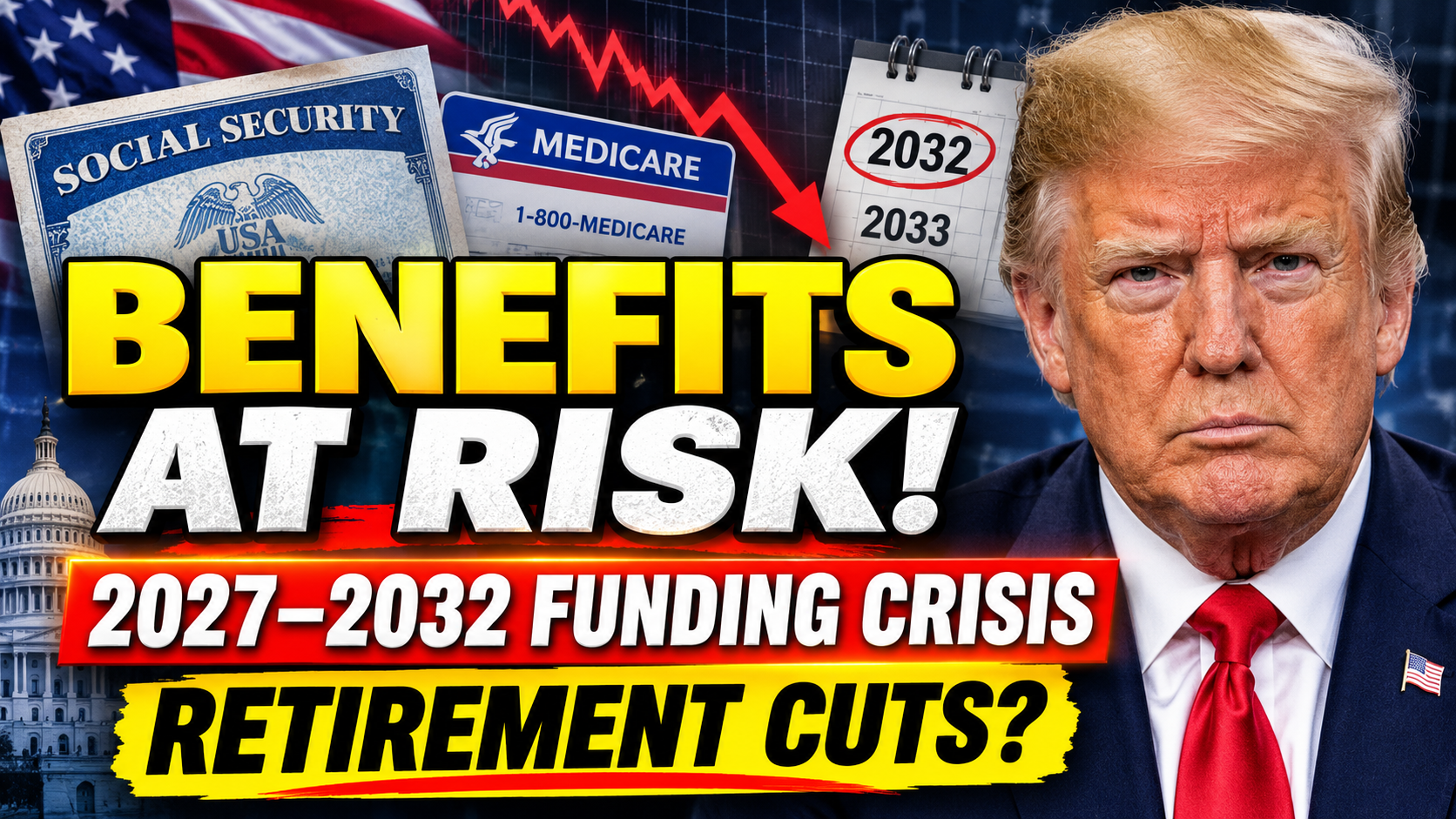
The financial future of Social Security and Medicare is becoming an important concern for millions of Americans approaching retirement or already receiving benefits. Both federal programs face long-term funding challenges, with the latest projections pointing to important deadlines in 2032 and 2033. If Congress does not take action before these dates, beneficiaries could face reductions in the payments and healthcare coverage they are currently scheduled to receive.
According to the 2026 reports released by the Social Security and Medicare Boards of Trustees on June 9, 2026, the Social Security retirement and survivors insurance trust fund could exhaust its accumulated reserves in 2032. Medicare’s Hospital Insurance trust fund is projected to reach a similar point in 2033.
These projections have raised questions about whether retirees could receive smaller monthly checks, how Medicare coverage might be affected, and what lawmakers can do to strengthen the programs. However, the exhaustion of trust fund reserves does not mean either program will immediately stop operating. Knowing the difference is essential when evaluating the financial risks facing America’s retirement system.
Deadlines
The Social Security and Medicare programs rely on dedicated revenue sources, including payroll taxes, beneficiary premiums, and federal contributions. These funds help finance retirement payments, disability benefits, hospital services, and other healthcare expenses.
However, demographic changes and rising program costs are putting pressure on their long-term finances.
The 2026 trustees’ reports identify separate funding deadlines for Social Security and Medicare. These dates represent projections based on intermediate assumptions about economic growth, employment, inflation, population trends, and healthcare spending.
The main projected deadlines are:
| Program or Trust Fund | Projected Reserve Depletion | Benefits Covered After Depletion |
|---|---|---|
| Social Security OASI | Fourth quarter of 2032 | 78% |
| Combined Social Security OASI and DI | Third quarter of 2034 | 83% |
| Medicare Hospital Insurance | Second quarter of 2033 | 89% |
| Medicare Supplementary Medical Insurance | No projected depletion date | Adequately financed through annual funding adjustments |
These estimates show that Social Security’s retirement and survivors insurance fund faces the earliest major funding deadline.
However, the projected percentages do not mean beneficiaries will automatically receive these reduced payments on the dates shown. They indicate the share of scheduled benefits that could be financed using continuing program income if reserves were exhausted and lawmakers made no changes.
Social Security
Social Security’s Old-Age and Survivors Insurance (OASI) Trust Fund finances retirement benefits and payments to eligible family members and survivors.
According to the 2026 trustees’ projections, the OASI fund could exhaust its reserves in the fourth quarter of 2032.
Once this happens, payroll taxes and other continuing income would still flow into the program. However, that revenue would not be sufficient to cover all scheduled benefits.
Under the intermediate projections, available income would cover approximately 78% of scheduled benefits. This means a financing gap of roughly 22% could emerge if Congress does not introduce changes before reserve depletion.
For retirees, this is an important distinction. Social Security would not disappear, and eligible Americans would not automatically lose all their retirement benefits. Instead, the program could face a situation where incoming revenue is insufficient to pay the full amount currently scheduled under law.
The potential impact would depend on the legislative response and how any changes are structured.
Combined
The trustees also examined a scenario in which the OASI and Disability Insurance (DI) trust funds are considered together.
Under this combined projection, reserves would be exhausted in the third quarter of 2034. At that point, continuing income would be sufficient to cover approximately 83% of scheduled benefits.
However, this scenario requires an important legal distinction.
The OASI and DI trust funds are legally separate. Combining their reserves for financial analysis does not mean that the government can automatically transfer money between them. Congressional action would be necessary to authorize such a change.
The Disability Insurance Trust Fund also has a different financial outlook from the retirement and survivors insurance fund. According to the projections provided, the DI fund is expected to remain solvent through 2100.
Therefore, retirees should pay particular attention to the OASI projection rather than assuming the combined date applies automatically to their retirement benefits.
Medicare
Medicare faces a separate funding challenge, particularly through its Hospital Insurance (HI) Trust Fund.
This fund finances Medicare Part A, which primarily covers inpatient hospital care, skilled nursing facility services following qualifying hospital stays, hospice care, and certain home healthcare services.
The 2026 trustees’ report projects that the Hospital Insurance fund could exhaust its reserves in the second quarter of 2033.
After reserve depletion, ongoing program income would cover approximately 89% of scheduled Part A expenses.
This means Medicare Part A would continue receiving revenue through payroll taxes and other sources, but the available income would not be sufficient to finance all scheduled costs.
The resulting funding gap could require Congress to consider changes to program financing, payment arrangements, or other aspects of Medicare.
For older Americans who rely on Medicare for hospital treatment and other covered services, the financial outlook is worth monitoring.
Part B
Not every part of Medicare faces the same funding problem.
Medicare’s Supplementary Medical Insurance (SMI) Trust Fund finances Part B and Part D. Part B covers physician services, outpatient treatment, preventive care, and certain medical equipment, while Part D helps cover prescription drug costs.
Unlike the Hospital Insurance fund, the SMI Trust Fund does not face a projected reserve depletion date.
This is because its financing structure allows funding to adjust annually to cover projected expenses. Beneficiary premiums and federal general revenues provide the necessary financing.
However, this does not mean Part B and Part D are free from financial pressure.
As healthcare costs rise, the amount required from taxpayers and Medicare beneficiaries can also increase. Higher premiums and federal spending may therefore remain concerns even without a projected trust fund exhaustion date.
Solutions
The 2026 trustees’ reports make clear that Congress still has time to address the projected funding shortfalls.
Lawmakers can consider several approaches, including increasing program revenue, changing benefit costs, adjusting certain payment rules, or combining different policy measures.
Potential options include:
- Increasing payroll tax revenue through changes to tax rates or taxable earnings limits.
- Adjusting Social Security benefit formulas or eligibility rules.
- Revising Medicare payment policies to manage healthcare spending.
- Increasing federal contributions or other dedicated program revenue.
- Combining revenue increases and spending adjustments to reduce long-term funding gaps.
Each option involves financial and policy considerations. Increasing taxes could affect workers and employers, while benefit changes could influence retirement planning for current and future beneficiaries.
The timing of congressional action will also matter. Changes introduced before reserve depletion could give workers, retirees, and healthcare providers more time to adjust.
Warning
The Social Security trustees issued a separate notification to the Speaker of the House on June 9, 2026, under Section 709 of the Social Security Act.
The notification highlighted concerns about the OASI trust fund’s financial position. According to the trustees, its reserves could fall below 20% of annual program costs by the beginning of 2032 before being exhausted later that year.
The report also identified an earlier deadline for congressional action.
Changes would be needed by 2031 to prevent the fund’s balance ratio from falling below the 20% threshold. Maintaining that minimum reserve ratio through the beginning of 2036 would require substantial financial adjustments during the 2031-2035 period.
This warning is significant because it highlights the importance of addressing the funding gap before reserves reach critically low levels.
The full projections and financial details are available in the official 2026 Social Security Trustees Report and the 2026 Medicare Trustees Report.



Outlook
The projected Social Security and Medicare funding deadlines do not mean that retirement benefits will suddenly disappear in 2032 or 2033. Both programs would continue receiving revenue even after their respective trust fund reserves were exhausted. However, without legislative changes, that income would not be enough to cover all scheduled obligations.
For Social Security, the OASI fund could finance approximately 78% of scheduled benefits after depletion, while Medicare Part A income could cover around 89% of scheduled expenses. These projections underline the importance of congressional action before the deadlines arrive.
For current retirees and younger workers planning for retirement, the most practical approach is to stay informed about legislative developments and avoid treating projected benefit reductions as an immediate certainty. The decisions lawmakers make over the coming years will play a major role in determining how Social Security and Medicare are financed for future generations.